
Chapter Text
Lan Zhan opens his eyes to the kiss of sunlight on his face.
The wrongness of it assails him like the sudden sluicing of cold water. In all of his forty years, barring the rare bout of illness or extreme fatigue, he’s never once awoken after sunrise. Worse, he’s never come back into his consciousness with such fitful sluggishness, as though he’d been violently kicked and beaten the night before. His eyeballs seem to burn and press against the inside of his skull, a dull pain rising to his temples in raw shards and lumps, and as he rolls blindly onto his side to reach for the usual mug of warm water on his nightstand, his skittering fingers push through an unprecedented emptiness, closing in on — nothing.
Reflexively, Lan Zhan jerks his arm back before he can tumble off the bed. Then, slowly, he sits up, his mind whirling in his disorientation, gazing around him with wide, disbelieving eyes.
This is not his room. The bed is narrower than his own, the mattress substantially softer and creakier, the sheets and blankets far more coarse and rumpled. There are books everywhere — on the sturdy brown desk beside the window, on the shelves lining the walls, even on the floor. Titles on folk religion, scholarly journals, and even research papers, all in a multitude of languages, heavily annotated, and haphazardly bound. Hanging almanacs and yellowing TCM charts festoon the walls, and talismans in various stages of study and preparation, the brushwork on them experimental and spiky. Not the work of an orderly mind, clearly, but the ravings of a savant, or perhaps a madman.
A scholar’s den, then. Or — and this with a jolt of discomfort to his midsection — a fellow practitioner. Lan Zhan blinks, but the scene before him adamantly refuses to dissolve. How had he contrived to wake up in someone else’s home? Had he perhaps sleepwalked here? Lan Zhan snorts softly, aware that he has never sleepwalked in his life, and even as he resolutely dismisses the notion, a low current of unease nags at him. How did he get into this place? And where is the rightful owner of this home, right this moment?
He makes to swing himself out of bed, and then stops abruptly short, his breath falling from his lungs in rapid, shattering gasps.
These are not his clothes. Most disconcerting and horrifying of all, this is not his body.
As if to confirm for himself, he lifts up the loose black t-shirt he’s wearing. The smell of the unwashed fabric hits him as he does, a primal muskiness floating to his nostrils, intimate enough to set his ears to burning. More startling still is the shape of the body he’s trapped in: here, a pair of muscular arms; there, a lean torso swathed in spidering Buddhist tattoos. His nipples are pierced, adorned with a set of ridiculous titanium rings, and at the sight of them, Lan Zhan lets out a low moan of mingled outrage and incredulity. And then, because he must, he recklessly lowers the waistband of the boxers he’s wearing, only to be confronted by the dizzying sight of an unfamiliar, yet unexpectedly nice-looking cock.
“You,” a voice says from inside his head, and Lan Zhan nearly falls flat on his face.
That voice.
Wei Ying.
The syllables ring through his mind like a shout, yet his lips remain strangely still, and the room holds its stubborn silence. Somewhere deep inside him, he feels Wei Ying give a sharp huff of irritation.
“Lan Zhan,” Wei Ying growls. “You’re in my house, my room, my body. Get out. Now.”
“I can’t.” The words burst from him like pebbles. He hears the boyish intonation of Wei Ying’s voice in them, and halts, head spinning.
Nothing in his long, dutiful years of spiritual practice has prepared him for this. He knows of no spell or mantra that would pull him neatly from the confines of one unwilling body and deposit him safely back into his own, as easily as shifting one’s weight from one foot to another. Without thinking, he flings himself against the barriers of Wei Ying’s flesh, battering and pushing with all his might, and succeeds only in driving Wei Ying to his hands and knees.
“Stop that!”
Wei Ying throws his hands up to his nose to arrest the warm dripping sensation there. Pain radiates from him in hot little sparks, and Lan Zhan flinches from it, instinctive and chagrined. Wei Ying’s palms come away, bloodied thickly to the wrists. “You fucking idiot. If you’d done that for just a moment longer, you’d have killed me.”
There’s a resentful sulkiness to Wei Ying’s tone that is not completely unfamiliar. And Lan Zhan fights the old urge to snap back, to snippily insist that he had been trying, that he’d only intended to get out of Wei Ying’s body as much as Wei Ying had wanted him to leave. Bitterness grips him, and Lan Zhan fleetingly and vindictively contemplates choking on it, as if that might resolve the situation somehow, might show Wei Ying how much he, Lan Zhan, had been similarly inconvenienced by this arrangement. Then, almost as quickly as it had come, the impulse passes. Lan Zhan pushes his anger down, doing his best to centre his patience and ignore the sting to his pride.
“I’m sorry.”
“You’d better be,” Wei Ying grouses. He’s pinching the bridge of his nose, and Lan Zhan can feel the expert press of his fingertips on the acupoints there, cleanly and efficiently stemming the flow of blood. Clearly, this isn’t the first time Wei Ying has suffered from this type of ailment. As the bleeding slows and its metallic taste recedes from Lan Zhan’s mouth, he finds he can breathe more easily.
“Of all people to be trapped in my body,” Wei Ying says. It’s abundantly clear from his tone that he’d been privy to the uncharitable flow of Lan Zhan’s thoughts earlier. Then, heedless of the mess on the floor, he pushes aside several loose stacks of joss paper and sits himself resolutely down, legs crossed and palms on his knees.
“So. Lan Zhan. It doesn’t look like you’re getting out anytime soon. Could we at least try to be civil to each other while you’re in here? It fucking sucks, I know, and it’s very bad for me, not least because I can constantly feel how much you hate me.
“Well, I can’t change how you feel, and frankly speaking I don’t think I’d really care to. But I’ll ask you to please try to put a lid on it for both of our sakes, and then once you’re back in your own body, we can carry on antagonising each other like we always do. Is that fair?”
“That’s fair.” Carefully, quickly, blankly, before he can hesitate. Avoiding all thought, all emotion, all judgement, lest a stray sentiment of it leak into Wei Ying’s mind. “But —”
“But what?”
“My job,” Lan Zhan says, hoarsely. “I have to be there. My students —”
Wei Ying sighs, then drums his fingertips thoughtfully on the handle of a nearby coin sword. “That’s a problem. All right. Let’s lay out what we know, so we can find a way to break this curse. Maybe we can resolve this in time for you to get to your job by this afternoon. Shall we start from the beginning? Where did you fall asleep, and what’s the last thing you remember before you did?”
And here it is, Wei Ying taking charge and bossing Lan Zhan around again, like he always does. Organising things, stating facts aloud, talking through his ideas, making plans. All on the calm yet arrogant assumption of his own competence, and of Lan Zhan’s according and willing compliance. A second wave of annoyance rises to Lan Zhan’s chest at the simmering injustice of it all; at the immutable and unspoken idea that he must always be expected to capitulate to Wei Ying’s level-headedness, whilst leaving his own knowledge and theorising in the dust. Why did Wei Ying always have to be so domineering? Or maybe, Lan Zhan reflects, I was the one who set this precedent by allowing him to control things all the time.
Wei Ying sighs. “You’re doing it again. Hating me. Seriously man, what the fuck? Look, the sooner we can figure this out, the sooner you can get out of here, and the sooner I can have my life back. There are bigger things at stake here, Lan Zhan. And I won’t allow you to let us both miss it, this time.”
Oh, the jab smarts. This time. Lan Zhan jerks away from Wei Ying’s consciousness, resenting the raw trickle of guilt that Wei Ying’s rebuke had awoken in him. That had been petty and unbecoming. Wei Ying had deserved none of it.
He’s just as trapped with me as I am with him.
“Last night,” Lan Zhan finds himself recounting. Wei Ying’s mouth is tightly sealed, and this time the voice he hears himself speaking in is his own, bouncing and echoing peculiarly about in Wei Ying’s head. “I went to bed in my own flat at the usual time. I fell asleep easily. Nothing was out of the ordinary. Before that, I recall we were in that warehouse. Doing our mission. We — disagreed. And then we were back at headquarters, and my brother was there. He —”
Lan Zhan pauses, wincing at the memory. There’s something else bothering him too, something just slightly out of his reach, like an itch demanding to be scratched, or a dream begging to be seized. He tries to think of what to say next, but no words come.
Wei Ying picks up the story, slow and careful in the spiralling silence. “I remember that too. The warehouse. The vengeful spirit trapped there. It tormented people who bought over the property, disrupting business operations there. For years, it asserted its will, tainting their prospects and causing their ventures to fail. The warehouse changed hands countless times. You and I were tasked to cleanse the property, to drive it out for good. The new owner of the warehouse had given our association a tidy ang pow for our trouble.”
“Yes.”
“You played music to lull it,” Wei Ying continues, flat and relentless. “Once it was weakened, you hoped I would catch it in a gourd we’d brought along for the assignment. But I didn’t.”
Lan Zhan quails at the sudden onslaught of clarity. “You didn’t.”
“I let it into my body. I forced myself into a meditative state and battled it with my internal strength. I shouted at you to keep playing, to weaken it as much as you could. I sealed myself to prevent it from escaping. I remember seeing your face — you looked so disapproving, but you played on, just as I asked. And after several hours, I defeated it. I crushed it to pieces.”
Lan Zhan recalls the incident with a deep, foreboding chill. Wei Ying had sat cross-legged on the floor of the warehouse, his hands skittering on his knees, his eyes and mouth pinched shut in concentration. Beads of sweat standing out on his brow, steaming in rivulets from his flesh. The creature within had screamed its terrible rage, but he’d held it doggedly in, contained it with nothing but his own raw strength and sheer will. And Lan Zhan could do nothing but play on, his heart in his mouth, his bloodied fingers flying over the strings of his guqin. In that moment, it had been far, far easier to hate Wei Ying than to fear for him.
Reckless, foolhardy, yet needlessly selfless, and unquestioningly brave. And then Wei Ying had eventually defeated the entity, just as Lan Zhan had known he would, and Lan Zhan had put away his instrument and supported Wei Ying back to the association headquarters, calmly and dutifully, all whilst savouring the icy flavour of his own fury.
“And then we went back.” Wei Ying gives a mirthless chuckle. “The moment we stepped through the doors, you let me have it.”
“I scolded you,” Lan Zhan continues. An unsettling thought occurs to him, then: Perhaps I shouldn’t have. But his inner voice has taken on a lecturing cadence, and once again he coldly brushes his reservations aside. “What you did was dangerous, unorthodox, and against the rules of our association. You risked not just your life, but everyone else’s as well. What if the entity had won, and gained a warm, healthy body in the process? You would have endangered the rest of our association, as we would obviously have had to find a way to subdue you.”
“Glad you think so much of my warm, healthy body,” Wei Ying mumbles, and Lan Zhan has little choice but to let that remark slide, confined as he is with no visible way of showing his objection. But Wei Ying has already jumped back into the retelling, zeroing in on their evening’s denouement with razor-sharp focus.
“We argued. I remember thinking that we would have ended up brawling, if only I weren’t so weak. In any case, your brother happened to walk in and break up the fight. He — he —”
And it comes to Lan Zhan, then, like a thunderbolt exploding in his mind. “He shot a talisman at us. He said something about compassion, patience, and harmony. I can’t quite remember… I only remember feeling exhausted and not wanting to fight any more. My brother offered to drive me home, but I refused. I managed to go home on my own. My mind felt strangely foggy, as though I was trying to be somewhere else. At some point, I must have showered and gotten into bed. I didn’t dream. It felt more as though I fell unconscious, rather than asleep.”
“Yes,” Wei Ying breathes. He lowers his head into his hands, and the room fades to darkness before Lan Zhan’s eyes. “Yes. Exactly.”
A grey silence wraps them, like the tired aftermath of a long and futile quarrel. Lan Zhan tries to make his thoughts as small as possible. My brother’s doing. I should have known. Cooperation and balance are so important to him. He would go to any lengths to keep the peace, short of suggesting to the board of directors that either Wei Ying or I be expelled from the association.
“Lan Zhan.” Wei Ying breaks the silence at last. “What do you think we should do?”
There’s no guile in his words, no bitterness. It’s an honest question, and as Lan Zhan reaches for its source, he almost feels ashamed of his own suspicion. But surely Wei Ying has something in mind, something he’s already planned. Lan Zhan decides on a neutral tack on the spur of the moment. “Why are you asking me?”
“He’s your brother. You know him best. We have a choice. We could ask him directly, and listen to what he has to say. Or, if you don’t think that’s the best approach, I have a possible solution that might prove… dirty. And not to mention incredibly uncomfortable.”
“No.” The word slips from Lan Zhan before he can stop himself. “No more rule-breaking and risk-taking behaviour. Starting this moment, we’ll do things my way.”
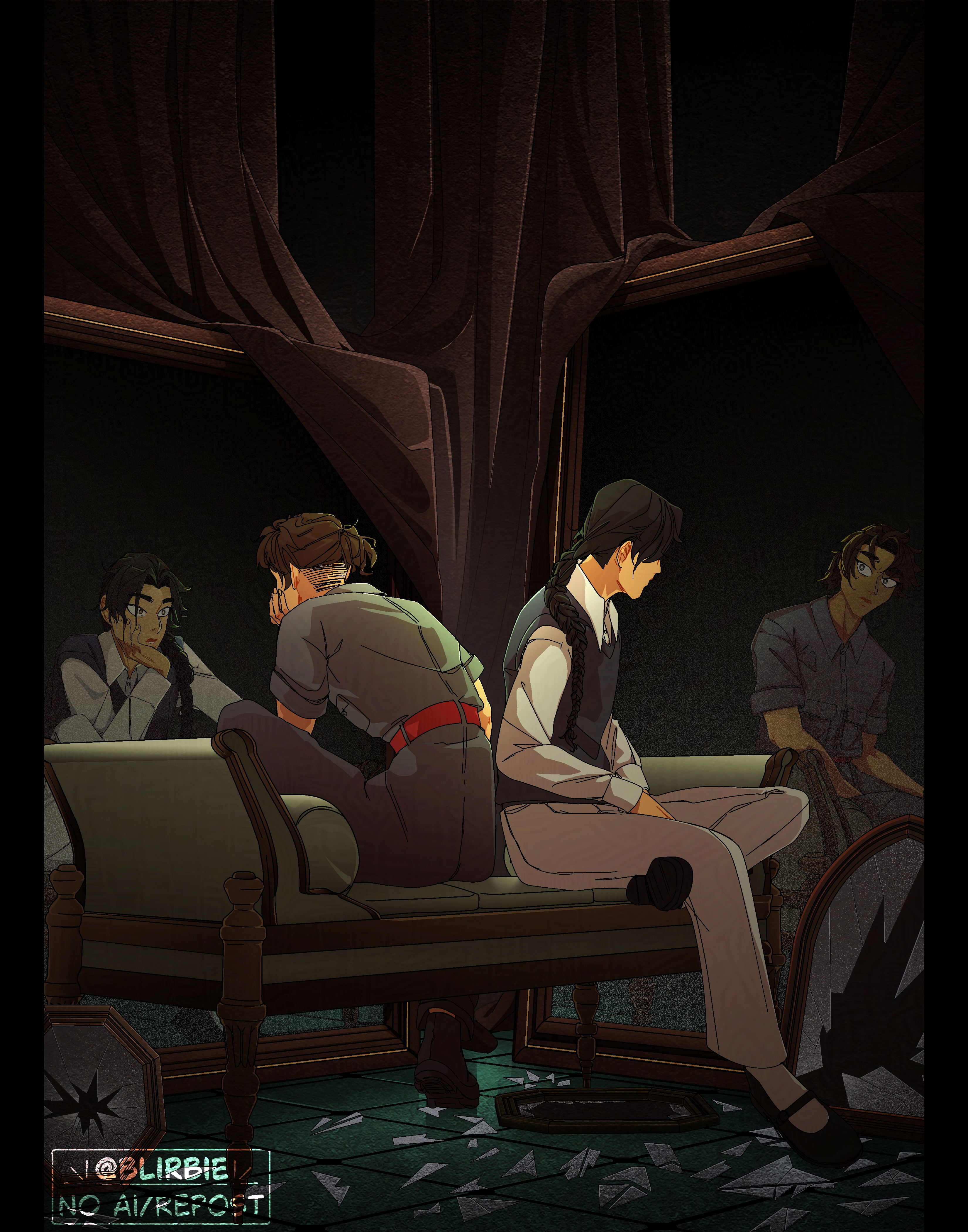
Neither Lan Zhan’s keys nor his fingerprints are presently at Wei Ying’s disposal, so it takes them several attempts to get into his condo unit.
“Cover the sensor with your palm.”
Grudgingly, Wei Ying obeys. A digital keypad flashes across the screen. “What’s the code?”
Lan Zhan hesitates. This is his flat, his private space, his inner sanctum; the one place in the world he can truly call his own. The thought of giving someone like Wei Ying unfettered access to it rankles like an itch beneath his skin. Even my own family members don’t know the code. Why should I give it to him?
“Because we’re sharing a body now, in case you haven’t noticed. We need to ascertain the exact nature of the curse before we go in guns blazing to confront your brother. Look, I’ll make you a promise. The minute we’re free of each other, you may go ahead and change the code to something I’d never guess in a million years.”
Wei Ying’s logic, much like his mind, is impenetrable.
“Two-two-zero-nine-five-four.”
Wei Ying punches it in. With a soft whirring, the heavy wooden door slides open.
“Wow,” Wei Ying murmurs.
Even as Lan Zhan bristles slightly at that, he finds himself waiting with bated breath as Wei Ying slips off his sneakers at the threshold and ghosts into the living room. The house yawns and echoes around them like a child temporarily disturbed from sleep, before trustingly settling back into its earlier indifferent stupor. Wei Ying stands in the middle of the hall and peers around, his keen detective’s gaze flitting across the pristine leather sofa, the orderly wooden bookcase, the framed family photographs resting neatly atop a manicured sideboard, tastefully flanked by simple yet well-made ornaments of glass and brass and bronze. He picks up a ceramic rabbit on the coffee table and examines it with a perplexed expression.
“Put that down, please.”
“No altar?” Wei Ying spreads his hands in consternation. “Wah. Your taste is so — modern. So Western. Where do you make offerings to your ancestors?”
“I don’t…” His words catch. And then, defensively, as if daring Wei Ying to judge him further, “I’ve never.”
“It wasn’t a criticism,” Wei Ying says. It’s maddeningly impossible to read anything from his tone of voice. “I just thought — well, we’re professionals of the spiritual art, aren’t we? This is our bread and butter, our way of life. But I guess…”
Rudely, Lan Zhan interrupts him. “Let’s go to the bedroom. It’s — I’m there.”
“Right.” Wei Ying replaces the rabbit hastily on the sofa armrest and jumps to his feet, and Lan Zhan’s stomach gives an untimely lurch as he’s once again knocked off-balance by the unfamiliar length of Wei Ying’s stride. “Fuck. I wish your invitation had come under better circumstances.”
“What are you talking about?”
“Nothing. You’re just so — obtuse.” And just like that, Wei Ying slams the trickle of thought away, blocking it from Lan Zhan’s curious reaching. Bereft of its substance, he can nonetheless still perceive an echo of it, elusive as a fragrance on the wind.
A secret. He’d very nearly revealed something of himself to me.
“Oh, don’t worry your pretty little head. It’s nothing you don’t already know.”
“Over here,” Lan Zhan says gruffly, because Wei Ying’s feet have started moving off-course, in the direction of the guest bathroom. He leads Wei Ying to the master bedroom, but even as Wei Ying pushes the door open, he feels his breath hitching in his throat, his heart sinking to his feet. For the second time that day, he perceives his world swinging around him in nauseating spirals, lights thudding to supernovas at the corners of his vision, his reality coalescing and hurtling at breakneck speed towards a small, infuriatingly imperceptible point.
He’s looking at himself. Sprawled belly-down on his lavender blue percale Hotel Collection bed linen, limbs carelessly and childishly starfished, neck turned recalcitrantly to one side to expose a marble sliver of his own profile. His hair is fanned out over the pillowcase like a fallen hand of playing cards, and Lan Zhan actually recoils, mortified beyond measure at the sight of the cold saliva seeping from his own open mouth, spreading out over the expensive fabric, a jarring testament to his disarray and shame.
“Never figured you for a stomach sleeper. You always seemed to me like you’d be the sort to sleep like a corpse. You know, on your back, with your hands folded over your chest like this.” Wei Ying laces his fingers together to demonstrate.
“I’ve never slept on my stomach,” Lan Zhan says, quietly. “Could you… try to wake me?”
“It probably won’t work.” Nonetheless, Wei Ying reaches down to shake Lan Zhan’s shoulder.
And at the contact, an unpleasant frisson washes over Lan Zhan’s senses. It feels wrong, unnerving, like icy water poured over a nightmare, like being turned inside out in his own skin. There is his hand — no, Wei Ying’s hand — on his shoulder, and that’s his own flesh he’s touching, slack and lukewarm and clammy, the shell of a corpse. He fights to relax, to untether his mind, as if by doing so he might somehow make himself liquid enough to glide back in, to pull the edges of that old skin close around his being again and settle back into its familiar rooms and corridors.
But wishes are not spells, and once again he sags against Wei Ying’s confines. And that reedy, insistent pain, blossoming in a thick red line along the tension points between Wei Ying’s eyes and the soft spot above the back of his neck.
“I told you not to do that,” Wei Ying says, wearily. He sits down unsteadily on the edge of Lan Zhan’s bed, knuckling his temples as he does. Nausea ripples through him, through them both. Lan Zhan can taste it, the creeping sourness like fire in his belly. The word Sorry lingers on his tongue, a bitter, forbidden flavour.
“It’s fine. Forget it. If the roles had been reversed, I’d probably have done the same.” Wei Ying takes several deep breaths, and then, as easily as shutting a door, he puts his annoyance at Lan Zhan aside. “So that didn’t work. But your body is still alive. I felt your pulse when I touched you. Your qi is cycling, albeit very slowly. It’s as though you’re in a coma.
“The way I see it, we don’t have many options at the moment. Either we talk to your brother, or we go back to my place and let me attempt to separate us. Like I said, it’s probably going to be unorthodox, and it’s most certainly going to hurt.”
Scowling, Lan Zhan stares down at his own unconscious body. His brother hadn’t done this on a whim. He was measured and calculated, a man who weighed his every word and action as though he was continually being judged by a silent audience. Always, even as a child, the twin needles of contemplation and temperance knitting a fine line between his brows. His eyes, though ostensibly warm and clear, were perennially turned inward, seeing everything and betraying nothing.
Knowing my brother, there has to be a lesson here, one that he wants me to reflect on and internalise. Lamenting the issue or brute-forcing my way out won’t solve the problem. Lan Zhan pushes the decision carefully around in his mind, and then, clear and grey as resignation, he feels the shape of his decision descending upon Wei Ying’s lips.
“Let’s pay my brother a visit.”
Lan Zhan and his brother have always been close.
Five years apart, yet to Lan Zhan, he and his brother could have been twins, separated only by the careless, capricious hand of fate. They’ve mirrored each other for as long as he can remember, not perfectly but comfortably: a hand settling into a glove, a bolt sliding into a lock, a chord struck in pleasant harmony. Through the years, they’ve only grown more attuned to each other’s thoughts and movements, as finely and precisely as a well-choreographed dance.
Oh, they have always had their subtle differences here and there, like his brother’s easy geniality, the relaxed set of his shoulders, his natural ability to quietly take command of a room upon entering. Lan Zhan has never begrudged or envied his brother these things, just as his brother has never begrudged or envied his reticence, his focus, his inherent drive to see the rules of their association followed to the letter.
But now, standing before his brother in Wei Ying’s languid, restless body, Lan Zhan can see only the places where they have irreparably diverged. Here and there, he’s splintering away from what had previously made them two halves of an unbroken whole: unable to perceive the fine join lines where he and his brother usually ended and began, and as a result, unable to get an accurate read of his brother’s true intentions.
I’m seeing him through Wei Ying’s eyes, and not my own.
“Oh, Ah Zhan,” his brother sighs. He sits down on the edge of his wooden desk, cradling his mug of teh halia speculatively. In his long-sleeved button-down and tailored slacks, he looks forbidding and uptight. Like a bureaucrat, a drudge, a total stranger.
They’re in his office in the association’s headquarters, a tiny nook on the second floor of the shophouse, partitioned from the rest of the unit by a series of strategically placed low filing cabinets. Lan Zhan vividly remembers the day his uncle had proudly bought over the space, and how the fengshui master he’d later employed had cut a trampling path through it, busily rearranging desks and heaving potted plants out of the way.
“So can you help us, or not?” Wei Ying demands. There’s a slight edge to his voice, and Lan Zhan can faintly sense him struggling to be respectful. “I’m — we’re — very uncomfortable. I know what your brother is thinking and feeling in every single moment, because he has absolutely no filter in place. Me, on the other hand — I’ve so far been able to block my thoughts from him, but it’s so fucking — I’m sorry. It’s draining me. I can’t concentrate on anything. I want my life back. I want my privacy.”
Delicately, his brother places the mug on the desk. “Mr Wei. How long have you been in this line of work, now?”
“Seventeen years.” Lan Zhan feels Wei Ying swallow, a dry lump bobbing in his throat. “Since I was twenty. Since — well. Never mind.”
Another secret.
“Then your level of mastery is likely amongst the highest of those in our association.” His brother gazes at Wei Ying levelly, and Lan Zhan thinks he glimpses an apologetic flash in his eyes. “Even so, your methods to resolve the binding on your own will prove futile. You see, this spell was designed by my great-great-grandfather, to be passed down the line from son to eldest son.
“This association was founded in the nineteenth century, when my ancestors first made their way down from Swatow to earn a living here. You’ve read the history books. You know that there were mass migrations from all over southern China, and that on such a small island, people from different provinces and villages often clashed over things like languages, spiritual beliefs, and cultural habits.
“When my great-great-grandfather set up the association, he thought it prudent to devise a means of ensuring harmony and upholding mutual respect amongst its ranks. He worked as a letter writer for other impoverished coolies, and he had the means to create this spell. It embodies our old clan’s ancestral values, in particular our commitment to consensus and balance. Right now, both of you are in Mr Wei’s body. In three days, both of you will be in Ah Zhan’s. And so on, back and forth, ad nauseum.
“There is no counter-spell, and thus I cannot lift it for you. That is something you and my brother have to do together, on your own, as a single, concerted entity — to break the cycle by embodying everything this spell represents, completely and wholeheartedly, of your own volition.” Here, he raises his eyebrows slightly. “Ah Zhan, are you listening? You don’t have to worry about your students for now. Let me handle their learning while you and Mr Wei take some time to reflect on the best way to move forward. This is far more important.”
Silence. Lan Zhan can sense Wei Ying’s mind working, cycling and teeming endlessly through the possibilities and dead ends, faster than the speed of light. A muscle twitches in his jaw, taut as a puppet’s string.
“I didn’t know about any of this,” Lan Zhan tells him desperately. He can’t quite put his finger on why it’s so important that Wei Ying believe him. “If I had known, I would have said something.”
“I know,” Wei Ying murmurs. He swings his gaze up to Lan Zhan’s brother’s face. “I understand completely.”
A pause. And then, as Lan Zhan’s brother continues to look on expectantly, Wei Ying lets out a deep billowing sigh, a rush of warm air through parted lips, heavy as resignation.
“We understand completely.”
“We should have some rules,” Wei Ying says, aloud.
At the sound of Wei Ying’s voice, Lan Zhan’s attention snaps sharply back to the conversation at hand. It’s morning, and they’re in Wei Ying’s bathroom. Wei Ying is leaning over the sink, shirtless, a toothbrush in hand. His other hand is clamped around a toothpaste tube that bears a sizable thumb-shaped depression across the middle. The mere sight of that only serves to perplex Lan Zhan all over again. Why would any sane person squeeze toothpaste from the middle of the tube, instead of the base? It just doesn’t make any sense.
“My toothpaste,” Wei Ying says, evenly. “I’ll squeeze it however I like. Which, by the way, segues in nicely with what I’m about to say next. Let’s lay down some ground rules.”
“Ground rules?”
“You heard your brother.” Wei Ying squeezes a generous blue worm of toothpaste onto the toothbrush, and the sheer wastefulness of it all makes Lan Zhan want to scream. “We’ll be taking turns sharing bodies. The sooner we set some rules, the sooner we can learn to live with each other as he said, and the sooner we can go back to our respective lives.”
Lan Zhan immediately sees the logic of this. Still, he finds himself grudgingly asking, “What do you have in mind?”
Instead of replying, Wei Ying swishes the toothbrush carefully around and behind his lower incisors, then moves to the top row. Lan Zhan can feel the bristles chafing along Wei Ying’s gums, can taste the strong mint of the toothpaste against the roof of Wei Ying’s mouth. His gut gives an unwanted clench, which only intensifies as Wei Ying leans ahead to spit.
“Well,” Wei Ying says, as he briskly rinses out his mouth with a cupped handful of water. “How about this for a start? Rule number one, whoever’s currently the host gets to make all the decisions. That includes mundane things like what to eat, what time to get out of bed and go to sleep, what to do during the day, and so on. The guest may make suggestions for the host’s consideration, but may not take over the host’s body.”
“But I did,” Lan Zhan blurts out. It’s something that has been bothering him for a while. “When we woke up on the first day. I moved your limbs and got out of your bed, and you let me.”
“You probably managed to take control because I wasn’t fully awake yet,” Wei Ying retorts. “You practically pulled my pants down, remember?”
“I’m sorry.”
Lan Zhan finds he actually means it. As the apology thrums through him, through them both, he feels an unexpected shiver rushing over his skin, sweet and strange as electricity. Wei Ying’s cock had been right there below the waistband of his boxers, half-hard from sleep, hanging warm and heavy between his own spread thighs.
“Rule number two,” Wei Ying continues, in a deceptively casual voice that suggests he’d missed absolutely nothing in Lan Zhan’s train of thought. “Keep your personal musings contained.”
Oh.
“I think those two will be enough,” Wei Ying begins, but Lan Zhan hastily interrupts him again.
“Rule number three, the host must also be respectful of the guest.”
“That’s too vague,” Wei Ying grumbles. “What do you mean, be respectful? I’ve been largely respectful of you. Last night we practically went to bed at nine-thirty. Nine-thirty! What person below the age of sixty even does that nowadays? And while we’re on this topic, you never let me eat my Haichijia noodles for dinner either. We’re always eating shit like steamed fish and stir-fried naibai on plain white rice. No salt, no oil, no sugar. Fuck, I’m only thirty-seven, but you’re making me live as though I’m eighty-seven. And you want to talk to me about respect?”
Lan Zhan cringes inwardly, a curl of guilt twisting his stomach. Wei Ying’s words seem to lodge in him like barbs, sharp and true. He’d only meant that perhaps they ought to pay each other a little consideration, give each other a little more grace, that sort of thing. Lan Zhan hadn’t realised how much Wei Ying had resented eating a clean diet and going to bed on time.
It baffles me why he wilfully chooses not to act like an adult, but perhaps that’s not really the issue here. The fact remains that he didn’t even complain much when I asked him to do those things. Maybe that’s what’s truly important, above everything else.
“Let’s just keep it to two rules, then.” I’m sorry.
“Lan Zhan.” A breath, a sigh. Wei Ying stares at his own reflection in the mirror, meeting Lan Zhan’s gaze searchingly and unwaveringly. “You don’t need to apologise. Look, let’s just — let’s just try out these two rules for a while, all right? Think of it as an agreement between roommates, if you must. A contract to uphold, a boundary to draw. Our line in the sand, to keep ourselves and each other as sane and as comfortable as we can. It’s the quickest way I can think of to get us through this, and it is as much for you as it is for me.”
Lan Zhan looks carefully into Wei Ying’s face, noting for the first time the breaktaking contrast between the angular line of his jaw and the plush curve of his lower lip. The entire effect is more appealing than jarring, as if he’d somehow uncovered a sweet vulnerability in Wei Ying’s usually self-assured demeanour, akin to finding a rare treasure buried in the sand. Studying Wei Ying like this, he almost feels as though he’s committing Wei Ying to memory, lighting him from within in his mind’s eye.
“All right,” Lan Zhan murmurs. He watches Wei Ying’s lips move in the mirror. “All right.”
The one thing Lan Zhan can’t get used to is the people.
Wei Ying tends to attract attention wherever he goes, which Lan Zhan supposes isn’t surprising, in and of itself. Wei Ying is widely considered conventionally and classically attractive — objectively speaking, of course — and Lan Zhan knows he ought not to envy Wei Ying his natural magnetism, which rather like his reckless temperament, is something he can’t really help.
But the staring is nothing but relentless. People, people everywhere: lounging in doorways, standing in the middle of pavements and corridors, leaning over railings; dozens of heads turned unerringly in Wei Ying’s direction like sniffer dogs scenting a trail. Hundreds upon thousands of gazes, all of them flat and unsmiling and unblinking, identical in only this small, unnerving detail. Lan Zhan feels their eyes creeping over Wei Ying’s skin, burrowing through his body, groping towards the raw point where Wei Ying’s consciousness is reluctantly, unsteadily melded against his own. There, Lan Zhan finds, they can perceive him too.
His flesh crawls. They’re on the bus now, on the way home from the dingy little office building where Wei Ying works from Monday to Friday as a QA engineer for a small software startup. Even without turning, Lan Zhan knows there are three people standing in the crowded aisle, swaying with the bus’ movements, their dull eyes locked fast to Wei Ying’s back like fish hooks in soft fabric.
“Look at this,” Wei Ying murmurs. He’s either cheerfully ignorant of the staring, or in dangerous denial. As Lan Zhan watches, he flips to a messaging app on his phone. “Your brother just texted some people in the association. It’s a typical gong tao-type case. Some guy went to a siam diu and got himself into the usual mess. Shall I tell him that we’ll check it out?”
“Sure.”
“Something’s bothering you, Lan Zhan. You don’t usually agree with me so readily. Let me guess — you’re annoyed because I played Grasshopper’s greatest hits on repeat while I was working through those test cases earlier.”
There is that. Lan Zhan instantly tries to clamp down on the thought. He wonders if he’s getting better at it, but Wei Ying just laughs, good-natured and unrestrained, a silent chuckle ringing though Lan Zhan’s head like music.
“What is it? Oh, come on.” Then, as Lan Zhan eventually capitulates and lets his consciousness flow free, “Ah.”
“I know you’re used to it,” Lan Zhan tells him stiffly. “But it’s — strange. They don’t even look away when you look at them. How do you stand it?”
“Lan Zhan, I don’t know. Look, some people are just weird. I have no control over what others do, and as long as no one’s holding a knife to my throat, I try not to let it bother me too much. I guarantee you, this happens all the time. Maybe you never noticed this while in your own body because you were too busy hating me to care.”
There it is again. A glimpse of something large and flapping hurriedly whisked out of sight, a secret breathed not in words but impressions. Lan Zhan reels, fighting the urge to chase Wei Ying’s words back to their source, knowing it is none of his business, yet hating his own curiosity all the same.
“Don’t worry,” Wei Ying chuckles. “I can’t be hurt. Remember?”
He slips his free hand below the neck of his shirt. Lan Zhan feels his palm close in around the smooth metal of the Buddha pendant there. An unexpected wave of relief washes over his skin at the contact. When he closes his eyes, he can almost picture the shape and size of the amulet: a triangular chamber housing a tiny, immaculate golden deity.
“So you see,” Wei Ying whispers, and Lan Zhan abruptly realises that he means it in a comforting way. “As I said, you shouldn’t let it bother you.”
For all his years of experience in the association, Lan Zhan had never worked a case like this before. Even after the fact, ensconced as he is now in the relative safety of Wei Ying’s flat, the afterimages of the night’s happenings continue to play in the darkness behind his closed eyelids, searing themselves into his memory with their ghostly heat. When he inhales, he tastes the bitter dregs of smoke and sweat and liquor.
“It makes sense that your brother never let you work such cases,” Wei Ying says. He’s standing before the Kuan Yin altar in his living room, reverently arranging a series of joss sticks in a battered pot of ash. The deity smiles benevolently down at him, the reddish glow from the lotus lamps catching the smooth planes of her pale face.
“You were always given the ‘nice’ assignments. White-collar businessmen needing new homes and offices cleansed, rich people looking to get rid of lightly cursed objects, respectable taitai types in need of various types of spiritual counselling. Am I right? He’s never sent you to red-light districts, rental flats, migrant worker dormitories, and the like. Those are usually reserved for people like me.”
Lan Zhan tries to bristle at this, but the feeling rings hollow in him, a tired sense of outrage without an identifiable target. The truth is, Wei Ying’s words have shocked him, utterly and unerringly, cutting deeply to the core of his pride. His worth as a spiritual intermediary, his self-perception, his reputation: once he had worn these things like glittering armour, but now they lie around him in tatters, ground to dust in the wake of this cruel realisation. The ensuing shame that envelopes him is hot, stinging, and, as a petty part of him decides, thoroughly undeserved.
He opens his mouth to deny, to blame, to explain, but Wei Ying invariably gets there first.
“It’s all right. I get it. You’re his baby brother, and he cares too much for you to risk you physically and spiritually. There are two sides to this business — the dangerous half, and the stable half. In our case, the stable half is also the half that keeps the association financially afloat. Without the patronage of high-income clients, we’d struggle to survive. And we need well-spoken, educated, and elegant people like you to do business with these clients.
“For rough folk like me, we get the unsavoury jobs. We do the sort of work that keeps ordinary people safe in their beds at night. We risk our minds and our bodies, and get our hands dirty, and finish our assignments in the best ways we see fit, which may not always be the ‘right’ ways, according to the association’s rules. The best we can look forward to is a lavish funeral after passing in the line of duty, fully expensed with association money. Nice three-story paper house, several paper cars with eternal Certificates of Entitlement, paper maids and butlers, and enough wealth and paper trinkets with which to amuse ourselves in the afterlife.”
A bleak silence falls. Lan Zhan breathes into the quiet, thinking and reflecting, listening to the rhythmic echo of Wei Ying’s footsteps as he pads into the kitchen bathroom. There, he peels off his bloodstained t-shirt and tosses it into the sink. Gingerly, his fingers come up, prodding at his split lip, picking at the flakes of dried blood on his chin.
“Well,” Wei Ying announces, cheerfully. “At least it’s stopped bleeding now. And at least he didn’t break the upper part of my face or knock out any of my teeth. Don’t exactly want to be nursing a migraine tomorrow, especially with you here.” He pops two Panadol Extra tablets from a blister pack and dry-swallows them both at once, then faces his own reflection in the mirror and grimaces.
“So, Lan Zhan. The truth now, please. With my face the way it is, am I still handsome to you?”
And Lan Zhan thinks, then, of the Thai nightclub they’d visited earlier, of the garlanded women swarming them, young painted faces bobbing in the darkness like masks. The lights had strobed, and the music had wailed, and the nauseating scent of perfume had wormed its way into his nostrils and down his throat. They’d meandered around the stomping bodies and grasping hands toward a large, snivelling man in a corner.
The man’s eyes were haunted and unfocused, and he’d chain-smoked as he rambled through his story, cigarette after cigarette after cigarette. The fabric of his rumpled white polo shirt was hopelessly stained beneath the armpits in thick yellow rings. Every time he shifted in his seat, Lan Zhan caught an overpowering whiff of unwashed laundry and old sweat.
At some point in his tale, delivered in an incoherent mix of Mandarin and Hokkien, the man had started weeping. He’d bawled like an oversized baby, face vigorously contorted, clammy tears oozing down his red, unshaven cheeks. His utter lack of self-consciousness had startled Lan Zhan, who despite his initial revulsion had already begun to feel a slight, unwilling trickle of pity. He would have spoken kindly, perhaps offered a tissue or some water, or suggested they take a break so he might collect himself.
But Wei Ying, being his usual self, had just laughed.
“You’re not cursed,” Wei Ying said, in between gasps of mirth. “Uncle, ah. Take a good, long look at yourself. First you cheat on your wife of thirty years. You come to this siam diu and harass some poor foreign girl trying to make a living, refusing to leave even after the customary flower-hanging and drink-buying.
“Then you escalate. You somehow find her number, and you call and text her all the time. You show up at her home and follow her around on her days off. You wait outside the nightclub for her to finish her shift, and you badger her endlessly for love and sex. She’s clearly not interested, yet you dare to say she put a spell on you? What the fuck, you’re so pathetic. There’s no gong tao, just you and your stupid dick. My god.”
“Wei Ying,” Lan Zhan ventured. “Just wait a minute. How do you know —”
“I just know, okay? There’s no entity haunting him. It’s all his own doing.” Wei Ying turned back to the man. “Where’s my ang pow, motherfucker? That’s the least you owe me after wasting my time tonight.”
Lan Zhan had wanted to scream a warning, and perhaps in the end, it was his instinct that ultimately saved them both. Wei Ying leapt aside at the very last moment, the corner of the bar table rising up to meet his elbow with bruising force. A heartbeat later, the client’s meaty fist shot into his jaw, knocking over the ashtray and empty beer glass in its path; its weight and speed daring, consummate, absolute. Wei Ying instantly went down, hissing and writhing for purchase, catching the blow full against the front of his teeth with a dogged deliberation that made Lan Zhan’s head spin.
“Fucker,” Wei Ying growled. He’d spat out a thick mouthful of blood, tough and nonchalant as a movie star, and something in Lan Zhan’s belly had twisted. Through a greenish haze of bile and pain, he’d sampled Wei Ying’s adrenaline, felt its electric grip on his subconscious, seductive as a rip current. Wei Ying had not stopped laughing, not even when the bouncers dragged the man bodily out of the door and the manager came tottering over on four-inch stilettos to offer her sincere thanks and apologies. Mascaraed eyes darting apprehensively over Wei Ying’s tattoos, she’d informed him that he’d done them a great and unforgettable service by ridding them of that particular guest. In the same breath, she’d promptly given Wei Ying his pick of the girls in the house, free of charge, all whilst coyly beseeching him not to call the police.
It had not escaped Lan Zhan that she plainly assumed Wei Ying was a gang member, and that her establishment had somehow been dragged into some sort of turf war or other.
“That’s very generous, but I’m all right,” Wei Ying had told her gallantly. “My heart already belongs to someone else.”
In the present, Lan Zhan continues to peer at Wei Ying’s reflection in the stained mirror without replying. He can still sense an echo of his earlier exhilaration, the same sharp-edged thrill that had ripped through him in the heat of the fight. The emotion, he recognises now, is entirely his own, as separate from Wei Ying’s consciousness as oil from water. Yet, try as he might, he can no more shield it from Wei Ying’s perception than he can deny it, even to himself.
I wish I knew what it meant.
“It means you agree that I’m still handsome,” Wei Ying quips. He tips Lan Zhan an exaggerated wink in the mirror, then cheerfully reaches down to peel off his joggers and underwear. “And that’s just as well, because I need a shower, and you’re once again unfortunately stuck with seeing me naked for a little while.”
Revelations do not easily come to Lan Zhan, as a matter of principle. He’s always been used to thinking in black and white, to see people and events in stark absolutes; to judge in favour of appearances and outcomes over intent and context. The world has a set, predictable order in which things run, in which things are supposed to run; everything in its own time and place, as natural and inevitable as the sun rising every morning and setting every night. He has seldom been wrong, his brother and the association and its teachings have seldom been wrong, and all the rules he has ever known have always existed for good reason.
But Wei Ying has consistently flown in the face of that.
In the half-darkness, Lan Zhan ruminates, owl-eyed and uncharacteristically restless. Wei Ying is fast asleep, limbs splayed open atop his thin cotton blanket, spread out on his back with his head turned sideways on the pillow.
I could get up now, if I wished. I could make him walk into traffic, or jump off a building.
The thought is small, ostensibly unassuming, but Lan Zhan crushes it ferociously, livid at himself for having let it enter his head. Vaguely, he senses Wei Ying slipping into the pull of a dream. But even in sleep his mental walls are stout, and Lan Zhan finds he knows nothing of the images racing behind Wei Ying’s closed eyelids, the trapped emotions firing through his mind like lightning bolts.
Lan Zhan thinks again of the way Wei Ying had sauntered into the disco. He thinks of the way Wei Ying had admonished the client, the way he had taken the blow on his face, and later, the way he had laughed and spat and flirted with the club’s manager. He had been like that too, on the fateful night he and Lan Zhan had quarrelled. The same wild recklessness, the same harsh confidence brimming on the charred edges of aggression. Earlier, there had been truth in what he’d insinuated to Lan Zhan: that Lan Zhan, nestled within the protective bubble afforded by his brother’s position, could not even begin to imagine the choices he faced, the sacrifices he’d made, the world he inhabited.
“You don’t even know the half of it,” Wei Ying mumbles aloud, and Lan Zhan gives a guilty start at the sound of his voice. He’d assumed Wei Ying was fast asleep, had felt his awareness gradually dwindling to oblivion as the minutes wore on. Now he perceives Wei Ying uncoiling himself within him, a comfortable velvet consciousness suffusing his entire body. Wei Ying is awake, but just barely, his interest clearly piqued at the quiet meandering of Lan Zhan’s thoughts.
“I was thinking,” Lan Zhan begins, stiffly. And then stops, realising how foolish he sounds.
“The things I’ve had to compromise for you,” Wei Ying says. He stretches out on the bed, catlike, and Lan Zhan feels a slow stirring in his lower belly, a syrupy unfurling of interest, not altogether unpleasant. Entwined as he and Wei Ying are in the delicious, muzzy realm between sleep and wakefulness, it’s not entirely clear which one of them is responsible for this particular quickening. Lan Zhan tenses at once, willing himself not to move, to think, to lose count of his own breaths.
But Wei Ying goes on, his words falling like hailstones: relentless, rounded, matter-of-fact. “Privileged much? Well, I’ve pretty much laid everything out for you earlier, but now that we’re once again being completely honest with each other, I’ll just come right out and say it. I need to jerk off. Now. Badly. It’s something I frequently do, especially after missions and nightmares. It helps keep the bad thoughts from taking over. But — ugh. I obviously can’t, with you here.”
Lan Zhan goes stock-still. Heat, pooling between his legs with a prickling intensity akin to embarrassment, or perhaps something else, something just as large and electrifying and indescribable. In the ringing silence, he hears the boom of Wei Ying’s heart, feels the firing of his blood, and sees, clear as day in his mind’s eye, Wei Ying’s boxers lowered, his beautiful cock flushed dark and standing proudly at attention…
“Oh,” Wei Ying groans, suddenly. He slides his hand over his crotch, arching greedily into the building pressure there, and bright static flashes momentarily across Lan Zhan’s vision. The pleasure is sure, immediate, absolute, and Lan Zhan hazily wonders if he might summon enough willpower to tear his awareness away from Wei Ying’s, to pull them both back into the realm of sensibility, and to promise, hand over heart, that it would never, ever happen again.
But as always, Wei Ying is the one to decide for both of them.
“No. Not like this.”
A mental shove from Wei Ying, and Lan Zhan finds himself careening weightlessly away from their shared ecstasy, slamming back into his own mind, all thoughts and sensations once again firmly his own. Wei Ying exhales noisily several times, fists clenched determinedly at his sides. As his breathing gradually settles, Lan Zhan can feel his erection subsiding, his earlier arousal fading to a grey buzzing emptiness. Distantly, he hears Wei Ying letting out a soft whistle of admiration.
“Wow. Wow. You were actually thinking of my dick back there. Lan Zhan, ah, Lan Zhan. I never would have pegged you as the sort of person to think of another man’s dick. Especially mine, since, well — you know. You kind of hate me.”
Lan Zhan waits for the indignation to pass, but it doesn’t. For some reason, this particular accusation hurts even worse than Wei Ying’s earlier judgement of his privileged upbringing. He squirms, acutely and uncomfortably aware of Wei Ying’s scrutiny; wishing with all his might to be back in his own body, to be alone with its familiar urges and private quandaries, in a place where a stray thought might just exist solely for its own sake: singularly unkind, yet uncompromisingly sacred.
“I don’t hate you.”
“Sure,” Wei Ying says, smirking. “If that makes you feel better. I’m extremely flattered, though. It was really kind of nice. I mean, a guy like you — you’ve probably never jerked off in your life —”
Lan Zhan nearly chokes. “I have —”
Wei Ying makes a delighted humming noise at the back of his throat, and it takes several swift, mortifying moments for Lan Zhan to realise that he’s being teased.
“Wei Ying, enough.”
“Sorry, sorry.” Wei Ying eases back into the pillows, his lips curving gently upward. A vague wistfulness emanates from him, the beginnings of an unspoken melancholy. He’s quiet for a long time.
“I just wish that things between us were different.”
Me too. “It’ll be over soon,” Lan Zhan says. He tries for a reassuring tone, and finds it. “We won’t be trapped like this forever.”
Instead of replying, Wei Ying rolls over. An unidentifiable sentiment surges rapidly in his chest, fierce and cutting as hurt, and then abruptly it falls away, dissipating as thoroughly as if it had never been. Lan Zhan instinctively strains after it, but by now even the afterechoes have vanished, and he can do nothing but stare into the empty darkness behind Wei Ying’s closed eyelids, and lose himself in the wondering.