
Chapter Text
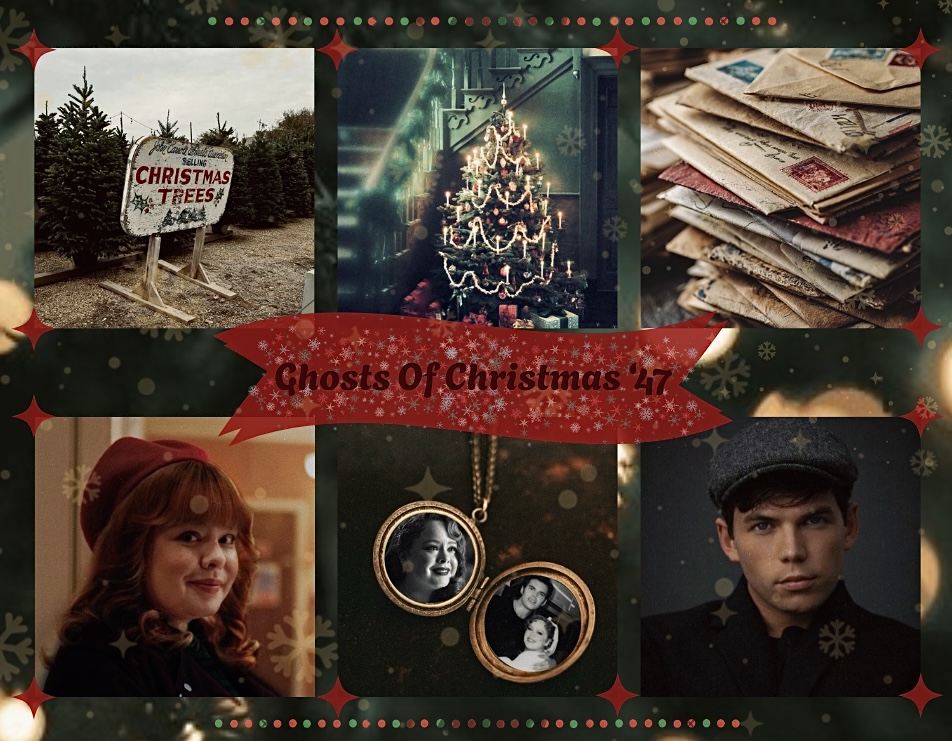
Here we are as in olden days
Happy golden days of yore
Faithful friends who are dear to us
Gather near to us once more
- Have Yourself A Merry Little Christmas, 1943
“You must make your own life amongst the living and, whether you meet fair winds or foul, find your own way to harbour in the end.”
- The Ghost and Mrs Muir
💫💫💫
Christmas Eve, 1947
Not the showiest choice, that’s for sure. Pretty, but imperfect. Weathered and leaning, a little sparse on one side; a little shaggy on another. But that’s part of its charm.
Right then. This is the one.
As he reaches into the thick tangle of green, pushing aside prickly needles to find the trunk, something familiar brushes the air—oranges and rich, cedary pipe smoke—warmth cutting through the knife-cold December morning. The scent hits him with an ache so sharp his breath stutters.
Father.
Colin smiles, a little bit melancholy, a little bit cradled. He treasures what he has come to regard as godwinks, reminders that Edmund Bridgerton remains with his loved ones in spirit, his legacy still making its mark even if his feet no longer leave prints on the ground.
Infrequent and fleeting though these moments are, they are always inexplicably right on time. There in the dark hours when Colin has needed them most. A foxhole in Calais. A midnight filing room in Brussels under shellfire. And now, a tree lot on Christmas Eve, his first holiday back in London after a long time away.
He closes his hand around the trunk, but instead of bark and sap, his fingers brush a hand beneath time-tired wool, heat bleeding through threadbare stitches.
“Oh!” a woman gasps.
A hat-covered head appears through the curtain of evergreen branches, lush copper curls spilling forward with the tilt of her head.
He’d know that hair anywhere.
“Pen?” he asks, letting go of the evergreen. “Is that you?”
It’s December 24, 1947–the first holiday season since the blackout ended, and he’s been stumbling through fog for months. Then he sees her standing among the evergreens, the air sharp with fresh-cut pine, coal smoke, and the faintest thread of orange.
His first glimpse of her is like being jolted awake, every nerve sparking, like kindling catching and rushing into flame.
Emerging from a lonely shell.
Alive.
“Colin Bridgerton!” She releases the tree and plants her hands on her hips, a wry smile stretching across her face. “Of all the tree lots in the city, you walk into mine.”
The sound of her voice, tart and teasing, has him rocking back on his heels. Time melts away, if only for a moment.
“Ah, so you come here often?” he asks, committing to the bit.
“Only when I’m on the hunt for the imperfect blue spruce.” She brushes her mittened hand over a branch, making the needles quiver in the snappy air. “You?”
“First timer,” he jokes, dropping briefly into his Humphrey Bogart impression. Whisky poured over gravel, as someone once described Bogart’s voice. “S’pose I need an expert. What should I be looking for, kid?”
“‘Kid’ is it?” She lifts her pretty copper eyebrows. “Next thing I know, you’ll be calling me sweetheart.”
Sweetheart. Oh, how he wishes.
“I already have a nickname or two for you, don’t I?” he says lightly.
Pen. Love. And while these days, “love” is bantered about with a friendly albeit detached affection, his feelings for Pen aren’t the least bit friend-like.
“Mmmhmmm,” she says too quickly, and in the next breath she sashays around to the far side of the spruce, half-hidden behind its branches. “Right. See how this one is a little patchy over here? And these straggly bits on this side?”
He hides a smile behind his gloved hand. She only babbles like this when she’s flustered.
“No good?”
“Very good. All part of its charm. Along with the crooked trunk, of course.” Her voice floats out from behind the tree, a touch breathless, as if she’s inspecting an entire forest rather than one lopsided spruce.
“My thoughts exactly. A diamond in the rough. So I’ve chosen well?” he asks eagerly.
Too eagerly. Two minutes in her vicinity and he’s already seeking her approval. Like a schoolboy or a puppy, rather than a thirty-one-year-old seasoned news correspondent and world traveler. Pathetic, Bridgerton.
Pen emerges from the other side of the tree at last, cheeks pink, excitement bright in her eyes. “By my estimation, absolutely. I’ve always had a soft spot for the ones with potential.” She circles the evergreen as if coaxing out its best qualities, looking every bit the girl he grew up with rather than a grown woman of twenty-nine. “Some might declare this little darling ugly or pass her by, but she’s just patiently waiting for someone to see her worth.”
She stops in front of him and beams, her smile deep and certain. “Every tree has a purpose, don’t you think?”
Colin lowers his gaze to the sawdust-coated ground, suddenly feeling like they’re no longer talking about Christmas trees. Words clog his throat. Every airy or funny remark he reaches for feels wrong.
“I’ve missed you, Pen,” he manages at last, and he means it. His fingers twitch with the need to reach for her, to pull her close. He stuffs his hands into his pockets to stop himself from doing something foolish.
She simply looks at him, the humour in her eyes softening into something warmer. Then, as if it’s the most natural thing in the world, she steps forward and slides her arms around his waist in a tight hug.
He freezes, then surrenders and holds her back, his eyes drifting closed as her head slots beneath his chin. She’s solid and warm in his arms, not a ghost or a memory, but real. His hands press into the delicate muscles of her back, the familiar weight of her soft body against his chest making his heart stumble.
God, how he’s missed her.
When they finally part, he’s satisfied to note he’s not the only one a little winded. He watches her from beneath his lashes while she concentrates on dusting snow off a tree branch, both of them pretending the embrace was nothing more than a friendly greeting.
“You’re a sight for sore eyes,” he says, the truth rushing out before he can stop it.
“So are you,” she murmurs, colour rising in her cheeks when their gazes lock.
And she is—familiar and changed all at once. Wearier around the edges, but still luminously Pen. Same glowing, porcelain skin. Same morning-glory eyes. Same brisk, determined walk—two steps for each of his long-legged strides. But thinner. Tired. The war is etched into the soft planes of her face and dark crescents shadow her eyes, the same as everyone they see on the street.
“Best part of my day,” he adds, unable to keep the thought to himself.
Subtle, Bridgerton. At least you didn’t tell her it’s the best part of any day you’ve had for a long, long time.
“Well,” she drawls, “it’s still early.” She ducks her head then, fussing with the overlong sleeves of a navy coat that’s seen too many winters, plucking at a loose button. He drinks her in, memorising the details, comparing her to the version he’s held in his memory.
“I’d have known you anywhere,” he says softly.
It’s true. Her scent of lavender and ink seems to cling to his coat, warming him better than a roaring fire. He could pick her out of a crowd blindfolded, no matter how much time had passed.
And quite a bit has.
Two years, eight months, and sixteen days to be exact. Their last meeting was on Penelope’s twenty-seventh birthday. The night his dreams died.
She touches the rim of her dark blue cloche. “Even with the hat? It’s all the rage this year. Makes everyone look terribly sensible.”
“You never needed help with that, love,” he says.
The way his old endearment for her rolls off his tongue makes his ears heat. He really needs to think before he speaks. But he’s never guarded himself around Pen, and the flash of her dimples tells him she doesn’t mind. That smile could brighten the whole of London. It still knocks the wind out of him; has ever since she was a bitty little thing dressed in lemon-yellow frocks, freckles scattered across her nose like someone had dusted her with sunlight.
“And you never needed help being cheeky.”
“Me?” He throws her a look of boyish innocence—then takes a proper look at her, his eyes narrowing in sudden recognition. “That’s not much of a winter coat, Pen. Where’d you get it?”
“Oxfam here in Bloomsbury. Don’t look so stricken. On me, there’s so much fabric that it’s warmer than it looks. Not all of us are giants, you know.” She waves a hand over her diminutive 5-foot stature. “I recognised it straightaway.”
“You recognised my old coat in a charity shop?” he asks with a hard swallow. “Pen…I would’ve given it to you if you wanted it that much.”
“Well,” she says, tugging on the cuff of a sleeve, “you were away. And it was there, so I took it.”
He studies her, unable to help hearing what she didn’t say. She’s right; he hasn’t been here. And he doesn’t know how to explain why. Every excuse sounds flimsy, every reason a coward’s defense. “Actually, it suits you.”
She does look adorable in it, the sleeves rolled up and tacked with neat little stitches so it fits her petite frame. The idea that Penelope would want to wrap herself against cold winter days in something that was once his deepens the ache in his heart, fissures yawning with grief over missed chances and could’ve-beens.
He wonders if her husband knows she’s wearing a coat that once belonged to another man.
A man who never quite managed to stop loving her. No matter how hard he tried.
“Thanks.” She shrugs. “I knew it was yours because the right pocket’s deeper than the left. And this,” she says in a dramatic whisper, as if letting him in on a secret. She reaches deep into the breast pocket like she’s unearthing treasure and pulls out an orange drop, its faded wrapper crinkled, the sweet inside long past saving. She slips it back into the pocket where she found it, tucked away as though returning a charm to its rightful place.
“I keep it for luck,” she explains. “Do you still carry around a notebook?”
“Guilty,” he says, patting the pocket of his brown tweed coat with a grin, “of both the notebook and the sweet tooth.”
He produces two fresh orange drops and deposits one in the palm of her mittened hand.
“Oooh, thanks,” Pen says, her eyes lighting up. “It’s been an age since I had a proper sweet.”
They unwrap their candies, the thin paper crackling like frost beneath their feet.
The orange drop tastes sharper than in pre-ration days, certainly leaner than it did when he used to sneak them from Father’s pockets and he pretended not to notice. Pen pops the sweet into her mouth and closes her eyes, making a small noise of contentment. She’s always grateful for the smallest pleasures. Things he often took for granted in his search for what’s grand and adventurous.
He’s always loved that about her—how she makes every little thing feel like a blessing. Chess matches in the garden (which she always won). Picnics on scratchy blankets with crustless jam sandwiches and tart lemonade. Reading a book over each other’s shoulder under the gnarled old oak at Aubrey Hall.
Finding joy in the small and ordinary, the way Father taught them.
“There now,” Edmund used to say, whether Colin was enjoying a biscuit, learning something new, or fixing something broken. “Don’t let the good things pass you by.”
A radio fizzes from an old shed at the edge of the tree lot, the familiar notes of Bing Crosby dreaming of snow floating through the rows of fir trees lined up like soldiers reporting for holiday duty. Little ones giggle and chase each other, weaving in and out, the evergreen army providing an instant setting for tag or hide-and-seek. Families—both prosperous and plain—chatter with animated excitement about decorations and tonight’s visit from Father Christmas, sipping cups of hot Bovril between good-natured bartering over which tree they’re taking home.
He smiles at the living, breathing picture postcard. No matter how tight things are, everyone manages to find money for a Christmas tree.
While Penelope looks over the tree lot, grinning at a pigtailed little girl sitting on her papa’s shoulders, he studies her small hands. Her mittens are a cheerful red knit, thick and warm despite the careful darning at the fingertips. But isn’t that what they do these days? Patch and stitch and mend. Make do and carry on.
The wool covers her ring finger, and he finds himself absurdly grateful for the mystery, for the opportunity to extend their banter like it’s old times.
“Do you and your…uh, do you live around here?”
Subtle again, Bridgerton. Small wonder that intelligence hasn’t tapped you for a career in espionage.
The clerk, a cherry-nosed man bundled in a green scarf too long for his frame, glances between them with a knowing look. “Sweethearts?” he asks kindly. His spectacles are fogged over with the cold; he removes them and mops the glass with a starched white handkerchief.
“Old friends,” Penelope says before Colin can answer, her tone light but her cheeks ruddy.
“Right. Friends,” Colin echoes, never taking his eyes off Pen.
He points to the tree they’d both tried to buy. The one that needs rescuing. That deserves to be seen.
“The lady here has excellent taste in evergreens. She’ll take this one,” he says, peeling a folded note from his wallet and pressing it into the vendor’s hand with a quiet, “Keep the change.” Some of the proceeds are going to a local veterans’ centre. Men who left bits of themselves overseas so days like this were still possible.
“Are you sure?” Pen protests. “You had your eye on this one, too. And far be it from me to steal the best tree in the lot from under a friend’s nose.”
“There are dozens of trees that won’t object to spending Christmas with me,” he says, waving a hand at the bounty surrounding them. “I’ll find another.”
She giggles at his self-deprecating joke, the sound as pure and sweet as the church bells of St. Agnes’s across the way. “That’s sweet of you, thanks. We’ll settle up later?”
“Sure,” he says easily just to satisfy her. He has no intention of letting her pay for her tree. “Can I ask you something?”
“Always,” she says.
He nods toward the cumbersome evergreen. “Just how were you planning on dragging this thing home?”
She wrinkles her nose adorably while the clerk winds twine around the branches, preparing the tree for transport. It’s no trouble for him, but it’s taller than she is. “Hadn’t really thought that far ahead. This is my first Christmas choosing a tree on my own.”
He hums, unconvinced. It’s unlike Penelope not to have a plan, but perhaps he doesn’t know her as well as he used to. She’s married now. Married. It’s on the tip of his tongue to ask why her husband isn’t here helping her. Instead, he sweeps an elegant bow and says, “Madam, may I have the honour of escorting you and your handsome evergreen home?”
“Colin.” She giggles again at his antics, her face scrunching in comic bewilderment. “What about your tree?”
He shrugs. “I’ll come back for one later.”
“All right, then,” she says, smiling. Her easy acceptance of his offer and the silliness that comes with it makes the black, ugly knot lodged in his chest loosen a touch. The sound of his own laughter surprises him, rich and bright, warming the cold air swirling around them.
Pen tucks the orange drop wrapper into her pocket and nods toward the pavement. “Right then. Lead on, Mr. Bridgerton.”
He hoists the tree with an exaggerated grunt. “After you…” He nearly calls her Miss Featherington, the old habit rising automatically, but it sticks in his throat.
“After you, Pen.”
They fall into step, the bundled spruce bouncing between them as they navigate the slush. Pen’s boots slip once, and he tightens his grip on the trunk, ready to catch her if she falls. That old, protective instinct is still there, as sharp and alive as it ever was.
Once, when she was thirteen or fourteen, she’d toppled from a ladder in the Aubrey Hall library. He hadn’t caught her so much as cushioned her fall with his body. At sixteen, it was the first time he recalls being intensely aware of her, breasts crushed against his chest, sweet minty breath fanning his face. She’d leaned down and brushed her thumb across his lip. “Biscuit crumb,” she’d said softly, their eyes locking before she scrambled to her feet and left him sprawled on his back on the library floor wondering what the hell happened.
They stroll amiably through the slushy streets, the atmosphere thick with coal smoke and the scent of roasting chestnuts from a brazier cart.
For the first time in months, his stomach growls, gurgling happily at the delicious smell. “Mind if we stop for a moment? I’m famished.”
“When aren’t you?” She smiles at him with that fond, patient warmth that is pure Pen and heads toward the brazier cart.
“I know, I know. A grown man of thirty-one years who eats like he’s still in nursery.”
“You’ve an appetite for life, Colin. I’ve always admired that about you.”
Not so much lately, he doesn’t say. But somehow, simply walking beside her has his hunger returning with a vengeance. In fact, the whole world looks brighter (and tastier) with every passing minute by her side.
He buys a paper cone of roasted chestnuts from the vendor, juggling the bundled tree in one arm while trying to open the packet with his free hand. The tree keeps sliding, threatening to hit the slushy street, and he struggles to maintain his grip on both the evergreen and his snack.
“Here.” Pen eases the packet of chestnuts out of his hand. “Let me help.” She breaks open the cone and chooses the largest, its shell cracked to reveal the tender, glazed flesh inside. She blows on it carefully before holding it up, her warm breath making smoky puffs in the wintry late morning air.
“Open,” she orders with a little smile.
He laughs, leaning forward to accept the morsel. Her mittened fingers brush his lips, the tingling warmth of her accidental touch sweeter than any treat.
He chews slowly, savouring the warmth, the sugar melting on his tongue, grateful for the excuse to look anywhere but at her. If he meets her eyes now, he’s done for.
She pops a chestnut into her own mouth, smiling around the steam. The anxiety of the war years falls away. For this morning, it’s just them again—Colin and Pen, laughing on a snowy London fairway, chatting and sharing a treat.
And he lets himself pretend. That the world isn’t putting itself back together. That it means something, her wearing his old coat, the collar lifted against the wind. That her letters had never stopped coming.
That she doesn’t have a husband waiting at home.
Colin shakes off his doldrums. It’s Christmas. And like the rest of the world, he’s determined to celebrate properly after a hellish eight years.
Even if that means walking alongside ghosts—some he fears, and one he’s never let go of.
💫💫💫
The Railway Arms, April 8, 1945
“To Penelope!” Eloise shouts, raising her glass. “Cheers to twenty-seven, and many happy returns.”
“Hear, hear,” they all yell, whistling and banging their fists on the table.
Pen gives them a bashful smile and a soft thank you, barely audible above the raucous noise of the bar.
Their wartime haunt is alive with hope tonight.
The Railway Arms is absolutely heaving, bodies packed shoulder to shoulder, umbrellas piled by the entrance creating slippery little puddles on the worn oak floor.
Behind the bar, a radio crackles, tuned low to the BBC, war bulletins interrupting a lively version of Moonlight Serenade. The odour of grease from the adjacent fish and chip shop wafts along a cold wind anytime someone opens the battered front door. Every thirty minutes on the dot, a train groans into the station, setting windows filmed in coal soot and condensation to rattling in their warped frames.
Colin shivers, popping a hot chip in his mouth to stave off the cold.
“The war’s nearly over,” someone shouts, clinking glasses with a roar of laughter.
“I’ll believe it when I read it in the papers,” another calls back. “We’ve heard that tune before.”
“My cousin’s with Montgomery’s lot,” a man near the bar adds. “Says Jerry’s boys are surrendering in droves.”
“About bloody time,” his companion mutters. “Six years of this madness.”
“God willing, let it be true this time,” a woman says, her voice wobbling with emotion.
Colin looks around with satisfaction. This place is honest, not posh like the clubs in Mayfair, and he’s always felt more comfortable among the working class than the nobility. Perhaps it’s because the old ways of the monarchy no longer matter. Perhaps it’s because he’s not the titled one and, with Anthony and Benedict both blessed with two sons each, he blessedly never will be. Perhaps it’s because his spirit is restless and he’s at loose ends now that his war correspondence days are coming to a close. He’d rather rub elbows with rail workers, factory employees, and Americans on leave than peers who want to pretend the world hasn’t changed.
Pen likes it here, too. While other women of her class would wrinkle their noses at the smell of cheap beer and cigarette smoke, she settles in like she belongs. Because she does. Because she sees people, not stations, and cares for them, flaws and all.
If he were making a list, he’d scribble it down amongst the hundreds of reasons he loves her.
Besides, she’s the birthday girl, so everyone came to the spot of her choosing. The Bridgertons, Penelope, and their friend, Remington, are crowded around a weathered wooden table near the draughty windows. Coats are draped over chair backs; half-drunk pints ring the surface; an already full ashtray sits at Benedict’s elbow.
Secretly, he thinks his siblings like it better here, too, though Anthony would faint before he admitted it. This is the kind of place where no one cares who or where you were before the war. Only that you’re still here.
“Do you think it’s true?” Gregory asks, leaning forward eagerly. “That peace is coming?”
“Churchill says so,” Anthony replies, swirling his pint. “And from what I’m hearing in the Lords, the intelligence suggests Berlin won’t hold much longer. Days, perhaps. A week at most.”
“Please God,” Penelope murmurs, her fingers wrapped around her glass; the table hums with agreement.
“It’s been a long, bloody road,” Remington says quietly.
There’s weight behind the words—the kind that comes from having paid the price personally. Colin’s been there, seen the front and the aftermath, but it’s a damn sight easier to write stories about what’s happening than it is to be in the trenches. He respects Remington deeply, and if he’s honest, feels a bit small beside him. Remington had faced what Colin had only documented—and lost the use of his legs for it.
Benedict shifts in his seat, turning toward the table. He pulls out his cigarettes, tapping one against the pack before lighting it. “Speaking of, I visited St. Leo’s earlier this week. The disabled veterans’ ward. Been sketching portraits of the men there.”
“That’s good of you, brother,” Anthony says, patting his shoulder.
“It’s the least I can do.” Benedict takes a drag, exhaling slowly. “The newspapers are finally printing their stories, thanks to fellows like our brother here.” He nods at Colin. “Seems right that their faces should be seen too. Properly seen, not just…” He trails off, then shakes his head. “Anyway. Met a chap named Davies. Lost both legs at Monte Cassino. Cheerful as anything, planning to open a tobacconist’s shop in Lewisham with his brother.”
Colin can’t imagine it. To lose your legs, or even the use of them. He thinks he’d go mad if he couldn’t ramble restlessly down whatever streets called to him. He looks at Remington and immediately feels shame at his thoughts.
Then he risks a sideways glance at Pen, but she’s absorbed in a whispered conversation with Eloise. He knows exactly what she’d say anyway.
“You’re enough as you are, Colin. You don’t need to be anything other than yourself. The world needs you, just as you are.”
“Your friend won’t lack for customers,” Colin manages, clearing his throat. “Good show.”
Benedict stubs out his cigarette in the overflowing ashtray and immediately lights another.
“Remington, you should come along next time,” he says, meeting his eye. No pity, just an invitation between equals. Colin feels another pang of admiration. Ben has the sort of ease with everyone that Colin has always wished he could emulate.
“The men would appreciate meeting someone who’s been through it,” Ben says. “Someone who understands.”
Remington’s posture, already soldier straight, seems to ease slightly. His hands rest atop the polished armrests of his wheelchair with quiet dignity. “I’d be honoured. Truly.”
“Davies told me something that’s stuck with me.” Benedict pauses, cigarette between his fingers, smoke curling upward. “He said when you’ve stared death in the face, you don’t want to waste another minute being scared of living. Said he’s done waiting for life to happen to him; he’s going to bloody well make it happen.”
“Wise man,” Anthony murmurs.
“Braver than most,” Remington adds.
Colin says nothing, the warlorn veteran’s advice hooking into his ribs like barbed wire. He steals a glance at Penelope, but she isn’t listening.
She’s turned toward Gregory now, laughing at his ridiculous impression of Anthony—his cheeks sucked in and chest puffed out, muttering something about “parliamentary decorum.” Gregory sweeps his arm, and Pen lifts her drink out of the way before it spills, her cheeks flushed the same shade of pink as her homespun knit hat, a birthday present from Hy, who’s out on a date tonight.
His sixteen-year-old baby sister is on a date. Gregory’s sweetheart, Lucy, sneaks up behind him and wraps her arms around his neck, planting a kiss on his cheek. It’s only a matter of time before they wed, and Greg’s only eighteen. Colin looks at his happily married brothers, the lines on their faces more from laughter than sorrow, and suddenly feels both ancient and utterly unmoored.
Don’t waste another minute being scared of living.
The advice sounds suspiciously close to something Father used to say: “Don’t let the good things pass you by.” It’s a motto Colin’s always tried to live by, even if he doesn’t always choose well. He lives life to the full, seeking out every experience, every adventure, every pleasure he can find.
Lately, though, there’s a nagging voice in his conscience that it’s not enough. He’s involved in the war effort, true, but he’s mostly watched other people’s courage from a safe distance. Telling stories of bravery instead of living one.
Which is why tonight matters. Why he’s been carrying the small velvet box in his coat pocket for three days, the fabric worn smooth from his nervous fingers. A locket. Silver, delicate, with space inside for a photograph. Or two photographs, facing each other. He’d imagined slipping one of himself inside before giving it to her, then leaving the other side empty for her to fill however she wished. In the end, he decided that would be far too presumptuous. He’ll give it to her empty. Let her choose what, or who, she wants to carry close to her heart.
Tonight, after the party, he’s going to tell Penelope Featherington that he’s in love with her.
“My turn to buy the next round.” Ben hops up from the table. “Anyone need anything else? Penelope?”
“All good over here, thanks.” She flashes her pretty smile at his brother.
Colin’s hand moves to his coat pocket, feeling the small box there. His heart hammers. Soon. Just a little while longer, and he’ll pull her aside, give her the locket, tell her everything. Tonight.
Tell her what, exactly, Bridgerton? He’d rehearsed a talk in the mirror, the way he did all important speeches, but now his mouth is cotton-dry, his prepared words hollow and lacking.
Eloise leans across the empty chair Benedict left behind, picking at the label on her glass. “Word is Remington’s going to ask Penelope to marry him,” she says for Colin’s ears only, a worried crease between her brows.
Colin’s stomach drops.
“I suppose I should be happy for her. Remington’s a good man.” Eloise’s shoulders hunch, losing their usual defiant posture. “But marriage, Colin? We had plans. We were going to live together, be spinster sisters, have adventures without having to answer to anyone.” She presses her lips together. “Now she’ll be Lady Remington, and I’ll be… alone.”
The world tilts. The pub noise blurs, dim and distant, as if his ears have filled with water.
Eloise is still talking, but the words don’t register.
Pen.
Married.
To Remington.
When did that happen? When did Pen and Remington become sweethearts? How did Colin not know?
The pint glass is cold in his numb fingers. A long pull buys him time to think, to breathe, to stop the room from spinning. The glass rattles when he sets it back down, his hand unsteady. The pub is no less of a dizzying blur than it was before he swallowed half his lager.
Consumed with her own complicated feelings, Eloise doesn’t notice him reeling.
Pen turns back toward the table, reaching for the salt cellar, unaware that the ground has just dropped out beneath him. The crown of her bent head blurs while she sprinkles salt over the hot chips.
Colin pushes to his feet so abruptly he nearly upsets the baskets of chips and pitchers of ale.
“Careful, brother,” Anthony says, which only sharpens Colin’s embarrassment—but he has to get out. The air feels thin, the room too close, his chest cinched tight as a drum.
He moves behind Pen’s chair, leaning down so close that only she can hear: “Happy birthday, love.”
His voice is barely audible above the clinking glasses and roaring laughter, and thank God, because he’s barely keeping the tears at bay.
“I hope…” The words stick like gum to the bottom of his shoe; he cannot tell her he hopes she’ll have a wonderful life with a man who isn’t him. So he speaks the only truth he can bear to utter. “That is, I wish very much for your happiness.”
Before she can turn around to protest or ask why his voice cracks, he presses a brief kiss to her cheek, straightens, and turns blindly toward the exit, a burst of frigid, metallic wind guiding his steps.
Benedict crosses from the bar to intercept him just inside the threshold, cigarette dangling from his lips, and rests a heavy hand on his shoulder.
“Colin.”
He forces a tight smile, his eyes unfocused, his mind somewhere far beyond the pub walls, imagining things he’d rather not picture.
“I’m managing, brother.” For what else is there to say? She’s marrying someone else. He doesn’t want to come apart in the middle of the Railway Arms.
He shrugs into his coat, his hand closing around the small velvet box in his pocket. The locket. Dear God, the locket. He can’t carry it anymore. Can’t bear the weight of it, the reminder of his foolish hopes.
“Maybe some books are better left on the shelf.”
Benedict frowns, taking the cigarette from his mouth and stubbing it out in an overflowing ashtray
“But—”
Colin pulls the box from his pocket and presses it into Benedict’s hand. “Give this to Pen, please. Tell her—” His voice wobbles. “Tell her happy birthday.”
“Brother, wait—”
But he's already pushing through the door.
“Night,” Colin calls over his shoulder, choking back tears as he tugs his cap into place.
The clock strikes midnight as he steps into the fog, the chime echoing like a tolling bell. Cold night air tasting of coal and bitterness freezes the tears into tracks on his face.
He shivers, huddling deeper into his coat. Not all fairytales have happy endings, and he cannot shake the certainty that he’s reached the abrupt end of his—the love story he’d always longed for but never got to live.
Peace is coming. Any day now.
Then there will be no more excuses. He will have to make the best of his choices, his words, his life. There will be peace on earth, God willing, just not in his heart.
Maybe the true cost of peace is acceptance, knowing you can’t have everything.
Knowing that sometimes, despite your best intentions, the good passes you by, and there’s no fixing it.
💫💫💫