
Chapter Text
The plane’s wheels hitting the hot tarmac wakes Stede from his dream.
He doesn’t recall what it was, just that It was an amorphous one, most likely borne from the melatonin he’d taken somewhere over the dark Atlantic Ocean when sleep eluded him. A sense of a dream, he’d categorise it as. There but not. It takes him a moment to fully slide back into consciousness, almost as long as it takes his heart to settle from the abrupt jolt back onto solid ground. Once there, it leaves him grumpier than he’d like to be.
He’s always hated flying, takeoff and landing more so, those split-second moments when things could go very wrong, when you’re at the mercy of Fate and physics. You won’t go before you’re supposed to, they say, but someday you will, and you don’t know how it’ll happen.
Now, he leans forward, pushing up the window shade and revealing the world outside. It’s mid-morning in Italy, bright blue skies stretching above the hulking shapes of the planes and airport that make Stede squint and consider sliding his sleep mask back down, at least until his row is ready to de-plane. He wonders if he should feel any different when it all still looks the same. He could be anywhere. He could, finally, be anything.
The States are far behind him, but the weight of everything else in his life doesn’t fully abate the way he thought it would. Rather, it stays perched on his shoulders instead, peering down. Waiting, patiently, the way these things do.
Taking one earbud out, Stede listens to the captain’s announcements about the weather, the airport, where their baggage will be. Switching his phone off of airplane mode, he watches the time skip forward. A disconcerting feeling, the evidence that it is just a manufactured concept. And he thought—had been certain—that being so far away would have at least some sort of tangible effect. It just seemed right, how abstract ideas often are.
The reality of it, however, is much more sobering: here he is, on a different continent for the first overseas trip of his adult life, and he might as well be back at LAX for how he feels. That sort of sameness that says that, no matter where you go, there you are.
No text messages. He’d expected that, but it still strikes someplace tender. Nine hours on a flight and…nothing. Not from his parents, or even from the tentative acquaintances he’d made at university. Just silence and push notifications for Uber Eats and Net-a-Porter that an item in his wishlist is about to sell out.
Resting his forehead on the window, he slips his earbud back in and watches the movement on the tarmac as his music starts again. Maybe Ethel Cain is a bit too melancholy for such a bright, sunny day, but Stede’s body is still continents away where it’s dark, and he’s achy from being cramped in a seat for hours, even if it is first class.
Navigating the airport is another nightmare. Stede isn’t the type to pack light, and maybe it was excessive bringing five large suitcases for three months, but he also isn’t one to do anything by halves, especially when it comes to clothing and self-care. They’re the things that he can control, how he feels good about himself on days when he normally wouldn’t.
He finds a luggage cart around the baggage carousel and hauls all of his luggage onto it himself, then books a luxury car using his father’s business card. As he sees the triple-digit euro total on the app he feels a bit of satisfaction. Serves him right, Stede thinks only a little viciously, pressing his thumb to the screen harder than necessary to confirm the purchase.
It’s barely ten in the morning. He’s breathing hard, winded, while he watches the flurry of travellers around him, an endless river-like flow of strangers he'll never encounter again. There’s so much life around him, and Stede still feels like a ghost. Any one of these people could pass right through him.
He hopes that this wasn’t a bad decision.
——
There are a few important things that should be known.
The first is that Stede Bonnet is twenty-three, but feels both younger and older than he is, depending on who he’s around and what the subject of conversation is. The second: he graduated university a few weeks ago not quite with honors, but close enough that he lets himself feel proud for actually making it.
For most young adults, it’s a celebration. That final bridge crossed between adolescence and adulthood, where you can start an entirely new chapter and perhaps begin to come into your own.
For Stede, graduation had been less about celebrating and more about wondering how compressed his spine could become from the forced expectations of his father before he inevitably collapsed like a crushed soda can. There wouldn’t be an idyllic summer to relax before starting work, at least as far as Edward Bonnet was concerned.
Stede had made it through business school by the skin of his teeth, and he couldn’t fathom doing that for the rest of his life, especially not for his father’s company. Too many blind eyes there were turned to things that shouldn’t be. Stede himself didn’t fit into that box, anyway, and he didn’t want to sand down parts of himself just so he could.
This trip, whatever it’s meant to be, had been his idea of a fuck you: if he had to work at the company, then his father would have to let Stede have the summer free before he started work. Since he’s the sole child and Edward wants to keep the company within the family, Stede had gotten his way, though not without a few exchanged words that bordered more on aggressive than passive.
June through August. Those are his last months of the closest thing he can call freedom. There’s already an office for him, one of the less-desirable ones that people didn’t want. No windows, hidden in a corner, hardly more than a glorified broom cupboard. An office for somebody unimportant who will be conversed with solely on the phone, whose presence is not only unneeded but also unwanted.
Stede doesn’t often let himself daydream outside of the books he’s reading. It can get too painful at times, and for all that he’s the daydreamer sort he’s also a pragmatist.
Still, as he gets into the sleek car he booked with his father’s money he can’t help but imagine the sultry Italian air being a catalyst for an anonymous night or two of sex. Sweaty skin, damp hair—arms, legs, chest, groin. A hard cock that isn’t his own, there for him to touch and taste with the reverence of the devout.
He isn’t a virgin, not since that night with Mary, the girl who was friends with his roommate. He’d been partially drunk on Schnapps, and he couldn’t stop looking at his roommate. Maybe, he’d thought then, taking in Mary’s brown hair, her pretty brown eyes. If I have sex with her, he’d thought, tipping back his glass, then this other thing, it won’t matter.
He’d taken her into his room, each of them stripping off another item of clothing in an unspoken turn, and he’d come inside her to the thought of soft pecs and dark underarm hair. Then he’d known, remembering his father’s disdain and snide remarks while Mary redressed, looked at him silently, and left.
For this, now, for what he really wants, he doesn’t know how any of that will unfold, if it even does at all. He wants to believe in the romance of it, he knows that much. He’s seen—and read—enough of it. It has to be out there, If not, then what’s the point of being human?
The leather in the car is supple and perfectly cool thanks to the built-in seat aircon. Neutral smell, nothing obvious, just plainly pleasant. The driver doesn’t seem to speak much English, and Stede doesn’t want to try to exercise his rudimentary Italian on him. He’s content, instead, to watch the paved roads melt away to dirt and gravel, to see the olive and chestnut trees growing in lusher as they leave Genoa behind for the sloping green mountains of the countryside.
He doesn’t know much about the town he’s staying in other than that it’s small and a few kilometres from the ocean. The long-term rental he’d booked looked promising online, and he can only hope it’s just as promising in person.
The countryside is almost too beautiful to be real. People live like this, Stede thinks as they pass squat, red-shingled houses whose history probably far precedes anything he’s seen. No place in the states looks this purely beautiful—even the Great Plains and the Southwest bear the scars of their past. It reminds him instead of Aotearoa, all of this untouched purity green and bold.
Perhaps he should have gone there. At least he knows its mountains and beaches from childhood. He wouldn’t be quite so alone. Or maybe he would have been, still. At the end of the day he’s still running to delay the inevitable.
He isn’t the type to be able to change his life. That’s reserved for much braver men than him.
——
The man that meets Stede at the door to the house is tall and weathered with age, hair a grey-brown crown around his head, his nose off-centred in a charming way. He has a kind face, though, and kind brown eyes, and he welcomes Stede with a hospitable smile. He speaks in accented English and introduces himself as Guido, the owner.
They exchange numbers just in case of emergency, and after a few demonstrated tricks on how to fix the door that sometimes likes to stick, and about how the kitchen sink can be finicky unless the handle is turned just so, Stede is on his own again, entombed in solitude. He looks over at the narrow, uneven steps up to the second floor, back at his plethora of suitcases, and heaves a sigh to no one but himself.
——
It wasn’t a bad idea. Stede repeats this to himself as he hauls each suitcase up the stairs one by one. A little physical exercise is good for the brain! And the sooner he gets the hard part done the sooner he can trek down to the little town for coffee and a sweet. The last thing he’d eaten had been that abysmal excuse for a breakfast on the airplane, and his stomach is beginning to complain.
Three suitcases down, though, and Stede’s breathing hard at the top of the steps and dreading the walk back down. He’d packed too much. Of course he had. His father was right. He’s too soft, too much of a spoiled rich boy to even try to set out for a life not comfortably sheltered by his trust fund and his father’s empire.
Tears prick at the corners of his eyes before he can stop them.
Fuck, he’s better than this. Crying at a minor inconvenience—if only his father could see him now.
Not much of a man, are you, boy?
With a furious shake of his head Stede wipes the heels of his palms over his eyes, just once, and squares his shoulders. He sniffles, but there’s no one around to hear it, so for once he doesn’t keep it quiet. It’s a moment of weakness leaving, or so he tells himself.
“I am adequate,” he says to the empty house, to the sloping stairs, to the tick-tock of the grandfather clock on the ground floor. No answer, but that’s to be expected. He’s used to the silence after he speaks, always too much or too little or too eccentric. Here, though, far away from the people who have taunted him his whole life, it seems a little more believable.
Once all the suitcases are upstairs Stede collapses onto the bed in grateful relief. Staring at the ceiling, he counts his breaths, focussing on the steadily-slowing thump of his heart. How his body melts into the mattress as exhaustion catches up with him and leeches into him.
It’s a modest bedroom, just big enough for the four-poster queen-sized bed, a dresser, and a wardrobe, all in a deep walnut brown. The photos that line the walls are sepia-coloured portraits of family members Stede doesn’t know, and he turns his head to look at them one by one. What were their lives like, he wonders, and what did they like? Have every one of them walked the old wooden floors at some point in their lives?
Stede gets lost in his head like this, sometimes. Imagining the lives of others, because their lives had to be better than his, sterile like a hospital room, everything done with clinical precision. It’s easy for him to get lost in it, building elaborate backstories using scenarios from his own fantasies. Sometimes, he thinks, he’d prefer to live there if he could. Create his own paths, build his own stepping stones, know each part with a comfortable familiarity.
Before he realises it his eyelids are growing heavy; each blink open comes slower, until it finally doesn’t come at all, and he drops off into dreamless sleep.
——
The house is dark when Stede wakes. Fumbling around on the bed for his phone, he unlocks it. 20:33, it says, accusatory. His tongue is thick and dry in his mouth. Somehow, despite sleeping for nearly nine hours, he’s almost more tired than he was before. His eyelids want to keep slipping closed, heavy like they’re pulled down on weights.
So no dinner tonight, that’s for sure. No unpacking either, even as Stede thinks about all of his linen shirts and shorts that need to be hung up before they wrinkle. There’s surely got to be an iron somewhere in this place, no matter how…rustic it looks.
Oh. Stede frowns. How unfair. Just because he’s feeling somewhat melancholy. It’s as charming of a place that Stede could have imagined. A perfect background to spend only a few months in. And he’s in Italy! Alone! Free to do whatever he pleases whenever he so chooses. Is this how other people feel? It’s addicting, if so. Nobody to hold him accountable for anything—he can lie here as long as he wants, if he wants. No classes to attend, or chores to do, or a job to go to.
Staring at the ceiling, Stede thinks, unbidden, about the Badminton twins. They also went to university, but it was really only to say that they did it. Now that they’ve graduated they’ll be heading to their spots in their father’s business where they’ll be put in charge of entire departments with no experience, unless you can count nepotism.
What does he have? Not much of anything. A love of fine things, a secret desire to be an interior designer but no true skill to go with it. Like much else in his life it’s a fantasy. There’s no room for happiness for somebody like him. He’s destined to have his nice things, but material possessions can only carry someone so far. What good is a fully-stocked closet if there’s nowhere to wear them and nobody to wear them for?
He rolls over. The linens are freshly washed, smelling strongly of a clean neutral scent, like the interior of the car that took him here. He curls his knees up towards his belly and closes his eyes, expecting his exhaustion to be too much to allow him to fall back asleep.
He’s asleep again within minutes.
——
The melancholia of the previous night dissipates with the morning. When Stede wakes up, it’s to the sun stretched warm across the bed from the curtains he couldn’t make himself get up and close the night before. Just outside the window is the sound of gentle birdsong.
It takes Stede aback as he lies there listening. Has he ever woken up to birds like this before? He doesn’t think so. His father’s house is too big to allow things like trees to grow next to it. Usually, he thinks, it was silence, given that their closest neighbours were nearly half a mile away thanks to their extensive property.
Rather than hop out of bed Stede lets the morning gradually awaken him. He dozes, just on that cusp of consciousness, until the light has slanted to the floor. His morning unwinds in a similar fashion: he takes his time choosing his clothes, figuring out the shower, rummaging through the kitchen.
Habitually he picks up the heavy cast iron tea kettle, ready to fill it under the faucet, before he stops himself and puts it back. The town, he remembers with a shake of his head. Outside the thick-paned windows the sun is bright, the sky a clear Tiffany blue. It’s the sky of an open future, a high school teacher used to say. Though Stede doesn’t really believe it, somehow it’s stuck with him after all these years.
The walk to the piazza is long enough that Stede feels warm after, but not so long that it could become an issue in the future. It’s nice, anyway, to be with the quiet of nature. LA hardly offers that, even in its hills. The countryside here offers verdant foliage, clear blue skies untainted from smog. When he tips his head back, Stede is treated to so much sky that he feels like he could fall into it.
Pulling his phone from his pocket, he takes a photo of the sky, the green hills just visible on the bottom right corner. It brings a bit of warmth to his chest, and the rest of his walk into town is buoyed by that feeling. Maybe he can do something here.
The village itself is a modest-sized cluster of old brick buildings, all of them sloped upward following the trajectory of the hills. The cobblestone piazza is bright with the morning sun as it slants in, casting light across the scattering of tables and chairs grouped in front of a trattoria and cafe.
In the middle of it all, seated alone at a small table, there’s a man. Stede notices him right away—or, rather, he notices how handsome the man is, the way anybody does when they see someone they think is attractive. Which is to say, he doesn’t do a double take, but it’s a close approximation, and his eyes, drawn against his best judgment, keep finding their way back to the man for just one more look, just to see if he’s as beautiful as Stede’s quick glances said he was.
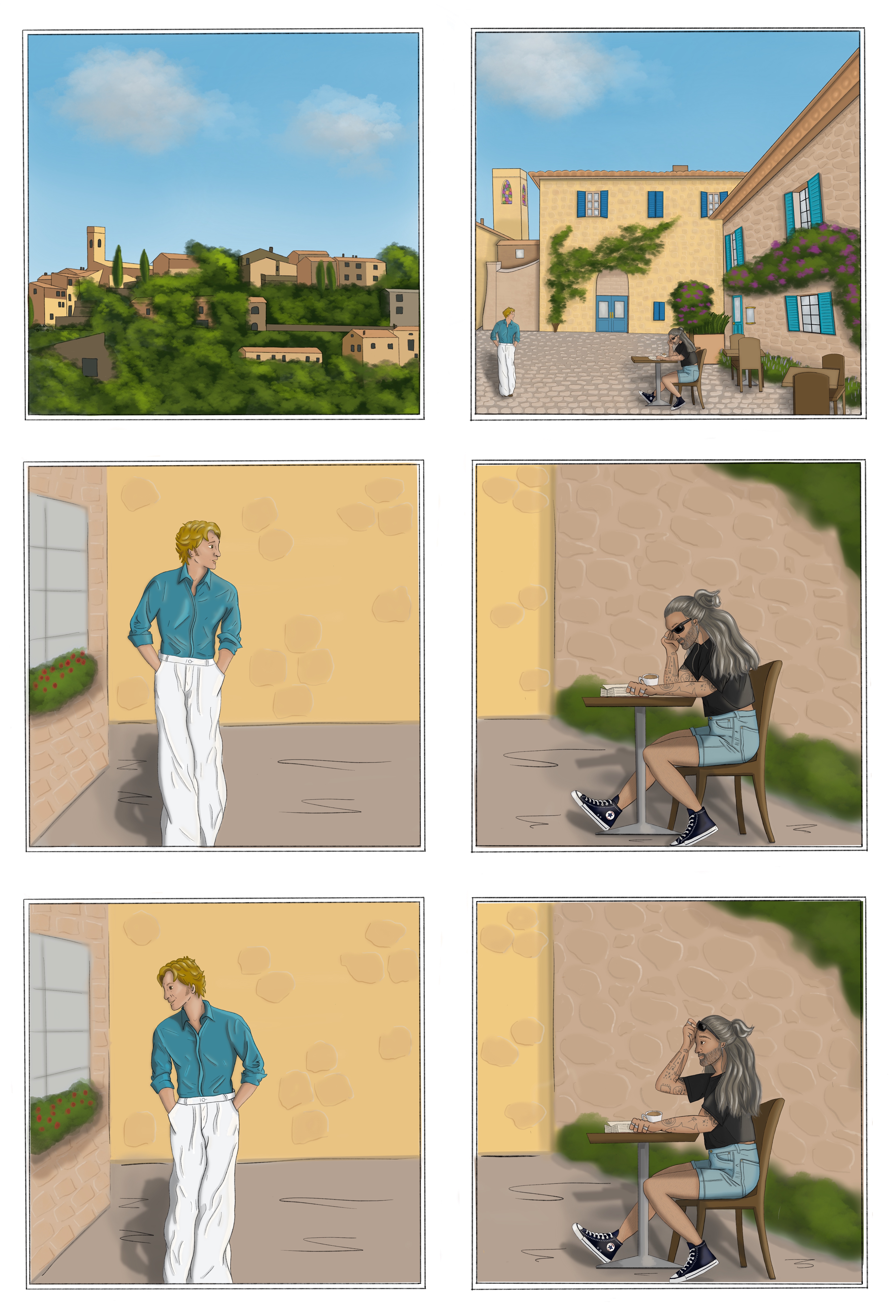
The man, white china cup positioned at his right hand and a thick book open on the tabletop, seems blissfully oblivious to the motion of the world around him. It’s a well-loved book at that, edges creased with wear, pages a little battered. So he either reads a lot, or he likes to buy his books secondhand. Stede suddenly has a quick little fantasy about running into this man in a small used bookstore, their hands both reaching for the same book on a shelf.
It’s a slightly breezy day, so the man keeps tucking his long grey hair behind his ear. There’s a small row of silver piercings trailing up his lobe, anchored by a single dangling sword.
Stede’s suddenly struck breathless with how much he wants: to touch, to look, to permanently brand into his memory. The wind catches him, too, billows the flowing material of his shirt and pants around his body.
What does this man sound like? Are his hands soft, or calloused? Would he let Stede learn every inch of his body, like that harpoon of desire wants him to?
Those well-loved pages flutter in the wind. The man has to spread his fingers over the book, drawing attention to the long, elegant length of them, the two thick silver rings on his forefinger and pinky. When he flips the page he does so with a finger slid just under the page he’s reading, letting his fingertips drag as he moves onto the next. Now, he settles a bookmark carefully in the vee of the book’s spine and closes it. His silver hair tumbles down his back as he stretches his shoulders.
“Scusa!” an irritated voice says. “Sei sulla mia strada.”
Stede startles, stammers out an apology half in Italian and half in English, and turns to make room for the harried-looking mother with an equally-as-harried toddler clutching her hand. Really, though, is it so difficult to just walk around? It isn’t like it’s very busy. He exhales through his nose and tries not to wrinkle it at the glare the woman gives him as she drags her child along their way, muttering about American tourists.
When Stede turns back around the man is gone. Just an empty cup is left at his table.
——
Transportation wasn’t a major concern when Stede was still in LA, but it’s becoming increasingly obvious that he can’t just walk everywhere. Nor does he want to think about getting a rental car, never mind that he’d have no idea where to go to find a rental place.
That’s how he ends up at the line bicycle supply store in town, looking at the display of bikes for purchase. The last time he’d ridden a bike had probably been when he was a preteen, but it can’t be that hard to remember, can it? The metaphor exists for a reason.
“It’s best to get around with a bike,” says a voice from behind him.
Whirling around in surprise, Stede comes face-to-face with the man from the tables outside the cafe. They’re almost of the same height. Now that the man’s sunglasses are pushed up Stede notices his large, dark eyes, the lines at the corners of them and the age sun-spotted across his face. A little slither of something makes itself known in Stede’s belly, like a beast awakening.
“Excuse me?” he responds eloquently, his brain crawling along trying to catch up with the fact that the beautiful man he'd been ogling is talking to him. Him! He has the urge to look around, make sure there isn’t anybody else this man could possibly be talking to. Surely there has to be some tall, handsome Italian man behind him that Stede somehow missed also pursuing the bikes.
The man chuckles. Those dark eyes are still locked firmly on Stede, not over his shoulder or above his head. On him! “Sorry if I scared you. Just wanted to tell you that the best mode of transportation here is bike. Lotta the roads are small and unpaved and really wind-y.”
“Your accent,” says Stede, still surprised, unable to process past the shared sound of home, made all the more shocking by the sudden discovery in the hills of Italy.
The man grins wider, eyes squinting with it and showing off a neat row of small, uniform teeth. “ Your accent, mate. Who’d think Italy would bring two kiwis together?”
Stede, slowly rebooting back to full power, manages to say, “Not me, that’s for sure.”
Absurd, is what it is. The good kind, though, whose existence makes you laugh simply because there’s no other way to react. A reminder of the randomness of the universe and how you just never know what’s going to happen.
“I think I saw you earlier,” says the man. Before Stede’s stomach can do a total freefall the man adds, ”Across the square? I’d remember this shirt anywhere.”
Oh thank god Stede very nearly says. He glances down at himself even though he knows precisely which shirt he’s wearing and how exquisite it is. It billows beautifully in the wind, soft teal like the hue of the ocean shallows on the shoreline. “This old thing?”
Something in the man’s eyes seems to soften. “Yeah,” he says, a bit quieter than before. “It looks good on you. The colour, I mean.”
Their eyes meet. The breeze ruffles their hair. Some distant part of Stede shifts, like a joint clicking back into place. A deep, satisfying ache.
“Do you,” they both start at the same time, then break away laughing. The man has a nice laugh, a tittering little noise that’s almost a giggle. “You first,” he says, and somehow that’s what makes Stede nervous, even though he hasn’t felt it this entire time.
“I was, um,” he says, stumbling a bit, “going to ask you if you lived here, or if you were visiting.”
The man makes a contemplative noise, twirls his hair round his finger once, twice. Bites his lower lip, and isn’t that a sight, that neat little row of teeth sinking into the plushness of it, all of it covered by the grey-white-black of his beard. “Ah, yeah. Actually retired here a couple years ago. Don’t live in town, though. I’ve got a little place by the water a few kilometres from here.”
“Retired?” Stede asks in surprise. Sure, he’s young enough that anything over thirty feels somewhat old to him, but this man doesn’t seem to be past his forties at the most.
“What, the grey hair didn’t give it away?” the man asks, a hint of a tease that immediately leaves Stede wanting the full thing. “Yeah, I got lucky, and then I got bored of it all, so I thought, why the fuck not?”
A simple statement, but one that still strikes Stede as unfamiliar and foreign. There’s never been a moment in his life where he could think oh, fuck it and deviate from the path. His path is lined with tall fences topped with barbed wire, a danger every step of the way.
“I’m Ed, by the way,” the man—Ed—adds, holding out his hand.
“Oh, I’m Stede.” Taking it, the first thing that Stede notices is how soft Ed’s hands are. The second is that Ed has the same kind of firm handshake Stede’s come to expect from the kind of people his dad consorts with. Some sort of businessman, then, or somebody who dealt with businessmen on a regular basis. It’s a defense mechanism, the same way an armadillo curling up or a possum playing dead is.
“I could ask if you’re visiting or not, but something tells me that you are.” It’s punctuated with another smile as Ed lets go of his hand. Stede isn’t sure what to make of the loneliness the lack of touch creates when he’s already so accustomed to it in his day to day.
Maybe it’s because Ed talked to him first, and he remembered him, and he’s smiling at him right now, in the middle of a bike shop where no more than five minutes ago they were complete strangers whose lives ran parallel. Maybe it’s because Stede can already see a clear divide in his life—before Ed, and after Ed, and that’s something so enormous he can’t begin to see its shape.
“You’ve got me,” Stede says, returning his own smile. “I’m here for a few months before I start my new job.”
An eyebrow rises up Ed’s forehead. He leans against a display of bicycle safety gear. “Here?”
Stede shakes his head. “In Los Angeles. That’s where I’m from.”
Ed studies him, not giving anything away. “Anything exciting?”
“Not really. Family business.” Stede tries not to make a face and fails. Ed chuckles.
“So why’re you here?”
The truth rises up first. Then the lie. For a moment, Stede doesn’t know which one he should go with. For some reason, he thinks he can trust Ed with the truth and know that there won’t be any judgment on the receiving end of it.
He must pause for too long, lost in thought again, because Ed suddenly says, “Fuck, man, you don’t even know me, I’m sorry.”
“No!” Stede replies, a tad too loud for the quiet of the shop before clearing his throat. “I mean, that’s okay. That we don’t really know each other. I think I could trust you with it.”
Impossibly, Ed’s eyes grow rounder.
“You could?”
“Yeah.” Exhaling, Stede says, “I was pissed off at my father after my graduation so I told him I’d only start working for him if he let me take this trip.”
Ed’s face does something complicated before settling on coolly neutral. “Your father, hmm?” he rumbles.
The response takes Stede by surprise, but he doesn’t allow himself space to dwell on it. “Unfortunately. I had to pursue what he wanted in university and it isn’t exactly what I’d have chosen for myself.”
Ed takes a step closer. “And what would that be?”
Ed is taller, Stede notices now, though not by much. Just an inch or so, enough to be obvious when they’re close like this. His hair isn’t just grey, either: there are strands of white, and strands of hair still almost black. Like this, Stede has to tip his head back ever-so slightly to meet Ed’s eyes.
“Interior designer?” he says, but it comes out as a question.
Is he imagining things, or do those eyes flicker down, just for a second? It’s too quick to really be able to tell, although Stede wishes he could grab time in his hands and hold it still, just long enough for that moment.
Ed studies him, eyes back up, and replies, “I could see someone like you doing that.”
It could be an insult. It isn’t. Rather, it’s said quietly, softly, as if Ed is careful with each word as he says them, the syllables plucked and lovingly shaped by his hands.
“What about you?” Stede asks. His cheeks are warm. He tells himself it’s from the sun.
Ed shrugs. “Oh, me, psh. Not important. I was a writer.”
Intriguing. Ed doesn’t seem the type, or maybe he does and Stede just hasn’t met a lot of writers. That’s probably it, since he hasn’t met a lot of people who exist outside his father’s bubble. “Anything I’d know?”
“Not unless you’d be into reading screenplays,” Ed replies, brow rising once again. Stede likes how it makes him look—rakish, devil-may-care.
“Well, what if I did?” he asks before affecting Ed’s earlier lean on the cool metal of a shelf, but without the effortless coolness of the whole deal. The tins of oil wobble, clanking against one another; internally Stede winces.
“I wouldn’t believe you,” says Ed, following Stede forward but still keeping a respectable distance. Stede bloody hates respectable distances.
With fake outrage, he replies, “How dare you say that to me and my screenplay-to-novel adaptations.”
Why did I say that he wonders just before Ed barks out a laugh. Then Stede is laughing, too, and it’s exactly like it was before. Easy, like breathing. Those unconscious processes your body goes through to keep you alive—that’s how it feels talking to Ed. Like paying attention and recognising it for the first time.
“I don’t actually read those,” Stede feels inclined to add. “Though I do like novels.”
“You seem the type.” Ed steps even closer. Stede could count the individual hairs of his beard if he wanted. Well, maybe not that, but he can see the individual hairs poking up from the stubble beneath his beard. It zings heat through Stede, liquid in how it sluices right down his spine.
“I do?” Stede manages.
“Mhmm. In a good way, ‘course. Reckon you’ve got loads of books at your place, huh?”
He can’t be—surely Stede is making this all up, the dip in Ed’s already-low voice, how he looks through his lashes, just enough to make Stede feel weak at the knees. It was a very pointed order of words, emphasis on the possessive pronoun. As if Ed would want to…no. He couldn’t.
….Could he?
The thing is, Stede did in fact pack a decent amount of books. He’d planned on scoping the area out and finding the best places to while away the day lost in those pages. Nothing close to what’s currently on his shelves in his room, of course, but almost not an amount to scoff at, either.
He tests the waters. “I do. Not as much as I have at home, however.”
The rabbit beat of his heart trips over itself. Easy to forget they’re both in a bike shop in the early afternoon, two glorified strangers who know some superficial facts about each other. But that’s how everybody has to start, isn’t it?
Ed hums. Looks at Stede, away, back again.
Oh, fuck testing the bloody waters: Stede jumps right in. “Would you like to see them sometime?”
Ed’s eyes widen, like he’s shocked to be the one asked. Stede really doesn’t know what to make of that.
“You asking me over?” Ed says. Heavy, those implications in that short sentence. Not just a hang, or friends getting together. That much is obvious.
Stede swallows. “Yes. If you’d want to, of course.”
The bike shop melts away. The nosy middle-aged woman who’s been puttering around them while she clearly eavesdrops disappears. It’s just him and Ed, both of them treading the same unfamiliar waters.
“I’d have to be insane not to, mate.” Ed punctuates the statement with a sly smile. Then he pulls his phone from his pocket. The world itself does not change, but for Stede it feels like there’s a shift, just enough where he needs to re-center his balance.