
Chapter Text
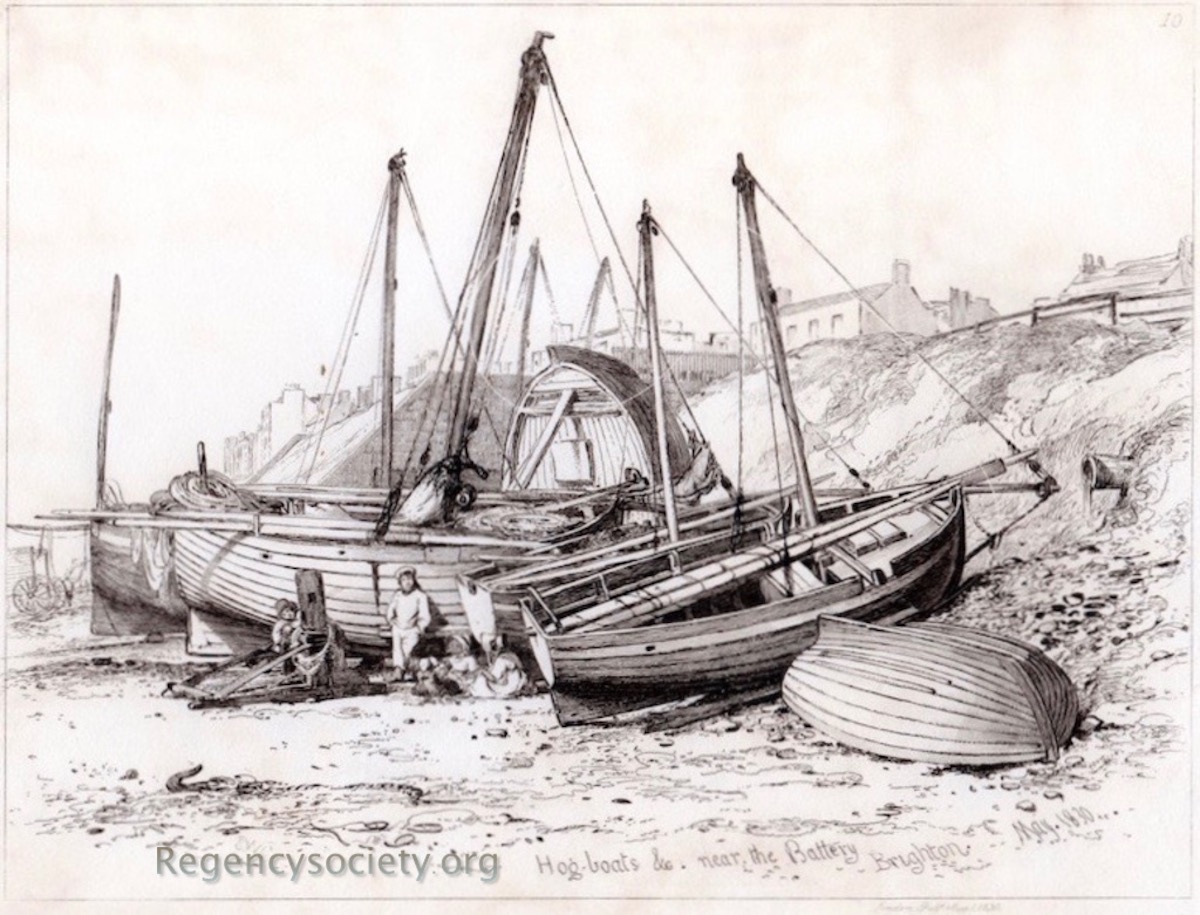
Fishing boats at Brighton beach, Aquatint, ca. 1810
Brighton, Spring 1820
The light at dawn was different in Brighton.
Anthony Crowley had noticed it his first morning here, when sleeplessness and an unfamiliar bed had driven him from his lodgings before the sun had properly risen. London mornings arrived dirty, filtered through coal smoke and fog, turning everything the colour of old pewter. But here, on this improbable shingle beach, the light came clean off the water – sharp and salt-scrubbed and almost painfully clear.
It was the sort of light an aquatint artist dreamed of. The kind that revealed every tone, every subtle shift from light to shadow. Crowley's fingers itched for his copper plates and acid, for the rosin dust that would create those delicate tonal effects he'd spent years perfecting. But his plates were wrapped in oilcloth under his bed, and his acid bottles were hidden at the bottom of his trunk, and he wasn't supposed to be thinking about aquatint at all.
That was rather the whole purpose of Brighton. To stop creating the acid-bitten images that had made London too dangerous to inhabit.
He'd been here for three weeks now, and the feeling of exposure hadn't faded. He ought to have been relieved – he was safe here, anonymous, just another gentleman taking the sea air for his health.
Brighton was good at anonymity, despite its fashionable pretensions. The town had a way of absorbing eccentrics and outcasts, of asking fewer questions than London ever would. The King himself had set that tone for years now. If Brighton could accommodate a King who kept mistresses and built pagodas, it could certainly overlook one humble artist in hiding.
Still, every morning Crowley woke with his heart racing, convinced that today would be the day someone would recognize him, would see past the careful fiction of Mr. Anthony Crowley, private gentleman, to the truth beneath.
The beach was nearly empty at this hour, save for a few hardy souls taking their constitutional and the occasional bathing machine being wheeled toward the water by patient horses. The machines themselves were absurd contraptions – wooden boxes on wheels, designed to preserve modesty while delivering their occupants directly into the sea. Crowley had watched them with an artist's fascination his first week here: the ritual of it, the attendant in her canvas dress wading into the surf, the shrieking bathers emerging transformed by cold water and convention into something supposedly healthful.
Everything in Brighton was supposedly healthful. The air, the water, the very shingle beneath one's feet – all prescribed by physicians and embraced by people who were, Crowley suspected, far more interested in the town's other offerings. The Castle Tavern's assembly rooms. The theatre on New Road. The subscription library where one could read the London papers and pretend to be shocked by one's own scandals, safely distant from their consequences.
He'd claimed a section of shingle near the old fishing boats, where Brighton showed her working bones beneath her fashionable veneer. Here, the fishermen still hauled their catches onto the beach each morning, and the smell of fish and tar cut through the perfumed pretensions of the town above. His sketchbook was balanced on his knees, charcoal moving quickly across the paper.
He shouldn’t even be drawing. At least not the sort of drawings that had made London too dangerous to inhabit. But his hands had never learned to be idle, and there was something about the fishing boats, the way they sat heavy and patient on the stones, that wanted capturing. They belonged here in a way the assembly rooms and the Pavilion's onion domes never quite would – they'd been here before the fashionable world arrived, and they'd remain long after it moved on to some other seaside fancy.
Charcoal was safe enough, he told himself. Quick sketches in a personal book. Nothing like the painstaking process of aquatint that had defined his real work – the work he'd signed Serpens.
Aquatint. Even thinking the word made his fingers ache with muscle memory. The technique had been his particular forte, the thing that had set his satirical prints apart from the crude woodcuts and simple etchings that flooded London's print shop windows.
The process itself was painstaking, meticulous, almost meditative in its precision. But the results were worth it. Where a simple etching might show a corrupt politician as a crude caricature, Crowley's aquatints could capture the sheen of sweat on a guilty face, the shadows that suggested moral darkness, the subtle gradations that made the subject uncomfortably real.
That's what had made his prints dangerous.
His sketch was coming together nicely: the curve of the hull, the texture of weathered wood, the coiled ropes like sleeping snakes. He was just adding shadows, when a voice spoke behind him.
"You have a remarkable line."
Crowley's hand jerked, leaving a wild slash of charcoal across the paper. He snapped the sketchbook shut and twisted round, heart hammering.
The man standing there looked mortified. "Oh, my dear fellow, I do apologize. I didn't mean to startle you."
He was perhaps a few years older than Crowley – somewhere in his late thirties, though it was difficult to tell with precision. Soft-looking, was Crowley's first thought, though not in an unkind way. Rounded at the edges where Crowley himself was all hard angles. Fair, almost white hair that curled slightly in the sea air, blue-green eyes behind gold-rimmed spectacles, a face built for kindness. He was dressed with understated expense – a gentleman, clearly, but not one who particularly cared to advertise it. His coat was beautifully cut but not ostentatiously fashionable, his cravat tied with more attention to comfort than style. He looked like he belonged to Brighton's quieter circles – the ones who came for the libraries and lectures rather than the gambling and spectacle.
"You were watching me work," Crowley said, more sharply than he'd intended.
"I was," the man admitted, and at least had the grace to look embarrassed about it. "Unforgivably rude. I saw you from the Parade and I'm afraid curiosity got the better of manners. I have something of a... well, an interest in draughtsmanship. In art generally." He gestured vaguely, as if this might excuse the intrusion. "Watching you work was quite mesmerizing, actually. You have a very distinctive style. The way you're building tone with the charcoal – those subtle gradations – it reminds me of aquatint work, actually. Very sophisticated for simple sketching."
The words landed like a stone in Crowley's chest. Distinctive style. Aquatint. Satan.
"Do I know you?" The question came out harder than necessary as well, edged with something that might have been panic if one listened closely enough.
The man blinked, clearly taken aback by the intensity. "I... no? I don't believe we've been introduced. I'm certain I would remember." He paused, then seemed to come to some decision about propriety. "Aziraphale Fell. I have a house just off the Marine Parade. I've been in Brighton for some time."
He offered his hand. Crowley stared at it for a moment too long before remembering himself and shaking it briefly. The man's – Aziraphale's – grip was warm and firm, his palm soft as if unaccustomed to any labour more strenuous than turning pages.
"Crowley," he managed. "Anthony Crowley."
"A pleasure." Aziraphale released his hand but didn't move away, which was unfortunate because Crowley rather needed him to leave now, immediately, before this conversation went anywhere more dangerous. "Are you visiting Brighton for the season, Mr. Crowley? Or are you one of us permanent refugees from the metropolis?"
Despite himself, Crowley felt his mouth twitch. "Refugees?"
"Oh, indeed." Aziraphale's smile was warm, conspiratorial. "Brighton is full of us, you know. People who found London a bit too... intense. Too insistent. Brighton asks less of one, I find. You can be peculiar here without causing offense. The town is far too busy being peculiar itself to notice."
It was true enough. Brighton had a quality of permissiveness that Crowley had noticed immediately – a sense that the normal rules had been temporarily suspended or at least relaxed. Bachelors living together in houses on the Steine without bothering to hide it. Artists and actors mingling with aristocracy in the coffeehouses. The King himself – when he'd still been Prince Regent – had been the forerunner in excess and experimentation, and the town had followed with enthusiasm.
"Something like that," Crowley said carefully. "Temporary refuge."
"Ah." Was that disappointment in Aziraphale's expression? "What a pity. I'd hoped you might be staying. Brighton could use more artists of your quality. We have rather too many young ladies painting insipid watercolours of the Pavilion and not nearly enough genuine skill."
He paused, worrying his lower lip in a way that suggested he was debating something. "Forgive me if this is presumptuous, but your style reminds me rather of – well. A particular artist whose work I admire. Especially that tonal approach… Most artists can't translate that kind of thinking to charcoal. It requires understanding the medium at a fundamental level."
Every muscle in Crowley's body had gone tense. "I couldn't say. I don't follow the printmakers much."
"No, of course not." But Aziraphale's eyes hadn't left his face, and there was something searching in them, some question being silently asked. "Well. I really must apologize again for the intrusion. Perhaps I'll see you about Brighton, Mr. Crowley. I walk here most mornings – the air is wonderfully clear at this hour, before the bathing machines crowd the beach and everyone begins their performance."
There was a dry humour in his tone that surprised Crowley – a suggestion that Aziraphale saw through Brighton's pretensions as clearly as Crowley did, but chose to be charmed by them instead of irritated.
"Perhaps," Crowley managed.
Aziraphale smiled – soft, genuine, faintly rueful – and turned to go. Crowley watched him walk back toward the Marine Parade, a figure of cream-coloured respectability disappearing into the morning crowds that were beginning to gather.
The Parade was coming to life now: nursemaids with children, invalids in bath chairs being wheeled along the broad pavement, fashionable young men on horseback hoping to be noticed.
Crowley’s hands were shaking.
He looked down at his sketchbook, still clutched against his chest like a shield. Opened it slowly to the ruined drawing, the wild slash of charcoal bisecting his careful work.
You have a very distinctive style. And worse: Very reminiscent of aquatint.
The words echoed in his head as he gathered his things and began the walk back to his lodgings. The town was fully awake now, and Crowley let himself be absorbed into its rhythms. Two gentlemen argued good-naturedly outside a coffeehouse. A group of children chased each other while their governesses shouted ineffectual warnings.
Brighton in the morning had a peculiar optimism about it – as if anything might happen, as if the sea air really could cure what ailed you, as if reinvention were as simple as changing your address. Crowley understood why people came here to escape. The town offered a kind of permission to start over, to pretend.
The problem was that pretence only worked if no one looked too closely.
He needed to be more careful. Needed to stop drawing entirely, perhaps, at least in public.
Crowley was so preoccupied with these thoughts that he nearly missed it: a print-shop window on North Street, and there in the corner, half-hidden behind more respectable offerings, one of his own pieces. "The Merchant's Prayer" – a satirical rendering of a well-known banker at his devotions, coin purse clasped where a rosary ought to be. It was several months old, from before the threat had arrived and he'd fled London.
Crowley stopped, staring at his own work displayed in a strange city, feeling oddly dislocated. He could see his own hand in every line, every careful tone. The banker's face was rendered with almost photographic realism, the play of light and shadow across his features suggesting both piety and greed simultaneously. The coin purse he clutched where a rosary should be was highlighted with brilliant whites that seemed to glow against the darker background.
It was some of his best work. Which was exactly the problem.
Below it, in small letters, the legend: After Serpens.
After. As if he were already gone.
The shop itself was called Ackroyd's – one of Brighton's better print sellers, catering to the fashionable crowd. The window was artfully arranged: landscapes of the Pavilion and the Steine, portraits of notable figures, fashion plates for the ladies, and tucked discreetly in the corner, the sort of satirical work that sold briskly but wasn't quite respectable. The aquatint prints were always more expensive than simple etchings. But collectors paid for quality.
Collectors like, apparently, the gentleman Crowley had met on the beach.
He was still standing there when he caught sight of his own reflection in the glass – and beyond it, on the other side of the street, a familiar figure in cream and gold.
Aziraphale was standing outside a bookseller's, browsing the window display. As Crowley watched, he glanced up, caught sight of the print shop, and went very still.
Then, quite deliberately, he looked directly at Crowley's reflection in the window.
Their eyes met in the glass. Aziraphale's expression was unreadable – surprise, perhaps, or recognition, or something more complicated that Crowley couldn't parse. For a long moment neither of them moved, two men reflected in a shop window on a Brighton street, connected by something unnamed.
Then Aziraphale inclined his head, the smallest acknowledgment, and turned away.
Crowley stood frozen, heart racing, hands still trembling around his sketchbook.
Oh, he thought distantly. Oh, hell.
The man knew. Somehow, impossibly, the soft-looking gentleman with the kind face and the expensive clothes knew exactly who Crowley was.
And he had smiled.
Crowley's lodgings were on Duke Street, in one of Brighton's less fashionable quarters – close enough to the sea to be respectable, far enough from the Pavilion to be affordable. The street was lined with modest terraced houses that had been hastily subdivided to accommodate Brighton's endless influx of visitors. Mrs. Pettigrew's establishment occupied a narrow building that smelled perpetually of fish and damp plaster, sounds from neighbouring rooms bleeding through walls that had never been built for privacy.
It was exactly the sort of place where a man who didn't want to be noticed might take rooms.
The landlady herself had been delighted to let to a gentleman – even one as peculiar as Crowley clearly was, with his unruly red hair, the dark glasses and odd hours and the way he'd paid three months' rent in advance without haggling. She'd informed him that the house was very respectable and that dinner was served promptly at six if he wanted it.
Crowley had assured her he'd mostly take his meals out. Brighton was full of coffeehouses and chop-houses where a man could eat cheaply and alone, while the town swirled past the windows. He'd already found his favourites: the King's Arms, when he wanted the noise of humanity to drown out his thoughts, the George, whenever he could afford something better than mutton and wanted to pretend he was still a gentleman of means rather than a starving artist in hiding.
He took the stairs two at a time now, let himself into his rooms, and locked the door behind him.
The space was small but adequate: a sitting room that doubled as his studio, a bedroom barely large enough for the bed, a washstand, a cupboard. The window looked out over Duke Street, where he could watch Brighton pass by without participating in it.
He'd accumulated surprisingly few possessions in his thirty-two years – a circumstance that made fleeing London on short notice merely inconvenient rather than impossible. His copper plates, his aquatint supplies, a trunk of dark and therefore slightly unfashionable, but rather elegant clothing. He'd learned to live lightly, to keep escape routes open.
He paced the room now, unable to settle, replaying the morning's encounter in his head.
You have a very distinctive style. Very reminiscent of aquatint.
The man – Aziraphale, what sort of name was that? – had recognized this from a rough sketch of fishing boats. Not just recognized him as competent, but identified his specific influence, the approach that was as much Crowley's signature as his pseudonym. Which meant he wasn't a casual observer of popular prints. He was someone who studied them, who knew Serpens's work well enough to identify the technique behind it, to understand the process that created those distinctive tones.
A collector, perhaps. Brighton attracted those – wealthy dilettantes who'd made their permanent home here, filling their houses with books and art and the sort of refined clutter that spoke of education and taste. Or a critic. Or – and this was the worst possibility – someone hired to find him.
But then why smile? Why that odd moment of connection in the print-shop window, that small acknowledgment that suggested... what? Complicity? Understanding?
Crowley dragged his hands through his hair, making it stand on end. He was being paranoid. Three weeks of looking over his shoulder had made him see threats everywhere. The man was probably just an art enthusiast, someone harmless who happened to have good taste and sharp eyes.
Except.
Except there had been something in the way Aziraphale looked at him. Not threatening, exactly. But knowing. As if he'd recognized not just Crowley's technique but Crowley himself.
Which was impossible. They'd never met before this morning. Crowley would have remembered that face, soft and curious and oddly compelling.
He needed to think. He needed –
A knock at the door made him jump.
"Mr. Crowley?" Mrs. Pettigrew's voice, anxious and apologetic. "Terribly sorry to disturb, but there's a gentleman here to see you. Says his name is Mr. Fell?"
Crowley's heart stopped.
"He seems very respectable," Mrs. Pettigrew continued, as if this should be reassuring. Brighton landladies had a finely tuned sense for respectability – it was how they navigated the town's peculiar social waters, knowing which eccentricities to overlook and which to report to the magistrate. "Says he met you on the beach this morning and wishes to apologize for the intrusion. Shall I send him up, or would you prefer to come down?"
For a wild moment, Crowley considered escape. The window, perhaps. The roof. Anywhere that wasn't here, facing whatever Aziraphale Fell wanted from him.
But running would be an admission. And besides, he was tired – so bloody tired – of running.
"Give me a moment," he called through the door. "I'll come down."
He caught sight of himself in the small mirror over the washstand: hair wild, cravat askew, eyes slightly mad behind the dark spectacles he habitually wore. He looked like a man with something to hide.
Well. That was accurate enough.
He straightened his cravat, ran dampened hands through his hair to tame it slightly, and went downstairs to discover what the soft-looking gentleman with the knowing smile wanted from him.
Aziraphale was waiting in Mrs. Pettigrew's parlour, a room of faded gentility that smelled of lavender and old upholstery. The furniture had seen better days – probably better decades – but everything was scrupulously clean. It was the parlour of someone maintaining standards despite diminished circumstances, which described half of Brighton's lodging houses.
Aziraphale stood when Crowley entered, and Crowley was struck again by how harmless he looked – the sort who gave children sweets and never said an unkind word.
Except his eyes were sharp behind those gold-rimmed spectacles. Intelligent and assessing and far too perceptive.
"Mr. Crowley," he said warmly. "Thank you for seeing me. I do hope I haven't inconvenienced you terribly."
"What do you want?" Crowley was past caring about niceties.
Aziraphale's smile didn't waver. "To apologize, primarily. And to make you an offer."
"An offer."
"Yes." Aziraphale glanced toward the door, where Mrs. Pettigrew was hovering with the transparent interest of a born gossip. "Perhaps we might speak somewhere more private? I promise you, Mr. Crowley, I mean you no harm whatsoever. Quite the opposite, in fact."
Every instinct Crowley possessed screamed danger. This man knew who he was, had tracked him to his lodgings within hours of their first meeting, and now wanted privacy for whatever proposition he was about to make.
It was almost certainly a trap.
"There's a coffeehouse on Ship Street," Crowley heard himself say. "The Grecian. Do you know it?"
"I do." Of course he did. Any gentleman who'd been in Brighton for any length of time would know the Grecian – it was where the town's more intellectual set gathered.
"An hour."
Aziraphale inclined his head. "I shall be there. And Mr. Crowley? I truly do mean you no harm. I hope you'll believe that, in time."
He left before Crowley could respond, pressing past Mrs. Pettigrew with polite murmurs and leaving Crowley standing in the faded parlour, trying to decide if he'd just made the worst mistake of his life.
Through the window, he watched Aziraphale emerge onto Duke Street and turn toward the town centre. The street was busy now. Aziraphale navigated it with the ease of long practice, nodding to acquaintances, sidestepping a flower seller.
Mr. Fell belonged here, Crowley realized. Brighton had absorbed him, giving him space to be whoever he was without demanding explanations.
And now he'd found Crowley. Recognized him. Sought him out.
The question was: Why?
Crowley had an hour to decide if he was brave enough – or foolish enough – to find out.
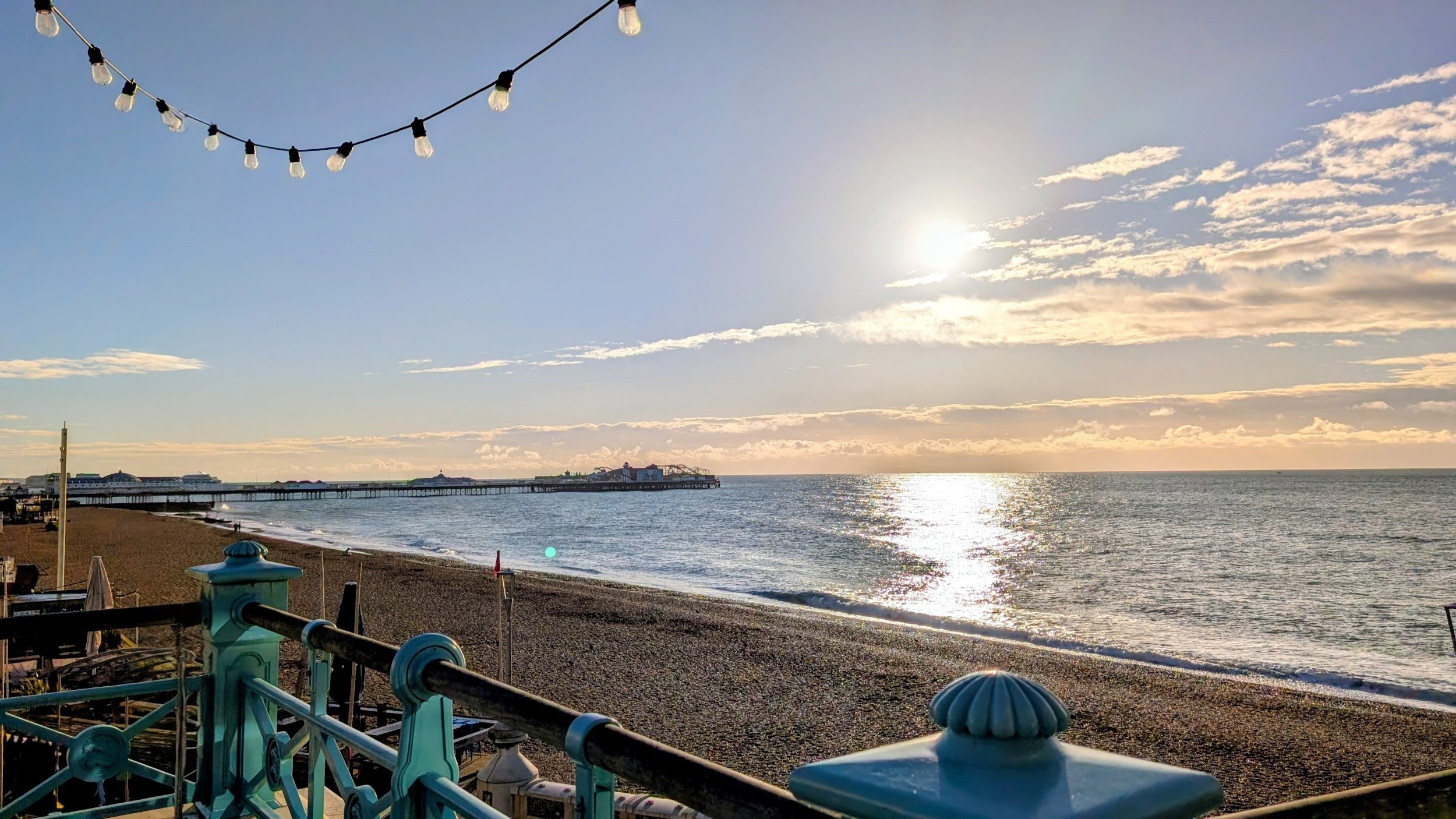
This is what I mean when I talk about the light in Brighton. It's still there.