
Chapter Text
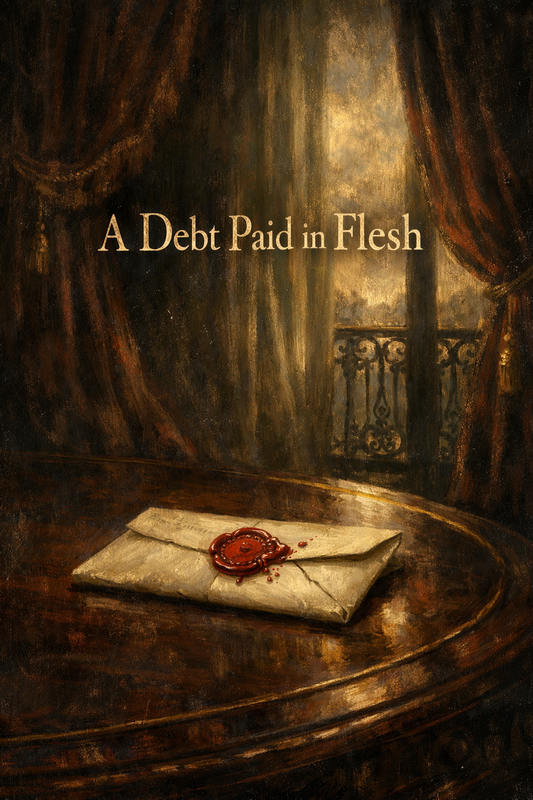
Savannah woke without haste.
The mist still clung to the river, drifting low around the docks, circling silent ships and weathered brick façades. From open windows came the faint scent of damp firewood, toasted bread, and harsh lye soap. The streets remained empty, save for a milk cart rattling past and the first birds announcing another humid day—much like all the others.
Beyond the streets the city polished, where cobblestones surrendered to packed earth, the Novak house breathed before opening its eyes.
The first to rise was Amelia Novak. Her knees cracked as she pushed herself off the thin mattress. She moved through the darkness by memory, fingers brushing the table so she wouldn’t wake the others—a habit carved into her bones by years of necessity—and lit the candle waiting in a chipped mug. The soft glow revealed peeling walls, a ceiling bruised by humidity, and the rope strung across the room where clients’ laundry still dripped slowly onto the floor.
She tied on her apron without washing it—there was neither time nor another one to wear. Outside, the sun was nothing more than a pale promise.
Soon, small footsteps followed.
“Mama…” Ana murmured, still half-asleep, braiding her hair with quick, practiced fingers.
“We start washing as soon as there’s light,” Amelia said without turning. “Mrs. Palmer wants everything by noon.”
Ana nodded. She had learned to obey before she learned to question.
In the back room, on a shared cot, Castiel opened his eyes at the first chop of the knife on the cutting board. He had trained himself to wake to that sound; discipline was the only luxury he owned. Sitting up slowly, he ran a hand through his dark hair and breathed in the familiar scents of soap, damp clothes, and inherited exhaustion.
As he dressed, he mentally reviewed what he would need at the clinic—his notebook, a pencil, bandages, and the small bottle of tincture Singer had asked him to bring. He loved that ritual. It gave his days structure.
To him, wealth and safety were only circumstances. Meaning was the true pursuit.
When he stepped into the kitchen, his mother was pouring weak coffee into three mismatched cups.
“I’ll be home late,” he warned. “The doctor said a patient from the countryside is coming in.”
“Protect your hands,” Amelia murmured, eyeing his knuckles. “They’re the only chance you’ll ever have at a respectable trade.”
Castiel offered a faint smile. He knew it wasn’t a compliment—only a prayer.
Gabriel burst in next, already dressed, whistling a tune. Sleeves rolled up, shirt loose, carrying the swagger of a boy who feared nothing because he had nothing left to lose.
“The Cartwrights hired me to fix their garden,” he announced proudly. “They pay well. And they give out sweet tea.”
“Hopefully better than last week,” Ana muttered.
“They always pay me,” he replied, puffing up. “I know how to be likable.”
Castiel rolled his eyes, but with affection. Gabriel was the only one who could pry laughter out of that house.
No one mentioned Jimmy.
He wasn’t there; he hadn’t come home. And everyone knew what that meant. The silence he left behind spoke louder than any confession ever could.
Amelia tightened the rosary hidden in her pocket.
“May God keep him,” she whispered, though she didn’t sound convinced.
Lucifer, the eldest, finally appeared, buttoning his coat. Dark circles under his eyes, tobacco on his breath, the look of someone who already knew something terrible.
“Castiel,” he said flatly. “Going to Singer’s?”
“Yes.”
“Good. Come home early. We need to talk.”
Castiel held his stare. Lucifer looked away first.
That was worse.
But Castiel didn’t ask—not yet. Their family had learned to hold its secrets until they became unavoidable. He grabbed his bag, kissed his mother’s forehead, and stepped into the awakening street.
Vendors set up stalls, girls chased chickens, men hauled sacks, and church bells marked seven. Savannah looked beautiful from afar, but those who lived in the poor district had learned better than to believe beauty belonged to them. Beauty and hunger rarely shared the same street.
Castiel crossed the square, breathing in the scent of damp earth. Dr. Singer’s clinic stood at the end of the street—patched brick, modest windows, a brass plaque dulled by time. To him, it was a refuge.
Inside those walls, he wasn’t the second twin, nor the problem’s brother, nor just another poor boy by the river. He was an apprentice doctor—nothing official, but real enough to let him believe he had a future.
And for now, that was enough.
✢──────────✢
Singer’s clinic was a single-story brick building that looked older than half the town. Paint peeled in long curls along the windows, and the bell above the door rattled like old bones whenever it rang. But to Castiel, the place carried the gravity of sacred ground.
Inside, the scent of camphor and boiled linens wrapped around him like a familiar cloak. The counter was chipped at the corners; the hallway creaked as if remembering every patient who had limped down it.
Castiel hung his satchel on its usual hook and rolled up his sleeves.
“Morning, Novak,” came a gruff voice.
Dr. Robert Singer—known to Savannah simply as Bobby—appeared in the doorway, wiping his hands on a cloth that had once been white. Broad-shouldered, beard streaked with gray, eyes sharp as a scalpel. His sleeves were always rolled up, his vest perpetually unbuttoned.
The ring on his left hand had long lost its shine—a reminder of a life he almost had.
“Morning, Doctor,” Castiel said.
“You’re early.”
“You asked me to be.”
“That doesn’t mean people listen.” Bobby grunted—his version of approval. “Come on. Full house today.”
As they walked into the examination room, Castiel’s gaze—always—rose to the framed certificate on the wall.
Harvard Medical College.
Bobby never mentioned it. But the town knew the story: the wealthy Bostonian who walked away from everything to treat the poor for nearly nothing. Some called him foolish. Others called him holy.
Bobby called himself tired.
To Castiel, he was nothing short of a miracle.
✢──────────✢
Sister Dolores waited with a little boy whose cough shook his ribs. Bobby knelt beside him.
“Fluid in the lungs,” he muttered. “We’ll make a poultice. Novak, warm the kettle.”
“Yes, Doctor.”
Castiel heated the herbs—camphor, mustard seed, and a pinch of something horribly pungent Singer swore by. He handed them over.
“You’re getting faster,” Bobby said.
“I memorized the ratios.”
“Show-off.”
But he didn’t hide the hint of pride.
The morning moved like a well-rehearsed dance.
A woman with a twisted ankle from the laundry stones.
An old fisherman whose hands trembled from decades of cold dawns.
A young girl burning with fever, her mother trembling more than she did.
Castiel cleaned wounds, held shaking hands, soothed frightened children. He prepared tinctures, boiled instruments, washed linens, and recorded symptoms.
He worked with reverence.
And Bobby watched him more closely than usual.
At noon, when the patients thinned, the doctor leaned against the counter.
“You’ve lasted here almost three years,” he said. “Most assistants don’t last three weeks.”
Castiel blinked. “I didn’t realize it had been that long.”
“You’ve got a good head. Clean hands. Better instincts than half the doctors I trained with.”
The praise struck harder than any insult.
Castiel swallowed. “Thank you.”
“Don’t thank me. Just don’t waste it.”
“I won’t,” Castiel whispered.
“Good. Then eat something before the next batch limps in.”
Castiel washed his hands, and for one quiet, precious moment, he forgot the debts at home, Jimmy’s absence, the hunger pressing at the edges of their lives.
For one quiet moment, he forgot everything else—and returned to a life that still had purpose.
✢──────────✢
Night fell heavy over Savannah—thick and airless. Crickets screamed in the yard, and the moon barely rose.
Castiel walked home slower than usual. Singer had kept him late, and exhaustion clung to him, but something heavier waited. He could feel it.
The windows glowed, but no voices leaked out.
He pushed the door open, and the absence struck him at once—heavy and unmistakable. No laughter. No Gabriel’s familiar whistling. Not even Ana’s quiet humming lingered in the air.
Just Lucifer, hunched at the table with his head in his hands.
Amelia stood at the stove, not cooking—only gripping the handle as if letting go would make the house collapse. Ana sat beside her, eyes swollen.
Castiel froze.
“Where’s Jimmy?”
Silence.
A punishing silence.
Lucifer finally lifted his head. His jaw trembled before he forced it still.
“He’s in trouble.”
Castiel didn’t sit. He couldn’t.
“What kind of trouble?”
Lucifer swallowed hard, then spoke like a man cutting open his own ribs.
“Jimmy didn’t just gamble. He borrowed from men tied directly to Mr. Winchester himself.”
Castiel felt his heart thud heavily in his chest.
“When he couldn’t pay, they went straight to Winchester,” Lucifer continued. “And Winchester…”
He dragged a hand over his face.
“Winchester paid the entire debt.”
Castiel’s stomach dropped.
“Why?” he whispered. “Why would he involve himself?”
Lucifer let out a broken laugh.
“Because to him, the debt was nothing. But owning a family? Humiliating a poor man? Showing his friends how easily he can make or break lives?”
He shook his head.
“He did it because he wanted something.”
Ana sobbed into her sleeve.
Castiel felt the room narrow.
“Where is Jimmy?”
“Gone,” Lucifer said softly. “He ran. Left us with the debt.”
The words fell heavy enough to sink the room.
“What does Winchester want?” Castiel asked.
Lucifer hesitated.
“A servant. In his household. To work off the debt. Not for a week or a month.”
A pause.
“For as long as he decides.”
Amelia crossed herself. Ana trembled.
“He wants Jimmy,” Castiel whispered.
“Yes. And Jimmy’s not here.”
The candle flickered violently.
“When do they expect him?” Castiel asked.
“Tomorrow morning.”
He understood.
Everything was already decided.
✢──────────✢
Dawn came pale and unforgiving.
Lucifer hadn’t slept. Amelia prayed without sound. Ana worried a dish rag until it nearly tore. Gabriel still hadn’t returned. Castiel stood near the doorway, bag packed out of habit.
“They’ll be here soon,” Lucifer said.
Castiel nodded.
“If Jimmy doesn’t return, he’s already dead,” Lucifer added. “Winchester doesn’t get angry—he takes offense. And men like him never forgive that.”
Castiel’s stomach twisted.
“They said… if someone shows up to take responsibility, they’ll leave the rest of us alone.”
Ana looked at Castiel through tears.
“Jimmy wouldn’t survive that house,” she whispered. “But you… you might.”
Castiel felt something cold move through him.
“Why me?”
Lucifer spoke gently, desperately.
“Because you don’t drink. You work hard. You follow rules. They won’t notice you. You’ll survive.”
And then, the knife.
“And you’re the only one who wouldn’t run.”
Castiel looked at his mother’s lined face, at Ana’s trembling hands, at Lucifer’s shame, at Jimmy’s empty chair.
He didn’t choose.
He simply nodded.
Amelia covered her mouth and sobbed.
“I’m sorry, Cas,” Lucifer whispered.
Castiel touched his arm. “I know.”
Outside, carriage wheels approached—slow, deliberate. Fate arriving.
Castiel picked up his coat, straightened his shoulders, and stepped out the door.
He didn’t look back.
If he did, he might not leave.
✢──────────✢
The estate appeared long before the carriage stopped—white columns rising through the trees, windows gleaming like watchful eyes.
Castiel felt smaller with every turn.
The gates opened without a word.
When he stepped down, the gravel crunched beneath his boots—soft, expensive, foreign. The house towered over him, immaculate and severe, as if waiting to judge.
The front door opened.
A stern man in a black suit stood there. Hendrick.
He looked Castiel up and down, expression unreadable.
“You are the replacement,” he said.
Not a question.
Castiel swallowed. “Yes, sir.”
“Follow me.”
Given where he came from, welcome was never expected, nor introductions offered. Only protocol remained.
Inside, polished floors reflected chandelier light. Portraits of long-dead Winchesters stared down from the walls. Wealth pressed in from every corner.
Hendrick led him toward the servants’ wing, where the ceilings lowered and the air thinned.
“Your duties will be assigned daily,” Hendrick said. “For now, you will report to the stables. Mr. Winchester wishes to see… effort.”
Castiel understood the real meaning.
Humiliation first. Usefulness later.
“Yes, sir.”
Hendrick paused, studying him—not cruelly, but with measured assessment.
“If you obey, you may last here. If not… Mr. Winchester has little patience for disappointment.”
Castiel’s heartbeat thundered in his ears.
“Understood.”
He stepped back outside, toward the stables—toward whatever punishment John Winchester believed a poor man deserved.