
Work Text:
Cultivator!
O, Cultivator! Thank you!
You—tall-form, pollinator, self-locomotive, primate with hair like raven feathers and crocus-purple stems-of-walking! Cultivator, thank you for bearing Us sunward!
—
It had been so long since the Growth last felt life.
Or, not long at all, for some of its pieces; there are always things dying, always things afterlife-resurrecting, and thus, always newly dead plants twining with and becoming part of the Growth. But when considering the sum total of its pooled existence without life… well, it had been unfathomably long, indeed. The Growth had missed it: the breeze, the soil, the silt and sun.
The Growth had lamented its capacity to miss. Had lamented lamenting, although it could only do so in that distant way of planthood—that is, the halfway, imperfect imprint of emotion that the Realms “gifted” it, that which it gifts to all those who did not before think. Not that it knew this. This was the only sort of emotion it had ever endured. In life, consciousness was so simple: utilitarian signals and feedings and warnings bounced between each other, when growths were still distinct. Now—now it missed. For a time well past, it longed.
And in its longing, it was rewarded.
Three strange beacons of life passed through the Realms.
Eyeless, earless, the Growth did not see them so much as it felt their disturbance: how the Realms shivered and displaced, death recoiling from that which it could not touch. All the Growth’s collective attention sharpened. Immobile, it could do no more than reach a lurching vine here and there toward the ripples, looking for more, wondering—and then it froze. For the strangelifes, pulsing, un-dead, were coming toward it.
The Cultivator was the only one of the three which descended from the strangelifes’ moving metal hollow. She stepped from it onto the island of the Growth. She made contact with the land, let her ankles brush through its undergrowth, stepped carefully, did not trample—she was like a breeze more than a creature, caused less breakage, even, than the ghosts which floated and did not step. The Growth was fascinated. It readied its burrs and pollens. Clad in leathers and nonskins, the Cultivator had so many places on which to find purchase—so the Growth reached out and clung.
It wasn’t an intentional bid for life-again. The Cultivator, in her nondeath, was a curiosity to be sure—but the Growth did not imagine she was anything but lost, that she could possibly bear it home to soil-and-sun. It could not have known. When she rose again from the island, it was a mere few miniscule pieces of the Growth that clung to her: curious, sure—but merely hoping for another island to disperse to. As with every host that wandered close enough, the Growth reached out and latched on with one goal in mind: to find another home for it to occupy, another place to assimilate, another ward against extinction. So—it did not imagine the direction she was heading was sunward. It could not have known. And it would have been blindsided when they reached that precipice anyway, but before they did, before the depth of this opportunity became apparent, something else shocked it from curiosity into complete captivation.
The Growth could not take the Cultivator as a host.
The Growth had always been able to take self-locomotive things as hosts.
Not the rock of its islands, not the metal of the strangelifes’ hollow; these surfaces were too inert to parasitize, the metal too smooth for even lichens to cling to. Those self-locomotive dead who touched down on the islands of the Growth, however? Yes. All of them. They proved excellent dispersers, once the Growth learned how to pilot them to new islands, spread new Growth. None lasted all that long—but long enough. The Growth populated much of the Realms. The Growth had wormed into creatures plenty, and from their eyes seen, from their skins felt, from their ungravity flew. So why not her?
Her body rejected it. Simply and utterly. Perhaps because she was still living? As a test, when the Cultivator leant forward over the shoulder of another strangelife, the Growth hopped to him and attempted to dig in. And—success. Yes, this one could be seeded; the Growth would be able to parasitize him fully when the seed took root. So why not her?
The Growth redoubled its efforts. The Growth tried to seed her. But nothing! It could cling to her surface, could ride with her, could even dip beneath her skin and explore inside—but to no end! A barrier remained between her and it; integration was impossible, assimilation a dream. The Growth was fascinated. Curious. Captivated. Frustrated. It had been curious before, and it lamented that curiosity, cursed it—the Growth, limbless, was not meant to crave, to seek—but this was all the more consuming. It had not before known frustration. And from the frustration of unsated curiosity rose a bubbling new emotion it had never known, was caught up in the froth of: excitement. Like a berry stepped on, or a bloom punching open, the Growth felt liable to burst.
And then—life!
That piece of itself upon the Cultivator, which the Growth’s main mass communicated with, crossed from death into life, and the shock of it reverberated across that link. All the Growth shuddered. Islandsfull of leaf-and-vine rustled, curled, feeling. Life again! Life, air, soil, sun!
Or—not quite sun, yet. The Cultivator had emerged from death into but another metal casing, the air stale. But present! Oxygen: how the Growth had missed it! It tasted different now, admittedly; the Growth no longer needed it as it had in life. But it was so nostalgic. Another foreign feeling.
The strangelifes scurried about. They emerged from metal into less-stale air, and spent time there refueling: chewing, swallowing, that gory unphotosynthesis of animals. And then Seeded-Strangelife shooed the others away, and the Cultivator acquiesced to the shooing, and passed through a threshold, and there—
There was the sun.
Self-locomotive hosts—ghosts, and now animals too—always took time to sprout in, once seeded. The Growth wouldn’t be able to pilot Seeded-Strangelife for a while yet, so while it waited, it pulled its focus into the piece-of-itself upon the Cultivator and felt.
Unstale air, moving, crisp. It was falltime in life, the Growth found. How it had forgotten seasons! Receiving that air’s crispness, it wanted briefly to fold in on itself, fall dormant, begin the process of wintering—but to no end. The Realms had no seasons. The Growth no longer had any reason to fear the cold, even here. So it shook off eons of cellular memory—shook off the memory of having cells—and resumed waiting: for the Cultivator to pass into a lively enough place, that which might become another islandfull of Growth. And, as before, it was rewarded.
The Cultivator crossed a new threshold into warmth. Humidity. Such a stark difference from the fall outside—here was a glass box of perfect summer, the air fresh! Fresh, that was, with a deliberacy to it. Whatever garden this was that the Growth had been brought to, it was a cultivated one. A loved one. And when the Cultivator set herself to work, when she turned attention and attention and attention to those living plants within, it became clear who it was that did the loving.
So carefully she’d stepped on its island. So carefully, now, did she reach for the occupants of her greenhouse. The Growth wanted to assimilate her: this so-careful animal. And it could not.
So it settled for its next best option: in this perfect summer-box, the Growth hopped from her clothing to an opportune pot of soil, and took root.
This would become the Growth’s first island-in-life. And once Seeded-Strangelife was parasitized, once the Cultivator had again collected pollen-and-burr enough to disperse elsewhere—then the Growth would follow them both further, begin more islands. It would happily spread. And through that ectoplasmic link which connected life-Growth and Realms-Growth, all of it would never need to miss again.
So it settled into its new pot. It twined and combined with its unwitting neighbor, a drooping flower. And, faster than any living thing does or ought, it began to grow.
The sun whirled over and over. Night came and went. The Cultivator visited and left and visited again, and outside the greenhouse, the weather surely fluctuated, grew colder—but inside, the Growth was unassailed as it spread. The sun turned, and the Growth took nothing from its light but comfort, appreciating the regularity of its revolutions and the contrast it brought between day and dark eve, where on the other side of the link, the Realms were always-glowing. That comfort held close, the Growth continued to do as it was wont: it wormed. Grew. Assimilated. It emerged from its soil and began snaking outward: creeping inch by inch to plants in pots nearby, bringing them into its fold, steadily overtaking the greenhouse entire. And the Cultivator watched over it as it did.
She had taken note of the Growth very quickly, back when it had just barely poked up from the dirt: a little shoot, still leafless. The Growth took note of her in return; by the way she disturbed the air, it tracked her regular visits, craved them. Her routine made the air swoosh predictably. Her tendings made the Growth’s living neighbors acknowledge her, release signals of safety, of nutrients-here. Attentive as she was, it was no particular surprise that eventually she’d noticed the Growth in particular. It was no surprise when her breeze stopped just near it and made its small form shiver—but it was a surprise when she’d reached out to touch.
Delicately, gently: the barest brush of finger-pads against the Growth’s stem. Warm, lively, animal touch. And then gone.
Automatically, the Growth had reached back, tried again to sink into her—but nothing. Not even now. And it—it longed, hurt—mourned? Was that this sinking desire? How terrible, this crushing emotion! Why, it begged, why couldn’t it reach her?
It was not to be. And so instead, the Growth, all of it, life-Growth and Realms-Growth both, in that moment leaned imperceptibly toward her touch. Voicelessly it thanked the Cultivator: that she had brough it sunward, that she had not moved to dig it from its squatting-place, that when her animal limb pulled away, she did so with care enough not to bend its stem.
Air had puffed toward the Growth, then. A vocalization. Speech. Would that it had ears to hear it, a mind to comprehend!
Soon. Soon.
Let alone by her after that, and at times encouraged by her, the Growth was indeed allowed to spread: to snake all through the greenhouse, making its way into every pot and planter, assimilating each specimen found inside. Those living plants the Growth brought into itself were, for now, yet living; they would remain as they were: chlorophylically green and brightly pigmented. They would linger as such as long as they could. But the Growth, not alive, could not provide for them—connected to its whole, eventually they would become as it was: dead. And death would leech from them life’s saturation, leaving them as uniform as the whole of the Growth: every piece of it, in the Realms and here, bone-white.
Eyeless, it could not yet see the majesty it had made of her greenhouse: it, white, stark, gnarled and overwhelming; its body a curled creeping, broken just occasionally by the living plants that poked out of it, brief splotches of color. And the pale green glass panes of the walls at the Growth’s back like a facsimile of the Realms.
Only once it had painted this image, built this greenhouse-Growth-island, did it finally decide to turn its attention outward again.
Cultivator’s so-perfect summer box—thank you! Cultivator—thank you! Now bring Us forth again!
And she did.
In fact, she had been already; before the greenhouse had been fully occupied, the Growth had started laying its groundwork: set spores and seeds to collect on the Cultivator so that she might drop them off elsewhere, beginning tiny seedings of new Growth-islands. Finally, now, it could turn the bulk of its attention to those seedings, feed its energy there. Finally, those new patches could sprout in earnest.
And they did, and so suddenly the Growth was everywhere. The Growth was Realms—always-glowing, never-sun—and the Growth was greenhouse—loved and ever-summering—and the Growth was life, rooting in, seeding, parasitizing swathes of autumn land. All was its object and ambition. It relished; it paid joyous attention to air-and-soil. In its relishing, it noticed: this land, so close to the tear-in-the-world, was saturated with ectoplasm. The Realms leaked out. It was a heady mix—life’s nostalgia, death’s glow!
The Growth would only learn later that there were boundaries to its colonization—that, in fact, this ectoplasm-saturation was its fuel and its anchor, the only reason it managed to cling onto this alive world. Until it learned so, however, the Growth spread with abandon. Unconfined to islands, to greenhouse, it lurched outward, and held on to everything.
The first and easiest hosts were the bugs.
While it waited on Seeded-Strangelife—whose seed was taking… longer, the Growth noticed, than its ghostly hosts’ had, to sprout—and held out hope for the Cultivator, the Growth in the meantime latched on to hosts elsewhere. Insects, of all possible creatures, were no trouble, most especially those of the hive. Worker bees and ants were already used to being a small part of a larger whole, and as such tended not to resist; thus, their tiny, tireless limbs brought the Growth forward: flew it to treetops otherwise untouchable, crawled it onto the fur of beasts.
Those beasts were trickier. The small ones less so than the large, and in some ways they were more useful; with their little lithe bodies, the Growth could cover fast ground, wriggle into warm, dark hiding places it might not otherwise have found. Still—it craved the large. The distance they could travel! The complexity of their bodies, emotions, minds! Their eyes, noses, ears! Here and there, the Growth had had tastes of them—had parasitized ghosts, held onto them until they dissipated—and it wondered: how different would an alive thing be?
But the larger, more complex a creature, the harder to seed, and the Growth found unpleasantly that it was yet harder here than in the Realms. Out here in life, the Growth’s well of ectoplasmic energy was not so bottomless, and that which lingered in the air finite. Unfortunate—but fine. The Growth reeled itself in and aborted the greedier of its parasitizings; those writhing pieces of itself in cougars and cows shriveled up and ceased. This was no hard loss. No matter how slowly, no matter how few hosts it held to bear it, the Growth would spread still.
It had spread far already! So many sunbleach-white growths had sprung up across this place, this stretch of land-and-sun which (later, through a host’s ears) it would hear called “Amity.” Amity Park. Park—how fitting, the Growth would think then! How perfect an island for it! A park is a grassy, flowered thing. A park is a place ripe for all sorts of growth.
So, no—the larger hosts it abandoned were no loss at all. And the Growth kept a few, anyway: Seeded-Strangelife, a sharp and vocal red-shouldered hawk, a slinking black dog wriggled free of its collar. It could manage that many. It was eager to.
Eager. Another foreignness: in life, no pieces of the Growth had ever wondered what it was to be an animal. None of the Growth had ever wanted for eyes or ears or tongues. In life, it had never known them, never needed to. In death, still, it did not need to—but it could. It could crawl inside and pilot and be, could embody, could assimilate. The Growth knew so many more senses now, and missed them.
So it relished in those hosts it allowed itself: the peculiar view of the multifaceted ant’s eye. The excellent buzz of the bee’s wing. The ardent sensitivity of the black dog’s nose. The ease of the hawk’s flight: its symbiosis with currents of air. All of them so attentive to the world. All scanning their own horizons, looking for their next destination or meal. The Growth, inside them, was not totally on its own in piloting—the bodies assisted, calling forth instinct, muscle memory, to help. The bodies taught. And so the Growth learned all the more intimately: these foreignnesses. Like emotion, so many experiences it had no context for. Before, it could not imagine in the first place, so how could it have imagined this? Ambulation? Sight?
The Growth’s attention, so unused to these senses, was demanded in entirety. Vision, in particular, it fell prey to: from within the black dog, the Growth watched, rapt, as the world was made a function of distance and depth. First and longest, the Growth had known it as motion, temperature—no matter how many eyes it parasitized, this unveiling would never cease to captivate it.
Captivation. Cursed, cursed, cursed was the Growth by this feeling.
All that to say: while, elsewhere, the Growth had broken the glass of a greenhouse and begun to overtake a public park, it used most of its attention to trot on black paws over concrete.
Dog-Growth slunk between the legs of humans strolling down sidewalks, buildings stretching above on either side. Instinct asked that it follow its nose—something meaty-smelling, appetizing to the body, was wafting this way—and Dog-Growth acquiesced to that instinct, lifting paw over paw, wending through the crowd, ducking hands that reached to pet. Here and there, its ears lifted involuntary at whistles, clicks, calls—but Dog-Growth paid them no mind. The foodsmell led into territory not yet seeded by the Growth. This was its highest priority.
The human population grew denser as Dog-Growth approached the foodsmell. It was an overcast day, gloomy and low-lit, but as the black dog (fur pricked with growths bone-white, just barely visible) joined the crowd, it began to see lights: strung up over poles and stretches of cloth and tarp, illuminating the street, and the tables where humans held things up in their hands. Repeatedly, they called out, trying to attract each other. Some of what they offered was food.
In the midst of the festival, the foodsmell had split and complicated: multiple tables had different meaty offerings, on bread and on skewers and falling from human hands to the ground, and at one table in particular was something not quite meat but just as delighting; memory bubbled up in Dog-Growth and it heard phantom vocalizations, tail-wagging: treat? Treat? Instinct, and hunger, asked that it go to these places in turn and beg—but the Growth was uninterested in that.
This gathering, although in a place as yet unseeded, was held on asphalt. If the Growth wanted to lift up this road, it would have to go elsewhere, find a place from which to worm under and crack it. There was nothing for it here, and, thus, Dog-Growth turned to leave. It ignored the body’s growling stomach—had no patience for teeth and tongue and maw—and started weaving through legs again, heading for an exit, scanning the horizon to find another garden, a park, a lone weed—
And then the body’s ears perked up. It had heard something it recognized.
It was curiosity—how the Growth could not bear to leave it unsated!—that made Dog-Growth halt, and swivel its head toward the source of the noise.
There: squeezing ungainly through the crowd after it was a new-growth human on awkward legs. She was small, with hair like twin puffs of dark dandelions, grown just enough to vocalize with the complexity of her elders. As she came, she called out again, and—yes. Yes, the black dog, the beating heart of it, recognized that call.
A harsh syllable, and then a bright one. A single word. A name.
Dog-Growth did not move. But the black dog’s insides jolted: me, me, me!
The girl vocalized more. Most of it was that same sound, the name she called it. The rest was just noise.
And then—the Growth was not practiced at depth, so forgive it for being startled—suddenly she was upon it, little limbs wrapping around Dog-Growth’s neck, strong fingers curling into its fur, tugging. It hurt.
The Growth had taken myriad hosts before. The Growth had felt pain before.
But it was not practiced at hurting, so forgive it for being startled; Dog-Growth jerked, alarmed, its own feelings overwhelming the black dog’s reaction, and instinct reared up—the body leaped to assist—a threat? An enemy? Bite!
The girl shrieked. Dog-Growth tasted iron. It was overwhelmed with the sense: the warmth, the tackiness, the taste—and then two large hands took hold of its top and bottom jaws, and wrenched them open.
Dog-Growth skittered away. The adult human, eyes trained on it, knelt and turned to attend to his daughter only after Dog-Growth had gotten far enough away. It didn’t stick around—it wasn’t interested in more pain, and wanted to tuck the black dog somewhere so it could pull its attention away, jaw still smarting—but it did look back for a moment, to make sure nothing had moved to pursue.
The girl’s upper arm had leaked that red sap of animals. A crowd had gathered around her. She was clinging to her father, who was squeezing her arm, looking up and making noise at the onlookers. And the girl, between sobs, was saying something. No—she was calling it: that same sound as before, that harsh-bright, the name. And the black dog’s body wanted to run to it.
The dog, familiar with humans, well-practiced at divining their bizarre wants, could make a good guess as to what the cadence of her vocalization meant.
Harsh-bright. Low-high. A name, its name, cherished, affectionate, and—confused.
She was confused, Dog-Growth understood as it loped away. Neither she nor the black dog’s body expected it to panic when she reached for it. She wasn’t angry, or even particularly sad; she wanted to know why.
The Growth could understand that.
Why. Yes, it could understand. The Growth had long had “why”s it wanted answered—why had the Realms gifted it this? Why had the strangelifes come? Why was Seeded-Strangelife so hard to penetrate; why could it not do so to the Cultivator at all?—and had long been denied those answers.
It was relentlessly denied them, even—still, now, Seeded-Strangelife was resisting parasitization. Not actively. It wasn’t like he was even consciously aware of it. It was simply that, unlike anything the Growth had parasitized before him, he was… elusive. More porous than most humans, comparable in that aspect to ghosts, but labyrinthine in that porousness. The Growth tried and tried and had not yet managed to find purchase, find a place to really sink in, meld with him. And it did not know why.
The Cultivator, out of its reach! Seeded-Strangelife, evading it! The Growth could not bear them. They were irrelevant to its goal—it could seed absolutely anyone else to disperse itself further, and it was—but the Growth couldn’t shake the thought of them. The Cultivator, especially. It craved. It was captivated. It lamented and longed. All this emotion—Realms, was this a gift? Or a curse?
To endure it, the Growth turned back to its other goal, its oldest.
Life’s denizens had finally begun to notice the Growth. It had dug solid and many roots by then: in parks and front yards and from cracks in asphalt, osseous growths had sprouted, sprung up, crept outward. White dotted the world. Human hands, thus—as human hands always do—began attempting to beat it back. They weeded and sprayed and burned and the Growth, recoiling from their violence, knew exactly what it wanted to do.
In the Realms, it had learned: parasitization was an effective deterrent against those who reached to touch.
It could not imagine why, but that knowledge held true here, too; humans had begun avoiding the black dog and the bone-colored mushrooms that sprouted from its fur. They did not like the look of it, perhaps, or were simply afraid of it happening to them—was it truly so horrible a fate?—or maybe they reacted to the fear of their fellows; the Growth did not know, did not, actually, care. The important part was the knowledge: were it to parasitize one of them, the other humans would surely stay their hands. Most of them, anyway.
And—they did. More effectively, in fact, than expected.
Or, rather, more quickly. The Growth was stunned to find that seeding humans was easier, actually, than seedings ghosts. And faster! And it took less energy! Still too much energy to justify on a large scale—and all those eyes-and-ears too distracting—but it was much more doable than the Growth had assumed, based on Seeded-Strangelife. Hah. Another evidence of his strangeness. Another raindrop cupped in the leaf of the Growth’s curiosity, weighing it down.
No matter—his seed would sprout eventually, and then the Growth would have him. In this moment, the Growth focused instead on the unstrange humans it had seeded. It pushed itself into them with one goal: to demonstrate itself.
The first was a woman, a “gardener,” far less kind to her front yard than the Cultivator would have been. She had tried digging the Growth out by hand and without gloves when it advanced into her suburb. In retaliation, the Growth wormed inside her, and had her in but a few turns of the sun.
(It was only a moment distracted by her senses. Eyes: color and depth, like ghosts but less vibrant. Nose: so much less than the black dog, and so much more opinionated. Ears: sound, less precise, but more complex; language. And mind: so much whirling, sparking distraction. The same as ghosts. So complicated. So intricate. They thought in the same way the Realms had taught the Growth to; piloting them, like having two minds.)
The woman gardener’s body yielded easily. The pathways within her widened and made room for it: for the Growth to take hold, anchor, and grow; for white vines to blossom up and curl through her and emerge. They pierced her skin and then wound around and across it: a thin, leafed ivy, a clingy thing. Her mind, half-conscious, distracted the Growth occasionally with fear-signals and muscle twitches—she tried to move her fingers, tried to take the reins back, defiant even if her body itself was willing—but the Growth brushed those away. It grew from her, made a portrait of her like it had the greenhouse, and when she was sufficiently demonstrative, it brought her out into the light.
Woman-Growth walked from her bedroom, where she’d secluded herself fighting a “sickness,” into her kitchen, into her front parlor, to the front door. It passed by a man on its way there, who stood rapidly from a chair, eyes wide—but it paid him no mind. It was busy fussing with the doorknob, brows furrowing with the effort; no Growth was ever meant to have such finely-controlled extremities. As it did, it brushed off the husband’s attempts to stop the woman from leaving.
It needed eyes on it. Its tactic was look how scary I am; don’t come near me! and it needed to be seen for it to work, so outside it went. And was briefly disappointed—cold as it had steadily become, few people were outside—before it realized the boon that was the woman’s frantic husband.
Woman-Growth walked forward, down the path, and started up the street. It was more of a wobble, a lurch; with the vines already so outgrown, the woman’s body was… not working well. But it could be moved. And as it moved, staring ahead without acknowledging the husband, he followed it, terrified, making noise. His cries very effectively beckoned onlookers out of their homes.
“Helen! Helen, listen to me!” the man cried, his screams interrupted by frightened tears. Through Woman-Growth’s eyes and ears, all the nuance of language the black dog had been guessing at was revealed. “Someone—help! Help me! Helen, oh God, Helen!”
Nosy, or perhaps concerned, neighbors emerged from front doors and poked their heads out of windows. They were too far away to hear gasp, but Woman-Growth saw them place hands over mouths, cover the eyes of children. A few charged forward out of some protective instinct—but not even halfway to Woman-Growth, they faltered. They watched, eyes bugging, as it smugly continued to shamble forward, pleased its efforts had the desired effect—and, beneath that, a little miffed also that no one appreciated what this host had become. Was hair so different from vine? They’re both hanging protrusions, ornamenting the body. Were the leafed vines trailing from Woman-Growth so grotesque?
To bolster the performance, Woman-Growth split its attention again. In onlookers’ yards, the Growth there crept forward: in noticeable increments, already-present pieces of itself grew, reaching toward those watching. Only some noticed—even a noticeable increment is a small increment; even a plant growing faster than it should can only grow so fast—but, of those who did, Woman-Growth watched in its periphery as they stumbled backward. One even fell completely over in shock. It imagined that those people were suddenly seeing it: the white dotting every visible patch of nature. All those bone-growths twirling upward, innocent-seeming, everywhere.
The husband stumbled forward again. He took hold of Woman-Growth’s shoulders from behind, calling for her, trying to turn her around. Yes. What a perfect moment, to demonstrate itself yet further!
That first day, when the woman gardener had ripped at the Growth and it had seeded her, it seeded her husband, too. In the days since, it had brought the seed to take—and then left it, dormant, waiting. For what, it hadn’t been quite sure at the time, but now it knew.
The Growth split its attention again and asked the husband’s dormant seed to bloom.
And bloom it did. From his body, his eyes, the backs of his hands, those growths which had been patiently waiting emerged: flower buds pierced out and petaled open, uniform in their color but as beautifully complex as any living flower. They dotted him, blossoming outward in one near-instant wave, faster than any normal plant ought and faster, even, than the Growth had thus far managed. In one fluid motion, the husband was its.
Onlookers staggered backward. Through two sets of parasitized eyes, the Growth watched them: some retreating inside their homes, slamming front doors and shuttering windows; some reaching for what surely were phones; some simply standing, eyes open, continuing to watch.
That was good enough, the Growth assessed. It left consciousness enough in Woman-Growth and Husband-Growth to keep them shambling down the road, at least for as long as their bodies could, leaving them to be seen by whoever came across them. Meanwhile, those witnesses to the husband’s assimilation would spread word: leave the Growth alone.
Success.
From there, with so fewer human hands reaching for it, the Growth’s low-growing seeds of itself erupted upward. Like it had with the greenhouse, its pieces all across town began to creep up and over and inside of buildings; like the humans had attempted to do to it, it chased them out. When they got bold enough to attack it again, the Growth simply took a new host, and reminded them what it could do.
With those hosts, it could listen in directly on their murmurings, and it was pleased with them. What do we do? they were worrying. Nothing is working—what do we do? Through those ears, it listened to their terror. Through those eyes, it turned and gazed at the cause: all its own white, twining and crawling, vine and branch and leaf and more, obscuring the living things it had assimilated, obscuring even the town beneath it. Dead-white, bone-white, just-so-subtly glowing; the Growth was everywhere and all-encompassing; it was impossible to avoid or ignore.
For all but the Cultivator.
Before it had overtaken too much, before most took note of it at all, she saw it. In every place the Growth sprouted, the Cultivator’s attention sought it out; in the greenhouse she would come to her tendings, but even beyond there, she took care to greet it. In town, wherever she crossed its path, she would reach out: skim her hands along its branch-and-vine, linger. She noticed it. She touched it. And when the townspeople finally got the message that touching meant nothing good for them, and they all collectively pulled their hands away, so did she—and for her alone, this was enough. The humans all thought themselves luckier than they were. They did not notice the pollen that fell on them or the branches that scratched their cheeks. The Growth could have near any of them, if it wanted, if it tried—but not her. Even if the Cultivator’s ankle brushed accidentally against a bone-bush, it could not have her. She alone could walk untouched through the thickest of its sprawl.
The town was its. The people were cowed. And so it returned to that weighed-down leaf—so it could think of nothing else.
The Cultivator and Seeded-Strangelife and their third spent nearly all their time together. To observe them, the Growth pulled its attention into Seeded-Strangelife, not yet pilotable (still! still!), but a hollow made in him enough to reach for his ear, his eye, a sliver of his mind. Enough to eavesdrop, and comprehend.
“…do?” the Cultivator was on the tail end of saying, voice plaintive.
Seeded-Strangelife answered her. The vibration of his voice, felt from within, was pleasant. “I don’t know, Sam. It isn’t like it’s a ghost. I can’t put it in a thermos, and there’s too much of the stuff to just destroy.”
“It’d be impossible to completely destroy unless you razed the land,” the Cultivator responded, her voice small.
She was right, the Growth noted, pleased. Its spores and pollens would remain, caught on breezes, carried away from any destruction. It would repopulate itself.
“Is there a way to help the people it’s infected?” The third strangelife spoke up.
Seeded-Strangelife glanced at the Cultivator, who bit her lip, tightening a hand around her own wrist. Through Seeded-Strangelife’s mind, the Growth then comprehended: they three were nervous, scared, unsure. They feared the Growth. Recently, they were merely worried about it, but that worry had since curdled into real fear.
The Growth hated to be confused. It knew its parasitization was a deterrent, of course, but—was it truly so frightening? This is what it was. This is what the Cultivator encouraged it to go on becoming.
“I don’t know,” Seeded-Strangelife murmured. “Not the ones that died of it.”
“No, I know, I just—”
“All but the stupidest people have stopped going near it. So hopefully no one else will…” the Cultivator cut him off, and then trailed off herself, wobbly-sounding. Her companions exchanged a glance that the Growth didn’t bother to interpret.
She hoped not? Why? When she had cared for it, allowed it to overtake her greenhouse?
“… You’re gonna be fine, Sam, you know that, right? It’s been way longer for you than most people and nothing’s happened,” Seeded-Strangelife said. He was squinting at her expression, trying to pinpoint her distress.
He did not know what the Growth did, it found then. Seeded-Strangelife did not know the Cultivator had done as she was predisposed to: she’d cultivated.
“I know. I know, I just—” The Cultivator cut herself off and looked out the window, biting her lip again. Conflicted, Seeded-Strangelife interpreted, and the Growth lapped up what he discerned from her. It wanted to comprehend her, ardently.
And Seeded-Strangelife knew her so well already! Like this, the Growth could not comb through his memories closely—the seed would need to fully take for that—and it could hardly wait. It wanted to understand her, and it wanted to understand him, wanted those answers to its curiosities, wanted to have them. If the Growth had any purpose besides self-propagation, it was this: sating itself. Chasing these curiosities. Leaning into the vivid sensations the Realms had gifted it. Horrible, curiosity—horrible, insatiable, lovely.
He thought himself safe, the Growth learned.
It sat in Seeded-Strangelife. It kept hold of that sliver of eye, of ear, of mind it had already taken. It settled its full weight into the seed in him and fed it. For him to bloom, it waited, and in its waiting it listened—and it found that Seeded-Strangelife believed himself different.
He believed he was an exception: that his body was impossible to take hold of in the way the Growth had with the others. And he was different, the Growth granted him that; of the strangelifes, he was the strangest of all, teetering always on the threshold of death. He was harder to seed. But he did not know that the Growth had taken ghosts before. He did not know that the Growth was already inside.
A breaking point was approaching. It could tell; it could feel it: anchors forming, the seed finding purchase where before purchase had been eluded. Finally. Finally.
It was at this point that Seeded-Strangelife went out to see the Growth.
This was not the first of his visits. He’d taken to going out to it frequently; he’d undergo his transformation and fly out, coast just overtop the Growth’s body to look: to peer close, to touchlessly comb through, to search for some exploitable weakness by which he might stop it encroaching, beat it back entire. He, of course, had and would find none.
The snarl he approached this time, on foot and human, was a thick mass of Growth that had overtaken a residential neighborhood. The place was evacuated and cordoned off by yellow ribbons, but it was easy work for Seeded-Strangelife to duck them. As he approached, the Growth was pleased to broaden its attention and know him from multiple angles: from inside, where it nestled most of itself, and from its main life-body, which knew his presence on the air, through the dirt beneath his feet. The Growth eased, leaning into and toward him: its second-favorite.
And then—it finally happened.
The seed took!
The Growth hadn’t expected it; found itself startled, scrambling, pouring itself into this sudden, bright new connection: him! Seeded-Strangelife! He was its, its, its!
It was such a perfect moment. The Growth was there, within him and without, ever-prodding, asking to be allowed entrance, and then—transformation! Seeded-Strangelife teetered and toppled from life into death, and in doing so, the whole of himself was bared. And the Growth had finally dug through and broke into that openness—so of course it took the invitation.
The Growth wormed in and became him.
“What?”
Strange-Growth spoke and took one step back, pressing a hand to his chest. He was awake, conscious—his mind was right next to its—and he fought it for control—
Strange-Growth lowered its hand, face blanking as it shoved himself into a box, sectioning off that half of its mind-self. Shush-shush. It’s alright. No fighting.
Finally—finally! One of its favorites was assimilated; finally he was its! Finally it could, as he had tried to do to it, comb through him; it reached into his mind, exposing fleshy memories, examining them—so it was that metal cave’s lightning that made him! So he knew it was fruitless, his combings of the Growth’s life-body; so he tried anyway, irrationally, because he could not bear it being impossible! Strange-Growth looked at himself and shuddered, with delight, with overwhelm. Just as emotional as a ghost. Just as animally loyal as a human. He knew something of being multiple, and it cheered, feeling again a new emotion, one it had no word for—only that recognition: we are alike.
It ran hands over its skin. It relished, and relished, and relished. It felt its own burrowing, and its mouth pulled open, baring teeth—a smile. Soon, growth proper would emerge from this skin. Soon, Strange-Growth’s body would be as its main body: reaching, twining, more-than-it-is-alone.
“Danny?”
Strange-Growth, all of it, reacted with equal recognition to the voice that spoke behind it. The Cultivator! Sam!
It turned, eager to see her, batting away any dread which leaked from him-in-the-mind-box. And there she was! The Cultivator was approaching from down the road, picking a careful path through the white growth around her. She hadn’t noticed Strange-Growth’s assimilation yet. She would soon—it couldn’t resist itself; it wanted to burst from this skin, reach bone-branch fingers up and out of itself, be more-than-it-is. Soon, it would.
“What are you doing here?” she asked.
Strange-Growth’s body, as all hosts’ bodies do, leaped to assist: speak!
“Looking,” it said, not quite a lie. In speaking, it marveled at what the mouth, so fleshy and animal, could do. “What are you?”
She made a strange face, but didn’t question its words. “Same as you, I guess. There must be something we can do, right?”
Strange-Growth didn’t respond. Instead, with one glowing, gloved hand, it reached out and brushed lingering fingers over a branch of itself, protruding from the mass.
The Cultivator’s eyes bugged. “What are you doing?”
“It’s safe for me.”
“You don’t kno—”
“It’s safe for you, too,” it continued. “Why?”
That halted her. She cringed, and looked away, and said: “I don’t know.”
“No?”
Very suddenly, the mind-self box burst. First from it came a flood of thought—all those thoughts which Strange-Growth had wondered inside of it—and his most recent theory piqued its interest: a memory of the Cultivator, dressed in plantlife, herself assimilated into it, reaching with vines like her own limbs. It was not the Growth. It would have remembered her if she was its, and anyway the plants in the memory were chlorophylically green, brightly pigmented—not it. After the thoughtflood came the other half-of-itself in earnest. Strange-Growth bit its own tongue, and shoved itself aside, and he said: “Sam.”
The Cultivator jumped at his tone, harsh-and-desperate. “Danny? What’s wrong?”
“It’s—I’m, I’m—” His words jumbled, repeated; it was a product both of his internal fight for control and his own confusion: he was it, it was him. Then—
Growth burst from his skin.
Hah. It knew it could not for long resist itself.
From the side of his throat, up through his cheek and one eye, bone-white branches slithered up and out. From his elbows, the base of his palms, it burst from him. It was beautiful. Stark. It was all that Strange-Growth had encouraged in itself.
The shock of it chased him away. Again in control, Strange-Growth’s face blanked once more, and it looked into the Cultivator’s eyes.
She seemed scared. Not of it, surely? It, who she had held?
“Oh, fuck,” she said, tracing its branches with her gaze the way she’d before done with her hands. But the words weren’t as charged as it had heard other people say them—instead, as Strange-Growth watched, something in her gaze shifted out of fear and into something far away. She looked suddenly like she was dreaming.
Even poking at the other half-of-itself for assistance, Strange-Growth couldn’t interpret this shift. But it wanted to understand. It wished, wished, wished it could crawl inside of her, comprehend her from within; it wished that she would let it—but no. No, that green memory proved. She could not be its because she was another’s.
Ah—
Strange-Growth’s knees buckled. It sunk to them, slumping slightly forward. What? Already? This body did not seem so fragile—but then, the Growth had never taken a host like this: teetering on strange precipice, with a mind so hotly present it squeezed next to the Growth’s and fought. Yes—that was it. He was burning itself out.
Strange-Growth redirected some of its growing branches into roots. From its calves, the tops of its feet, they grew downward, anchored the body there; it would keep itself upright as long as it could. It wouldn’t be long. The body couldn’t take this: both minds right there, neither sublimated, muscles twitching as two selves tried to move them. The Growth lamented—how it lamented lamenting!—to lose this host so quickly. How it had toiled to be Strange-Growth! How curious it had been! At least it had him, was him. At least he had been its.
Feverish, he reemerged from the mind. It let him take over. It was curious to see what he’d do.
“Sam,” Strange-Growth croaked, shivering. “Go,” he urged her—but paradoxically he lifted his hand. He reached out. For animal comfort, it knew, being entwined with all he felt. And again paradoxically he begged her: “Leave.”
She stared at him. At it. The Growth had not the opportunity to look at her with eyes, back when she’d tended to it in the greenhouse, but it imagined that this was the gaze with which she’d looked upon it then.
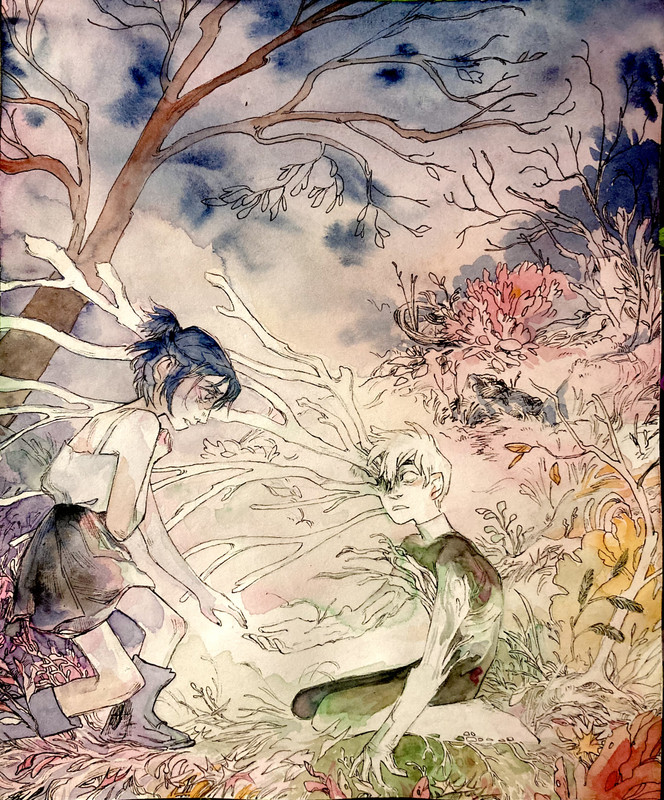
Strange-Growth took the reins again. Still with one hand raised, reaching out, it looked back at her with its unburst eye. It curled its branches toward her, another reaching. It was unsure of the expression it was making—it imagined only that it was some approximation of what it had before felt, in that greenhouse, without a face to express. It looked at her now, breathless, blooming, in the way it had felt then: as that tiny, fragile, leafless shoot in her grasp, so carefully caressed.
Hand-and-branch, held out, lingered.
The Cultivator, with one hand, not trembling, reached back.
—
Cultivator!
O, Cultivator! Thank you!