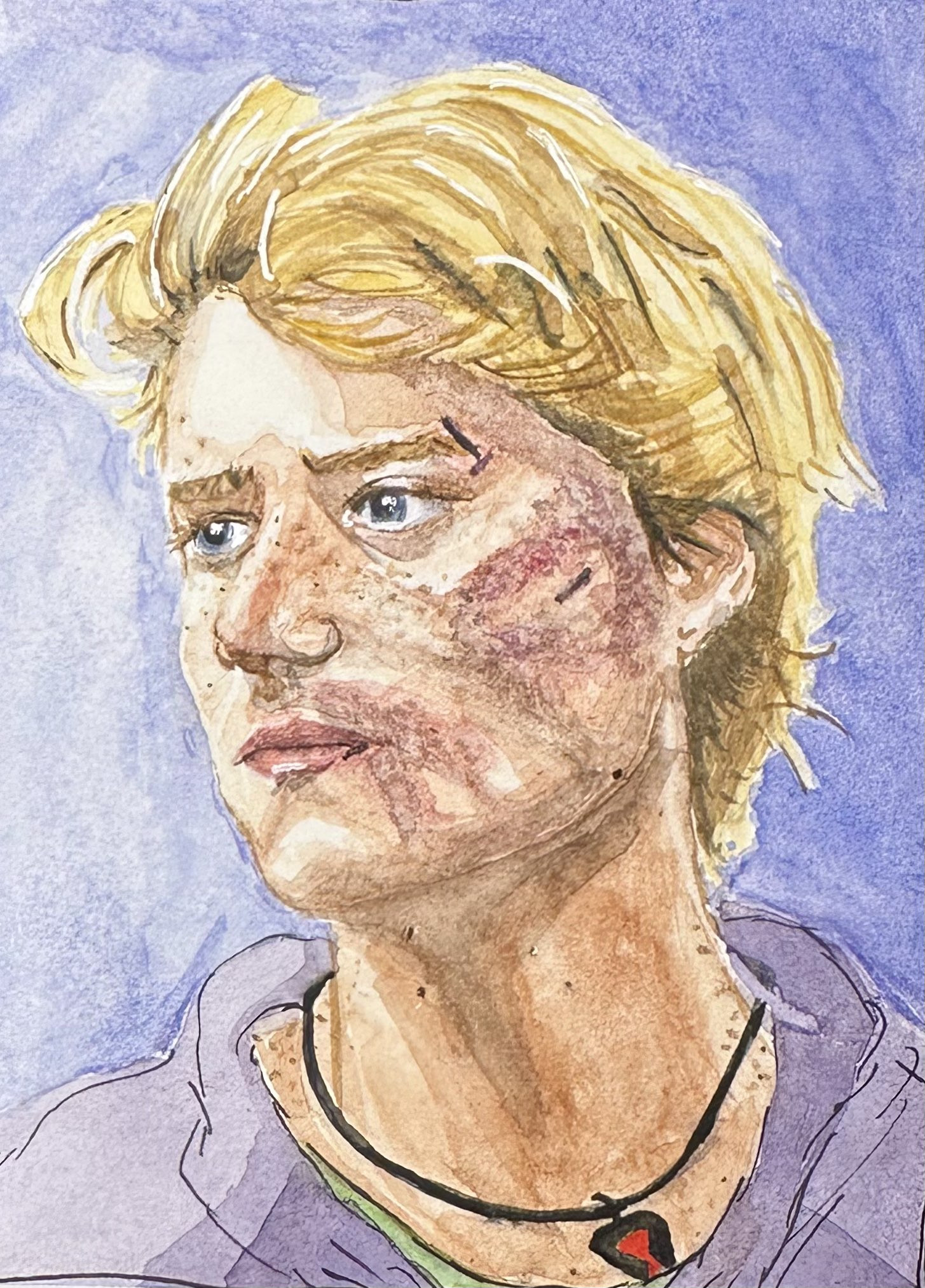
Chapter Text

Natasha has a policy about talking to her neighbors: don’t.
Don’t ask questions. Don’t answer questions. Don’t let them think they know you. Don’t let them see your weak spots. Don’t trust them.
Nothing personal, of course. That’s also her policy when it comes to the rest of the world. But it’s especially important when she’s home; this is the one place where she lets her guard down, where she lets herself be tired and soft and lazy and imperfect.
It’s just her and sometimes Yelena, when she’s home. She has no intention of letting that change.
Someday she’s going to buy an actual house deep in the woods, with a privacy fence and a security gate and no visible neighbors. She doesn’t need any of the traditional markers of success; just privacy, safety, and enough money to pay Yelena’s tuition to Juilliard without working every day of the week.
Realistically, it’ll be her student loans, because this won’t happen until well after Yelena has graduated, but a girl can dream.
Maybe someday she’ll adopt a cat. Taking care of a useless creature is something that only rich people and lonely suckers do. Right now, companionship is not worth the vet bills, but someday when she has the financial or emotional resources, she’ll be able to care for something other than herself or her sister.
For now, though, Natasha lives on the edge of the trailer park, in the last real lot. The ones at the very end are meant for long-term campers, but they’ve never been occupied for more than a week at a time since she’s been here, so she usually has a decent view of the scrubby patch of trees that separates the trailer park from the neighboring corn field.
She’s made herself a little oasis out back. A couple strings of Christmas lights twine around the railing of the stoop steps, and she has a pink plastic sun recliner, a small picnic table with an umbrella, and a pair of kitschy pink lawn flamingos that Yelena got as a joke; Natasha keeps threatening to throw them away, but she can’t bring herself to do it.
It’s not much of a yard, but she likes it. She likes having it to herself.
But one balmy Friday afternoon in late March, a tow truck drives up and backs into the lot next door, depositing a pull-behind camper in the space. A lanky, scruffy blond in a hoodie and battered sneakers hops out of the tow truck.
He waves and smiles until it drives away, and then he drops the pretense, taking in his surroundings as his shoulders slump. He sits down heavily on the doorstep of the camper and puts his head in his hands, taking big gulping breaths — exactly five of them, so deep his shoulders shake — before straightening up, raking his hands through his messy hair, and visibly steeling himself. He pulls out a keyring and for a moment it seems like he’ll go inside, but instead he pauses and abruptly turns around, shoving his hands in his pockets and heading down the gravel road that leads to the entrance of the trailer park. He’s walking with a barely-noticeable limp.
Natasha crosses the room to the window on the opposite side, and she watches him go. He scuffs his feet, kicking up little clouds of dust with every step.
She sighs and resigns herself to a few days of having her oasis invaded, and then she finishes getting ready for her bartending shift at the Shield. She’s been working there five nights a week ever since Peggy moved back to England, on top of six days a week tattooing at Tesseract, and the money is great, but it’s starting to wear on her; the last thing she wants at the end of a long night is to make boring small talk with yet another man who wants to stare at her tits and ask whether her tattoos hurt.
When she gets home later that night, there’s no sign of him — no lights on in the little camper— and she’s relieved. She takes off her makeup, changes into leggings, and heads outside, curling up in her pink chair with a cigarette.
Of course, the guy comes back before she can finish it. He’s weaving slightly when he comes into view, and the limp is more pronounced now. He almost walks right by the corner of his camper at first, and he does a double take when he realizes where he is, swerving abruptly. He’s silhouetted in the yellow glow of the streetlight, and it catches in his messy hair like the halo of a very unfortunate angel.
He hoists a smile onto his face when he sees her, raising a hand in greeting; then he trips over an untied shoelace, tilts forward with his arms windmilling, and somehow manages to turn it into a somersault.
“Oops,” he mumbles, swaying on the spot as he steadies himself, giving her a sheepish grin.
“Impressive,” she says mildly.
“You should see me juggle.” He shoots her a pair of half-hearted finger guns, and she raises her eyebrows, incredulous.
“I’d like to see that, actually.” When he glances around as if searching for something to juggle right there and then, she adds, “Maybe tomorrow.”
“I can do that,” he says happily. “Just one of many useless skills I offer. Clint Barton.”
“Hmm,” she says noncommittally.
When she doesn’t offer her name, he shrugs as if to say, “fair enough.”
“I’m not staying,” he says. “Just long enough for my truck to get fixed. Hopefully just the weekend — they said they’d be able to look at it first thing Monday, so. Yeah. I’ll be out of your hair.”
He pats his pockets and fishes out his keys, jabbing them unsuccessfully at the doorknob a few times. Natasha fights the urge to just take the damn keys and do it for him.
When he manages to get the door open, he pauses on the step to give her another awkward little wave.
“Sweet dreams,” he says, with a crooked grin. It’s very endearing, and it pisses her off.
That’s a good way to sum up Clint as a whole, really.
Over the course of the next few days, she learns that he can, in fact, juggle. He can also walk on his hands, do card tricks, pick locks, fold an assortment of origami animals, mimic certain bird calls, and drink a lot.
She doesn’t ask any questions, but neither does he. He minds his own damn business, which is why Natasha tolerates him.
He’s interesting, though — part of it is the way he very clearly tries not to be interesting. It reminds her of who she used to be. He tries to make himself as unassuming and inconspicuous as possible, tries to be one of those bland, forgettable people who aren’t threatening or remarkable in the slightest.
When he tells her he might be sticking around after all, he’s about halfway through a bottle of whiskey. He’d set up two camping chairs and a cooler in front of his door, facing her pink plastic monstrosity, and they’ve been sitting there shooting the shit for the better part of an hour when he tosses it out there like it’s nothing: “Looks like you’re stuck with me for a little longer.”
“Oh?”
“Can’t afford to fix the truck right away. Gonna help out at the shop a bit, try to work some of it off, but… gotta find a job, save up until I can pay for the parts. Shouldn’t be too hard, though.” The hitch in his voice is barely noticeable. “Worse places I could’ve ended up, right?”
“I suppose there are.”
He doesn’t seem to know what to say after that. He whistles a line from the Mr Roger’s Neighborhood theme song, making a face, before asking, “So if I’m stickin’ around, does that mean I get to know your name? I’ve just been calling you Marilyn in my head.”
“Marilyn?”
He gestures at the piercing over her lip, and she laughs.
“I suppose I’ve been called worse. Marilyn it is.”
“Well, if you hear about any jobs that might want a guy with very little work history and a whole lotta useless talents, send ‘em my way,” he says, with a self-deprecating chuckle. He puts the cap back on the bottle and flips it up in the air like he’s juggling bowling pins.
She doesn’t ask questions, but she learns who he is anyway, against her better judgment.
There are green flags: he doesn’t stare at her tits or try to hit on her. He doesn’t raise his voice or use his height as an intimidation tactic. He respects her boundaries, doesn’t pry, doesn’t try to talk about his feelings or her past.
There are red flags, too. He’s not half as stupid as he wants her to think he is. Several of his “useless talents” are the skill set of someone who has a lot of practice with the art of petty theft. He’s good at deflection, but his poker face is for shit — although maybe it’s just because she keeps catching him with his guard down.
That last problem is mutual. She’s not sure how to put him at a distance now that he’s gotten close enough to see her without her war paint on.
He gets all self-deprecating and flustered in a way that she’s pretty sure is genuine. Either he’s very good at pretending not to be anything special, or he actually believes he’s nothing special, and Natasha’s not sure which is worse.
One morning, as she’s getting ready for work, she sees him trying to feed the stray dog who skulks around the edges of the trailer park sometimes. It has one eye and too many visible ribs, and she’s seen a few people try to catch it, but none of them have succeeded.
Clint, though — Clint sits off to the side of the camper, holding out a leftover pizza crust with a small, lopsided smile, and she doesn’t see him move in the entire time she’s getting ready. He fidgets almost constantly, and seeing him like that takes her by surprise.
The dog circles for so long Natasha has time to go apply her makeup and curl her hair; it’s still hovering when she glances out the window again. She doesn’t want to walk out and startle it, but she has to get going. Just as she’s about to give up, the dog darts forward and nips the pizza crust with surprisingly delicate teeth. Clint beams.
The dog is gone in a split-second. Clint seems to remember where he is, and the smile fades.
She sees him in town a day later, using the pay phone across the street as she leaves the tattoo shop for lunch. He dials, but then hangs up and slumps against the wall for a moment, digging the heels of his hands into his eyes. His shoulders rise and fall with a few deep breaths.
Then he tries again — she can see it in his body language, the moment the voicemail recording starts, because his shoulders sag — but he leaves a message, flipping a coin between his fingers idly while he talks, scrubbing away tears before leaving.
So apparently he does have someone to call, and they’re just not picking up.
He’s very good at pretending to be careless. He always smiles when he knows she’s watching — when he knows anyone is watching — but she spots glimpses sometimes: puffy red-rimmed eyes, moments where he can’t seem to catch his breath. He’s good at distractions: a question, a joke, a goofy bit of slapstick to throw her off the scent.
One day, she watches from the doorway as he sits outside with the skinny goth girl from across the road, showing her how to do a ghost count.
“People make assumptions, right?” he says, watching as she keeps her eyes trained intently on his hands. “Attention is a spotlight. The brain makes connections and generalizations so that it can put more energy elsewhere, and if you can manipulate that focus —” He snaps his fingers abruptly, and then his other hand pulls a card from behind her head. “— people won’t notice what you’re up to.”
The girl laughs, delighted.
Natasha’s never even seen her out of her trailer before. It’s been a week; he already seems to know more of their neighbors than she’s met in three years. It makes her want to be nicer. Like many things about him, it’s irritating.
“Wanda, right?” she asks quietly, and the girl’s head whips around so quickly it must hurt her neck.
Wanda nods hastily, mutters to Clint, “Thank you again,” and takes off in a whirl of dark hair and cheap silver jewelry. Before Natasha can so much as blink, she’s gone.
“Wow,” Natasha says. “Am I that scary?”
Clint gives her a lopsided grin, doing a flashy one-handed swivel cut. “Yes, but only because you want people to think you are.”
She frowns at him, tracking the skilled movements of his hands and then glancing up at the dark hollows under his eyes.
She doesn’t like it when people think they know her. They don’t know her, he doesn’t know shit, but… it bothers her that he sees her so clearly. Maybe it was inevitable when he saw her here — the one place she thought she could be herself.
There are a lot of things she could say in response, a lot of ways she could manage him and keep him at arm’s length. She should ask how much he’s had to drink, or how many years he spent in the system, but instead she hesitates, tongue curled behind carefully painted lips.
“Wanda gets anxious,” he adds quietly. Natasha blinks.
She notices the two empty bowls on the top of his cooler, orange with the residue of what looks like mac and cheese. She notices the plastic tupperware of water under the edge of his camper, next to a carefully folded blanket that has a Milk Bone tucked in its center like a misshapen egg in a nest.
She doesn’t always trust kindness, but she’s found that there’s little to be gained by being kind to under-fed stray dogs and girls who don’t expect it. It’s been a very long time since she met someone like him, someone who gives without expectation, even when common sense would dictate that they don’t have enough to give in the first place.
She doesn’t ever remember being soft like him, but she’s very sure that if you dig down deep enough, he’s got a steely-strong core to match her own.
“I think you and I have some things in common,” she says quietly.
“You think I’m scary?” he asks, dry as anything. He gives her a small smile from under a fall of sun-bleached hair, pulling a bottle out from under his chair, and she doesn’t bother dignifying that with a response.
He offers her the bottle, and she shakes her head, fighting off a yawn. She has band practice.
The next day is a bad one. It’s been a long time since she had a day like this, where she wants to curl up and cry by the time she gets home; the only saving grace is that it’s an early night — Fury sends her home after she threatens the third guy who made an inappropriate comment.
Natasha’s uncomfortably close to her breaking point.
This time, when Clint offers his bottle, she takes it. It might be the worst vodka she’s ever had.
“I’m Natasha,” she says, wiping her mouth with the back of her hand. It comes away wine-red, and she reaches into her bag for a makeup wipe.
“Nice to meet you, Natasha,” he says, quiet and sincere.
“I’m going to change into comfortable clothes,” she says. They both pretend not to notice the wobble in her voice. “And then I’m going to bring out a bottle of vodka that doesn’t taste like rubbing alcohol, and you’re going to help me drink it. How does that sound?”
“Sounds like a plan,” he says, and doesn’t ask any questions.
And it’s stupid. It’s so, so stupid. She should know better than to get drunk around a near-stranger, no matter how safe she feels around him. But even Natasha gets lonely, occasionally.
Everybody needs to let off steam sometimes, or they’ll explode. Everybody has a breaking point.
When she wakes up on her couch the next morning, she has a splitting headache and no memory of how she got there, but there’s a note on the coffee table next to a bottle of ibuprofen and a glass of water.
Didn’t think you’d want me to see your room, so — couch. Sorry for the sore neck :(
The headache intensifies with the effort, but she manages to stir up a couple vague memories of telling him about Yelena. She remembers his big soft kicked-puppy eyes.
She also remembers throwing up on his shoes.
When she makes it outside, chin held high, she’s braced for whatever snarky comment he might make, but he doesn’t say a word; he just hands her a Pop-Tart and sips his coffee like it never happened.
She hands it right back to him and lights a cigarette. That’s not food.
“Sorry for getting my feelings all over you,” she says stiffly. “And… my stomach acid.”
He laughs, spraying Pop-Tart crumbs everywhere. “It’ll all come out in the wash, don’t worry. Shit happens.”
Natasha knows he’s not sticking around, but she thinks maybe it wouldn’t be so bad if he did. It’s been a long time since she let herself lean on anyone. She forgot how good it can feel.

Clint’s had unusually good luck in this town, all things considered. It could be so much worse. If he can’t find a job soon, he’s absolutely fucked, but… he’s not even going to acknowledge that as a possibility. He had enough in his stash of bills to pay for the tow, a spot to park the camper for a couple weeks, even enough left over for beer.
Most importantly, they’re letting him work off part of the cost of repairs.
He almost passed out when the head mechanic, Rumlow, told him how much it’d be to replace the transmission — it must’ve showed on his face. Rumlow hesitated for a moment, looking him up and down with unnerving intensity, before saying, “Look, you seem like a strong guy, and it’s fuckin’ impossible to find good workers around here, we’re always short-handed. Maybe we can work something out.”
As it turns out, Rumlow’s godfather Alexander Pierce is the owner of the garage and the used car dealership it’s attached to.
"We just have to keep this off the books,” he said apologetically. “You understand, don’t you? Can’t let it get out that my godson here has a soft spot for young men who are… down on their luck.” He and Rumlow exchanged a look that Clint couldn’t read, and it made the back of his neck prickle for a moment.
But then Pierce gave Clint one of the most reassuring smiles he’s ever been on the receiving end of — it was the way Clint imagines a grandparent might smile, like a hit of Xanax.
Anyway, Rumlow’s friendly enough, and he seems to know what he’s talking about, even though he can’t be much older than Clint. Apparently he’s been working with cars since he was a kid, and started working here before he was out of high school.
And it’s not like Clint has any option but to trust him.
He still sorta gets tunnel vision when he thinks about how many hours it’ll take. He keeps hearing Barney in his head: the fuck were you thinking, I told you it was a shitty investment, did you really think you could do this without me?
But it’ll all be fine. He’s gonna work some of it off, hang out for a couple weeks (a month or two, tops) and get a job, and he’ll be back on the road in no time, provided he doesn’t fuck anything up too catastrophically in the meantime.
If the circus sticks to their planned route, he can catch up with them, no problem. If he can figure out what to say — Barney won’t let him get left behind, not if he apologizes, makes up for it somehow. They’ll take him back. They have to; he doesn’t let himself consider any alternative.
When he starts thinking that far ahead, it feels like his head is buzzing with a whole goddamn swarm of wasps, so he tries not to think that far ahead.
He wipes oil off his hands, gives Rumlow the thumbs-up, looks around for the next job. Luckily there’s always another oil change.
There’s always a project, and there’s so much goddamn noise all the time. It bounces off the concrete walls and floor and gets all muddled up until Clint can barely tell one voice from another. He keeps his head down and laughs when everyone else does and keeps his hands full and never, ever says anything that might rock the boat. The morning passes quickly enough.
On his way out, Rumlow waves him down and asks if he wants to get a beer later.
“I can’t tonight,” Clint says apologetically. He promised Natasha he’d go see her band.
“Aw, c’mon, Barton, don’t be like that. Bout time you came out with us, got to know everybody.”
“I’ve got plans. Another time?”
“Sure,” Rumlow says, and claps him on the shoulder with a little more force than necessary.
Clint’s neighbor Pietro — Wanda’s twin brother — works at the garage, too, and the garage is only open a half-day on Saturdays, so they walk back to the trailer park together. The garage is a fifteen minute walk when he’s on his own, but it goes quicker than that when he’s with Pietro. He’s good company, just as outgoing and snarky as Wanda is quiet and sweet. Pietro talks a mile a minute and walks even faster, speeding right along in his tracksuit, rambling about the latest news from home.
Clint’s not sure how Pietro and Wanda ended up here , but from what Clint can tell, it has something to do with the civil war that’s currently raging in their home country, Sokovia. Wanda is some sort of hacker who may or may not work for one of the more rebellious factions at work there, but Clint hasn’t really gotten a straight answer about it; both siblings start to look a little shifty when the whole thing comes up.
Pietro clearly misses it, but he talks about it like he can’t go back. Clint tries not to identify too much.
When they get to the entrance to the trailer park, Clint waves goodbye to Pietro and stops at the skate park across the street to say hi to Kate, another new acquaintance. Clint would like to think that they’re friends, but she would probably disagree.
She’s here almost every day, with bleeding palms and a giant chip on her shoulder; even when the weather is shitty, she’s usually at one of the picnic tables under the shelter next to the half-pipe. She’s been helping Clint feed the stray dog who skulks around the edges of the trailer park.
As he approaches, he sees Kate wipe out spectacularly, tumbling and skidding a few feet with a shouted curse, and his heart just about stops. When he runs down to check on her, though, she scowls up at him, jaw tight, clutching one arm to her chest.
“M’fine,” she grits out.
Clint looks at her red cheeks and then over to the knot of guys watching from the other side of the park — one is snickering contemptuously, rolling his eyes in their direction.
“You know you’ve got nothing to prove to those assholes, right?” he asks, as she gets to her feet, blowing her long purple bangs out of her eyes with a huff.
“Easy for you to say,” she mutters. “They already think I’m a fucking poser.”
“What? Why?”
“Apparently girls only skate to impress guys.”
“Yeah, clearly you’re out here every day busting your ass because you want some of that sweaty stoner pencil-dick,” Clint says, and that gets a snort from Kate as she examines her bloody elbow.
Clint goes to retrieve her board, and he can’t resist showing off a little bit, doing a few kick-flips to test his muscle memory before trying a handstand.
“Not bad,” she says reluctantly. “Still creepy that you’re trying to be friends with a teenager. You’re old .”
“I’m twenty-three, I’m not exactly the Crypt Keeper,” he protests, half-laughing.
He’s seen her turn her back and walk away from some people with nothing but a middle finger aimed over her shoulder; he knows they wouldn’t even be having this conversation if she didn’t actually want to talk to him.
She scowls at him for a second before asking, “Are you gonna get weird and try to fuck me? Because ew. Not gonna happen, dude.” She hesitates before adding a belligerent, “I’m, like, real fuckin’ gay.” Then she tilts her chin up defiantly, fists clenched at her side like she’s waiting for an argument about it.
“Yeah, no, ew.” Clint gets distracted wondering how many times she’s had that argument before adding, “No offense.”
“So why the fuck are you always here?” she demands.
“Better than going home, I guess.”
She chews on her lower lip, shoulders lowering from where they’d been tensed up around her ears. “Yeah, okay.”
“Why are you always here?”
“Same,” she says, scuffing one of her beat-up Vans against the concrete. “Hey, can you teach me how to do a handstand?”
“Only if you get kneepads and a helmet first. Also, elbow pads. Speaking of, let’s go get you patched up.”
“You don’t have to —”
“Yeah, I know. C’mon.”
“Handstand?”
“Padding.”
She gives him an eye-roll that’s so bratty it deserves awards. She’s truly a master of the art.
“Fine, god.”
She gets her backpack off one of the picnic tables and fishes around in it for a second as they walk, passing him a box of dog treats.
“Aww, Katie-Kate, you didn’t have to do that,” he says delightedly.
She wrinkles her nose and says, “It’s not a big deal. My step-mom’s stupid chihuahua is on a stupid diet, anyway, it’s not like she needs them. Also, don’t call me that.”
Clint accidentally notices the price on the box of dog treats and tries not to let his shock show on his face.
Well, he’s not going to look a gift horse in the biscuits. He’s been trying to befriend the stray ever since he got here, and it still won’t linger long enough to let him pet it.
And at least Kate is starting to warm up to him. At first, she just curled her lip and gave him shit whenever he tried to talk to her.
Clint sits her down in his camping chair and grabs the first aid kit, trying not to look around at the mess. After he gets her bandaged up, he brings one of the fancy dog treats over to the edge of the park, where the mowed grass gives way to brush and bushes.
The stray is starting to look a little less emaciated, at least, so he must’ve been eating the food Clint keeps putting out behind the camper every night. His tail wags when he eats the first biscuit, and then he sniffs around a few times, keeping his one eye trained carefully on the two of them. He approaches cautiously to take a second treat out of Clint’s fingers and then hesitates for a moment before skittering off for the trees again.
He almost always comes in for a treat without hesitating, now. He still won’t let him pet it, but Clint can’t really blame him for that. He knows how people can be; he’s sure there’s a good reason the dog’s shy.

Penny & Dime is already crowded when Clint gets there and gives his name to the guy at the door. Natasha described her band as “mediocre,” said he’d be doing her a favor by showing up tonight, but it’s sold out; apparently they’re opening for a band who is pretty well-known.
The place is the fun sort of divey, with a dartboard, an old pinball machine, and Big Buck Hunter crammed along one wall of the bar area, which also has a tiny menu of greasy food. There’s a big arched opening in the back wall, where the stage is visible; it’s separated just enough that you can almost hear yourself think in the front space.
The stage is waist high, and it barely has room for a drum kit and the massive guy who’s sitting behind it. Clint spots Natasha fiddling with her bass while the guitarists talk. Natasha’s wearing a low-cut, off-the-shoulder black shirt with her high-waisted jeans, and for the first time, Clint can see the chest tattoo that he’s only caught glimpses of: a spiderweb that spans from her collarbones down between her breasts, with a black widow spider at the center of the web.
She has others that are usually on display, too: roses and moths and skulls, all up and down her arms, and a matching set of ornately detailed pistols on her forearms. They were mostly done by Carol, her mentor/boss. They’re all beautiful, but Clint’s favorite is the one she showed him when she was drunk and talking about her sister; apparently it’s drawn like a famous painting that Clint’s never heard of, but it’s just a sketch of a ballerina on her ribs.
Clint’s abruptly aware that he sticks out like a sore thumb, and he doesn’t like it. He’s good at making himself inconspicuous, and in most crowds, he would be, in his faded jeans and Star Wars shirt. In here, though, he’s the odd man out. Everybody seems to be wearing black and studded denim, and he can see hair in every color of the rainbow.
Before he can get too self-conscious, though, there’s a squeal of feedback and a tiny blond guy steps up to the mic.
It’s not the sort of thing Clint’s ever listened to before; his taste is weird and eclectic, but it tends toward hair metal and pop and old-school country. He even took up drums in high school jazz band, the two consecutive winters when they spent January and February in Florida, as a way to impress a cute girl. This is different, though. It’s fast and rough and raw, and it’s angry.
And yeah, okay, they’re not very good, but Clint sorta feels like that might not be the point. There’s enough feeling in the singer’s voice to make up for it.
The band doesn’t move around much, maybe doesn’t have space for it, but there’s a circle of kids at the front, thrashing around and slamming into each other like they’re playing hockey — they’re doing it on purpose, and it’s violent, but nobody seems to mind. Part of Clint wants to get in there, to lose himself in the crowd and see if the movement might calm his racing thoughts, but he mostly hangs back, drinks his beer near the bar, bouncing his foot with the breakneck rhythm of the drums.
“We’re the Avengers, and this is our last song,” the singer says brusquely, after what feels like barely any time at all.
When it’s over, Clint’s ears are ringing, and the air feels thick with stale sweat and spilled beer — the place is packed, now, and everyone gravitates toward the bar when the music ends, swarming around Clint and packing in close. He gets more than one sideways stare, and he’s reminded, again, that he doesn’t quite belong here.
He pushes against the tide, toward Natasha, who smiles when she sees him and gestures for him to wait — she’s packing up her gear, quick and efficient. When she’s done, she hops down from the stage, cracking the cap off a bottle of water and downing half of it in one go.
Clint follows her over to the merch table, where the singer is delivering a very intense monologue about the prison system to a teenager who looks increasingly overwhelmed. Natasha exchanges a look with the drummer, who introduces himself to Clint as Thor. Apparently his brother, Loki, is the lanky, black-haired guitarist.
The singer is named Steve, and “This is pretty much par for the course with him,” Natasha says wryly, before they’re interrupted by someone who wants to buy a sticker from her. Clint hovers for a bit, until Natasha leaves him on his own again to load up the van.
“Stick around,” she tells him. “The Valkyries are pretty good.”
“I could help,” he offers, trailing after her, but she shakes her head.
“Stay. And just — go with it, y’know? It’s fun, when you let go.” One last smile over her shoulder, and then she’s gone, hopping back on stage and heading toward a back door.
Clint takes a moment to wonder how often Natasha actually lets herself go.
By the time the next band is done tuning their instruments and plugging in their amps, the crowd has filled in around Clint. He has just enough time to wonder whether he should move toward the back when the singer abruptly steps up to the mic.
There’s a sudden, stifling press of bodies, pushing him forward until he can barely breathe, then back again, and he almost loses his balance along with the last of his beer. For a moment, he panics, startled, but then instinct kicks in; he plants his feet to brace himself, standing his ground. People keep smashing into him, tugging him and shoving him in one direction and then the other, pumping their fists, singing along…
He’s relieved to find the crowd thinning, until he looks around and realizes he’s right on the edge of that space where people are circling like a human maelstrom, thrashing around and careening into each other. The other people on the sides don’t seem to care; whenever someone runs into them, they shove them back, so that’s what Clint does too. He finds the rhythm, lets himself go with it — jumps, bangs his head, puts his hands up.
Then he gets shoved at exactly the wrong moment, flailing and twisting, and feels the sharp impact of his elbow connecting with someone’s face.
“Fuck,” Clint says, not that anyone can hear him — the guy almost goes down, but Clint grabs him, steadies him.
The crowd is still frothing around them, crashing into them like waves, but for a second Clint manages to hold eye contact. He gets a glimpse of flushed cheeks and big eyes as the guy shakes long brown hair out of his face. He has a slim silver ring through one side of his lower lip — the opposite side is split and starting to bleed.
“Are you okay?” Clint yells, heart hammering. “Sorry!”
“S’fine!!” He wipes away blood with the back of one hand and shrugs like he really means that, flashing Clint a red-tinted grin before twisting out of his grip.
The smile throws Clint off-balance even more than the crush of bodies did.
He’s having trouble breathing, and his ears are ringing, so he makes a break for it, sliding sideways through the crowd and trying not to do any more damage along the way.
He can’t really afford to pay for drinks right now, but he’s abruptly craving a beer and something to do with his hands, so he heads for the bar and orders a PBR — he hates it, but it’s the cheapest beer they’ve got — from a guy with burn scars and a manic grin. He sits and watches for a few minutes, and he considers leaving. There’s a whole lot of restless energy making him jittery, and the walk would burn some of it off, at least, but then he thinks about going home to his quiet camper.
A couple minutes later, Natasha makes her way through the crowd and perches at the bar next to him. She’s actually flushed, wispy tendrils of hair clinging to her cheeks, but she still looks about a thousand times more composed than anyone around her.
“What do you think?” she asks.
“I think I like it,” he says, honestly. “But it’s not like I’ve got anything to compare to.”
Natasha barks out a laugh and gives him one of those piercing, assessing stares. “First show?”
He nods and shrugs. “Unless dive bar karaoke or a country covers wedding band count.”
She orders two beers before Clint can insist he doesn’t need another, and she waves away his attempt to pay.
“Frank’s not paying us enough for this,” she says wryly. “So a few drinks is the least he can do. Right, Frank?” She raises her voice pointedly on the last sentence, and one of the guys behind the bar — a barrel-chested guy with neck tattoos and a nose that looks like it’s been broken nearly as often as Clint’s — scowls in her direction. She tells Clint, “I gotta hang at the merch table for a bit, but if you hang around, I can give you a ride home.”
“Take your time,” he says, and watches her weave through the crowd.
“How do you know the black widow?” asks the guy with the burn scars, gazing in Natasha’s direction. “Hi, I’m Wade.”
“The — what?”
“The black widow. You know, ‘cause of the —” He gestures at his own chest, and Clint remembers the tattoo.
“She’s my neighbor,” Clint says.
“Is her make-up really tattooed on? Is she really a secret ninja assassin?”
Clint turns his laugh into a cough and deadpans, “I did see her slit a guy’s throat with a playing card one time.”
“That woman terrifies me and I adore her,” Wade says fervently.
“Wilson, come get this chimichanga before I stuff it up your ass,” Frank barks from the grill window.
“Don’t threaten me with a good time.” He turns back to Clint and says in an undertone, “Seriously, please let her know that she is welcome to step on me literally any time.”
“Next time she’s training with her throwing stars, I’ll put your name in as a practice dummy.”
Wade makes an obscenely appreciative noise, and Frank gives him a look of disgust that could strip paint.
It’s funny, though — he’s seen a few people look at Natasha with a sort of wide-eyed awe, like she’s a mythical creature. He can tell that she doesn’t do anything to discourage them, but it’s strange to think of her the way other people seem to, all perfectly painted and ice-cold.
After he’s done with his beer, he goes to the bathroom, which is literally covered in graffiti. When he comes back, the band is finishing their last song, walking offstage to cheers, and the small bar is suddenly mobbed.
Clint sees a familiar face when he gets close: the guy he elbowed in the face during the show. One side of his mouth is swollen, starting to bruise, and Clint’s gut twists with guilt.
The guy brightens in recognition just as Frank hands him a plastic baggie full of ice, and Clint grimaces apologetically.
“Hey, sorry about that,” Clint says sheepishly. “Fuck, I feel like an asshole.”
“No biggie,” he says. “I’ve had worse.”
His voice is low and soft, rough like he shouted himself hoarse. He tucks an errant lock of hair behind his ear before applying the ice pack gingerly. His fingernails are painted, chipped black, and Clint’s never seen a guy wearing nail polish before.
“Can I buy you a drink?” Clint asks. “Least I can do… considering.”
“I don’t drink. But you could come sit with me while I drink some water.”
His eyes are smudged with eyeliner, making their icy blue-gray stand out, startlingly bright — Clint’s never seen a guy wearing makeup, either, aside from the greasepaint the circus uses on stage. Clint realizes he’s staring, and he clears his throat, tries to look somewhere else, flustered.
The guy doesn’t seem to care, though. He’s smiling; the corner of it is just barely visible around the ice pack, but Clint can see it in his eyes, too.
“I’m Bucky,” he says.
“Is that really your name?”
Bucky raises an eyebrow, and Clint’s already opening his mouth to backpedal when he grins and says, “No, my parents don’t hate me that much. It’s a nickname.”
“Clint.”
“Nice to meet you,” Bucky says. He holds out his hand.
Clint takes it, and then he notices the scars: little ones that cross-hatch his wrist like faint white tiger stripes, and a larger one, perpendicular to the rest, the raised tissue knotted and shiny and obvious. He stares for a second before he catches himself.
Bucky doesn’t flinch away, doesn’t withdraw his hand or try to hide, but he seems to be waiting for Clint to comment on them, almost resigned as he meets Clint’s eyes with a little half-smile.
There’s something about him — his open, steady gaze — that makes Clint want to hold onto his hand just a moment longer than he should, but he lets go.
“What’s your tattoo?” he asks, glancing curiously at the ink visible under the sleeve of Bucky’s black v-neck shirt.
“Til the end of the line,” he says, and shows off the upper part of his arm, which bears a crooked red star. “My best friend — Steve, the singer? He got his tattoo license not too long ago, and it was the first one he ever did on a real person.”
“You volunteered for that?” Clint asks.
Bucky wrinkles his nose, smirking. “He offered to do a touch-up, even it out a bit, but I’m keeping it this way. Keeps him humble, y’know?”
“And the other?”
He angles his body so Clint can see his right arm. There are a few small pieces partly visible, plus the edge of something curling along his collarbone, but Clint’s curious about the one on his right bicep: a red ball and what Clint’s pretty sure is a croquet mallet, with a banner that reads “I’m okay (trust me)” in script.
“Do you know that song?” Bucky asks, accurately interpreting his puzzled look, and Clint shakes his head sheepishly. “What kinda music do you listen to?”
Clint shrugs. “Never really listened to much, I guess. Radio. Classic rock, country…I’ll try anything once, though.”
Bucky makes a face. “Seriously? What are you doing here, then? I mean — shit, that came out real fuckin’ bitchy, sorry.”
“No biggie. Just never had a chance, really.” Bucky frowns like he wants to ask questions, so Clint cuts him off: “Tell me about yourself. Are you from around here?”
They end up talking for a few more minutes, as the venue starts to empty out around them. Clint learns that Bucky’s twenty-two, about to graduate from school with a music degree, and that he teaches kids music at a summer camp called School of Rock.
Eventually, Natasha flags Clint down, and Bucky mutters something about finding Steve. He hesitates before he goes, like he wants to say something, but instead he just gives Clint a small smile and a wave.
“See you around, maybe?” he says, and leaves before Clint can say that he’d really like that.
As they head out to Natasha’s car, a retro Spyder, she tells him, “Frank’s thinking about hiring somebody, if you still need a job. I was working here part-time, but I started picking up more shifts at the other venue I work at — money’s better. This isn’t a bad place to work, though.”
“Yeah, I mean — that would be great . Should I just come in and ask tomorrow?”
“No. Let me put in a good word for you and warn Jones that you’ll be coming, otherwise she’ll chase you off and possibly make you cry.” She catches Clint’s expression and rolls her eyes. “She just likes fuckin’ with people.”
“Thanks,” he says. “For that, and tonight.”
“I don’t mind having you around.”
Clint grins. High praise, from her. “Thanks. Oh, by the way, somebody asked me if you’re a secret ninja assassin.”
“What did you tell them?”
“That I saw you slit a guy’s throat with a playing card once, but that I could neither confirm nor deny anything.”
She looks oddly touched by that.
“You’re not so bad, Barton,” Natasha says, and then she yawns so wide her jaw cracks as they pull up in front of her trailer. “See you in the morning.”
“Night,” he says, and waves to Natasha before the door closes behind her.
Clint isn’t ready to go inside, so he climbs the ladder up to the roof of the camper. It’s a little easier to breathe up here, sometimes. He wraps his arms around his knees, hugging himself to ward off the shivers in the cool spring night, and looks up at the stars.
It’s not so bad, right? He has a job, and he’ll get his truck back, and he’ll chase after the circus until Barney forgives him, and in the meantime he has people to talk to and a place to sleep.
It’s going to be fine, but he’s fucking lonely.
He wants to be back where he knows his place — where there’s always a job to do, a routine to learn. With the circus, at least he knows the rules, and he knows how to blend in. Nobody there gives a shit what he’s done, so long as he pulls his weight.
He’s so lonely it hurts.
But it’s his own damn fault. Clint fucked up. He can’t blame them for leaving him.
Maybe if he repeats it often enough, he’ll start to believe it, so he tries it again: everything is going to be fine.
He’s fine.