
Chapter Text
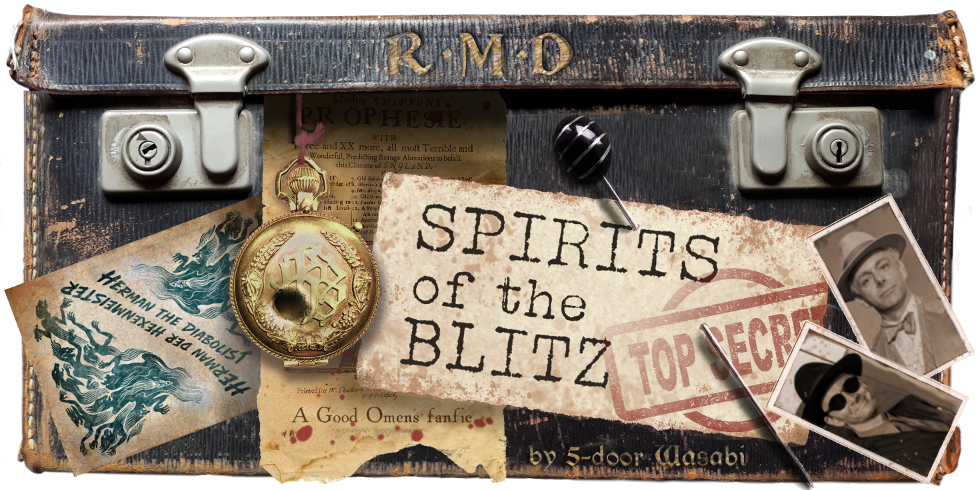
Notes found in a case bought at a church jumble sale, c. 2020
It is an old spymasters’ dictum that no-one who volunteers to be a double agent can be thoroughly sane.
This is because in general, what you need to do to become a double agent is to fail at being an ordinary agent (to be fair, you can also have the bad luck to be compromised before you arrive in enemy territory). You then get captured and handed over to counter-intelligence, choose co-operation over death, and transmit misinformation back to your former handlers, omitting any pre-arranged signals that would let them know your situation. Double agents of this type are unhappy and scared, and have every reason to be. They live in safe-houses for months or years with no-one but minders and handlers for company, and sooner or later they realise that nothing is waiting for them once peace breaks out but a lifetime of looking over their shoulder. Those are the main run of double agents, and working with them is no fun at all.
And then, there are what the trade calls ‘walk-ins’. Walk-ins agree to train as spies for one side, but plan to defect to the other at the first opportunity, classically by going of their own accord to a police station as the least-worst way of making initial contact. Those people — the absolute lunatics who reckon they can lie to professional liars and win — are always one-offs, and they can be a great deal of fun, except for when they get themselves killed, which is frequently.
Forgive me. I’m starting to sound facetious and maudlin, a dire combination, but what can you expect of a clapped-out spymaster? My name is Regina Morley Diceman, I am eighty-three years old, and the year is 1998. I’m writing this after a variegated career as a wrangler of the Counter-Intelligence Beast (as hairy a creature as you might expect, and not nearly as clever as you might hope). I am writing it because when I die, I do not want my last thought to be ‘Through no merit of my own, I lived through one of the tallest tales of World War II, and I never told a soul’.
So I am telling the Twenty-First Century, as the Twentieth one peters out, and those of us who’ve lived through most of it eye its successor thoughtfully. I am telling you, pecking out words with my withered fingers on a temperamental typewriter. I give you fair warning that the tale contains elements of the supernatural, and even if you don your strongest Suspenders of Disbelief, I fear you’ll never believe me.
I fear? I know. You can’t believe me, dear reader, however hard you try. It would take a miracle for you to believe this story, so don’t feel bad about it. It’s enough, truly, that it gets read at all.
Since this is a story of spies, it’ll involve the nuisance of codenames, but I’ll try to stick to five. The first of these, Heaven help us, was Nevermore. The second, God bless him, was hastily dubbed Guardian for security purposes, though he never officially worked for either side. Then there was the opposing team, among which we number Harmony of the Abwehr, and the beautiful and ruthless Amulett. Since I’ve left one codename for last, you’ve anticipated that the final spy was me, so well done you. If trained my acolytes as strictly as my old boss Bunny Hopkins, I’d reward you with a ration biscuit — though it might be hard on the teeth, since if I manage to hide this report properly, no-one will read it until my ashes have been scattered on a beach in Devon, and I’m beyond the reach of the Official Secrets Act.
My nom de guerre was Tyche. That’s two syllables: tie-key, the Greek goddess who presides over matters of fortune. Awfully pretentious, but in my defence, I didn’t choose it. My higher-ups in the Special Operations Executive hoped the spies I worked with would think the name lucky. They needed all the luck they could get, for Station XX — my branch of the SOE — ran nothing but double agents, and Nevermore was one of my own.
But I’m running ahead of myself. Let’s talk about this case of junk of which you’re now the proud owner. Did you buy it? Or find it tucked away somewhere? At any rate, you picked it over, which makes you a first-rate nosy parker and a person after my own heart.
Its leather is so battered that it’s tricky to make out the initials on it: R.M.D. It’s obviously older than the Second World War, and if you guessed it dated back to the First, you’d be right. It constitutes the first of my exhibits that bind a tale of sorcerous happenings to the warp and weft of WWII, so I’d appreciate it if you treated it gently. It’s a family heirloom, you see. The initials are my own, but they’re also my father’s.
The second exhibit is the sheaf of notes you’re now reading.
The third is a gilt-metal case about the size of an Eccles cake, with a dent in it.
The fourth is a hatpin with an ebony head.
Finally, there is an American 30’s comic with a menacing cover, titled ‘Diabolical: Hot Off The Press!’.
Let us next peruse the comic, since that’s where my story begins. Its central tale — a rehash of the legend of Faust — isn’t highly original, but it may pique your interest that as far as I know, ‘Diabolical: Hot Off The Press!’ does not exist. Not in Britain, and not in America, not in the British Library, nor the Library of Congress. When collecting such stuff became trendy in the 60’s, I offered several dealers here and in the States a tidy sum for any edition of ‘Diabolical’ they could turn up. No luck.
Future reader, you are welcome to search for this work yourself. But I predict you’ll fail to find it, and if you take that as a sign that what you’ve come across is a prank by an eccentric forger, committed enough to go to elaborate lengths to sell their tale to an unknown stranger, you won’t be too far off the mark.

VON SCHALL OF THE REICH
{Panel 1: A lonely forest glade. Moonlight skims the dome of an ivy-clad building. A man in dark robes stoops before it, chalking a circle on the ground. The scene has the monochrome severity of a woodcut.}
Caption:
Germany, 1936. Midnight in the Black Forest, in the grounds of an old estate.
The great house is long gone, but its folly remains, fronted by doors of bronze.
Nobody dares come here after sunset. Nobody but one.
- - -
{Panel 2: The robed man finishes his Summoning Circle. The hood conceals his face.}
Caption:
The exception is this man — von Schall, Diabolist of the Reich.
Von Schall doesn’t fear a dark power lurks in this place. He knows it.
And now, he is paying it a house call.
SCHALL: Aba! Zaba! Zowathim! Creature of Hell, I command thee!
- - -
{Panel 3: Lightning lacerates the sky, framing von Schall in a jagged ‘BOOM!’. He doesn’t flinch.}
SCHALL: Serpent of the Elamites, come forth!
- - -
{Panel 4: The gates open with a ‘CREEEAAK’, and smoke emerges from the folly. It clears to reveal a Demon sporting a dressing-gown, and not a great deal else. His posture conveys irritation.}
SCHALL: Infamous spirit! I command that thou remain within my Circle of Summoning, and make rational answers unto my questions. Mephor! Zalor! Be bound!
DEMON: [Yawning] Rational answers? I hope you brought coffee. So, it’s Amateur Summoner week. And what godforsaken year might this be?
- - -
{Panel 5: The Demon surreptitiously tries to snap his fingers, and fails.}
SCHALL: It is nineteen thirty-six, time is short, I did not bring coffee, and — why are you in a dressing-gown?
DEMON: I was napping. If you wanted a dinner date, you should’ve specified. Also…binding sigils? Honestly. Where are your manners?
- - -
{Panel 6: From within his own robes, von Schall pulls out a leather flask marked with a cross. It goes ‘SLOSH’ as he lifts it.}
SCHALL: They are in here, my fiend. They are all in here. You will obey me.
- - -
{Panel 7: The Demon tries to retreat, but is trapped in the Circle. von Schall grins, and does not notice that behind the Demon, in the darkness, beady eyes are watching.}
DEMON: Holy water. Very well, I’ll grovel — for tradition’s sake. Who the Devil are you, and what the Hell d’you want?
SCHALL: My name, my good fiend, is von Schall, and what I want is time. Not for myself, but for the Thousand-Year Reich, which according to my calculations will shortly be at war. It involves a contract.
DEMON: Argh! Anything but this. If you want to sell your soul, try Malphas or Dagon. I’m a broad-brush operator. Not in the contracts business.
- - -
{Panel 8: A beady-eyed rat scampers from the door of the vault, between the Demon’s feet. He studiously ignores it.}
SCHALL: I already have a Contract, and it has served me well. In five years’ time, however, it will run out. I risk being dragged to Hell at the very moment the Reich needs me most. But I was informed at the time of signing that the Contract had a postponement clause —
- - -
{Panel 9: The Demon laughs uproariously, in sarcastic, spiked HA HA’s.}
SCHALL: I’m no fool. My damnation is inevitable; the timing is unfortunate. But you fallen angels love your pranks, and I believe that there is indeed a postponement ritual…in the small print.
DEMON: Huh. What’s the catch? Can’t you read it?
SCHALL: The small print is in Linear Elamite, which none alive can now decipher.
DEMON: Tragic.
SCHALL: That is where you come in. I have done research, and I know you lived as a god among the Elamites. Nak-Hayauda, Serpent of the Forsaken, deny your old name if you can!
- - -
{Panel 10: The Demon gives a theatrical ‘HISSSSS!’. Three more rats take the opportunity to scamper through the Summoning Circle, smudging part of it away.}
DEMON: That was a long time ago.
SCHALL: Indeed. Now we have better weapons against your kind. [He is holding the contract in one hand, and the holy-water flask in the other.] Make your decision quickly.
- - -
{Panel 11: Von Schall has handed the scroll over with tongs, and the the Demon is making a performance of studying it.}
DEMON: Hang on. You got signed up for a hundred years? I don’t know why you’re moaning, this is a better deal than Faust got. And you don’t look bad for someone who’s pushing a hundred and thirty.
SCHALL: One hundred and thirty-three. I’ve not spent my time idly. Now, is there a method of renewal? Speak.
DEMON: The thing is, if I tell you the method, and you manage to meet the conditions, the Contract transfers itself to me. Like I said, I’m not in the Contracts business — and you really do not want me as your personal demon. I can be scarier than this.
- - -
{Panel 12: The Demon peers closer at the small print. More rats cross the border of the Summoning Circle, now much the worse for wear.}
SCHALL: You are trying to bluff a man who has nothing to lose. Stop wasting my time.
- - -
{Panel 13: The Demon glares defiantly. Smoke rises from beneath his feet.}
SCHALL: Enough. Remember where you stand, Nak-Hayauda, and speak truth. Swear it!
DEMON: I ssswear it.
SCHALL: Very good. Now tell me the method, or die.
- - -
{Panel 14: Von Schall has uncorked his holy-water flask. He holds it meaningfully.}
DEMON: Fine, fine. I’ll translate. Not that it makes much difference. First, you must offer the blood of a traitor—
SCHALL: And this simple act will postpone my damnation? What marvellous news!
DEMON: I’ve not finished. This is a three-course operation. Second, you must offer the blood of — oh dear — someone who loves you.
SCHALL: Even I have my charms. Proceed.
DEMON: Third, you must offer the blood of an innocent. All in one night, and on an altar. The innocent can’t be a child, by the way. You must kill an adult of genuinely pure heart, and how many of those are out there, hmmm?
- - -
{Panel 15: The stream of rats has now all but erased the chalk circle, but von Schall is too intent to notice.}
SCHALL: That is a tough one. Perhaps I should start a charity newsletter.
DEMON: Your contract will catch up with you sooner or later. Release me, and I’ll do my best for you when the time comes. You won’t get a better offer.
SCHALL: Tempting, dear demon, but implausible. And now…perish!
- - -
{Panel 16: Von Schall flings his flask into the circle at the same moment the Demon SNAPS his fingers. The flask splits with a SPLASH! where the Demon was standing, but the chalk circle has been erased by the rats, giving the Demon a fraction of a second to escape. It is not entirely clear if he managed it.}
- - -
{Panel 17: Von Schall turns around slowly. Out of the darkness, beady eyes are watching him, and the moonlight picks out whiskered snouts.}
SCHALL: Rats! [He snatches up his Contract, and runs for his horrible life.]
Now we’ve got that out of the way (but I hope you’ve committed it to memory, for I’ll be testing you on it later), I resume the burden of my tale.
In the late summer of 1940, I wasn’t a clapped-out spymaster, but an ambitious one in my mid-twenties. You may well wonder how one gets into this line of work. In my case, it was by two somewhat shameful accomplishments. The first was speaking German (the last letter that my pa, the late Reverend Diceman, had sent to my mother in 1915 expressed a wish that his unborn child should learn the language ‘in the hope that no such war ever happens again’). The second was by taking myself out of the Women’s Forestry Corps just as it was getting started, by falling ignominiously off a ladder.
There was no use cursing one’s luck, and I wasn’t given time to do so. No sooner had the medics done all they could for my hip, and some observant soul discovered I had spoken and written knowledge of German, than I was whisked off to join the FANY (the First Aid Nursing Yeomanry, and whoever thought that was a good acronym should probably be shot). I protested that I hadn’t a nurturing bone in my body, until it became clear that the FANY contained very few actual Nursing Yeowomen.
The FANY was, among other things, a cover organisation for female intelligence officers of the Special Operations Executive — the ‘Special Operations’ in question being espionage. It was under the SOE’s aegis that I was trained to serve in Station XX (that’s Station 20, if you’re not Julius Caesar) which organised Britain’s crew of double agents, and was otherwise known as Operation Double-Cross.
It didn’t get that name by accident. The fact that Operation Double-Cross was run by Station XX was an in-joke. Of course, in-jokes were a security hazard, something I was rapped over the knuckles for pointing out, for while I wasn’t the rock bottom of Station XX’s byzantine hierarchy, I was in the sedimentary layer of the middle third. At the summit was Lt. Col. Thomas Argyll Robertson, whose tartan trousers had earned the codename ‘Passion Pants’ from a host of lovestruck FANYs. Below him were a bunch of misfits he’d recruited from the Old Boys’ Network, and below them were men with military experience. Somewhere in that lot was my boss, ‘Bunny’ Hopkins — nicknamed not for any physical resemblance, but for his ability to extract valuable intelligence from shit — and dangling precariously from his good graces was Regina Diceman, whose name had been mud ever since she’d suggested it might not be the best plan to give a double agent called Kurt Goose the codename ‘Gander’.
Girl Guide’s Honour, it’s true. One day the Official Secrets Act will back me up on this.
Imagine the sort of folk who can’t resist wordplay when sending someone the Nazis sent to spy on you back to spy on them, and you’ll have an idea of what Station XX was like. I wasn’t much better, though when I was given a socialite who was less concerned with being captured by Nazis than in rehoming her Pekingese, you can bet I didn’t name her ‘Bourjois’ or ‘Martini’. My job consisted of trying to persuade impossible people to do improbable things for peculiar reasons — but luckily, the Diceman family had produced vicars and vicars’ wives for centuries. Although I was the sceptical black sheep of this holy flock, I discovered I was good at persuasion, and when occasion called for it, I wasn’t too bad at being a martinet.
After I’d been at it for six months, I decided that every double agent who freely offered their services, rather than being a fresh-caught German joe who chose Operation Double-Cross over being hanged, was certain to be mad. But even amongst this odd squad, Agent Nevermore stood out.
He’d seen fit to volunteer himself by sauntering into a police station on Albany Street in the spring of 1940, sporting a pinstripe suit, a black eye, and a pair of cracked dark glasses. He then claimed he’d parachuted into the fens of Cambridgeshire, and had ‘the bloodiest possible time’ trekking to a railway station. As the tea of the chief constable sat going cold and grey, Nevermore proclaimed himself to have been recruited by Berlin’s finest, in the hope of being sent back to Britain and sticking it to Hitler. In short, a standard-issue fantasist, but at least Operation Double-Cross, discreetly installed in St. James’ Street half a mile away, didn’t have to go far to make sure Nevermore was a loony.
That was when Nevermore produced ‘gifts from my friends in the Abwehr’: a wireless and a Morse key, a British passport in the name of Nigel Twiner, a cyanide capsule, and £1,000 in British currency. Except it wasn’t British currency. Like the passport, every note was counterfeit, and when the Bank of England saw them they went into a blue funk, for the copies were frighteningly good. When a retrieval team went to Cambridgeshire in search of Nevermore’s parachute, they found it where he said he’d left it, wrapped around a rock and sunk in a land drain. In short, Nevermore was the real thing, a British crook sent by the Germans to scout out distribution rings for their dangerous cash. This prize beyond rubies came with a shady past, no living family, and an avowed wish to thwart the scheme by rounding up fake money as it fell from the skies.
There was an even less conventional aspect to Nevermore. In the thirties, by his own account he’d spent a year wowing the clubs of Berlin as Lady Jay, renowned for an act in which her hair would turn into snakes by overhead puppetry, while she swayed like Medusa to macabre jazz. The Special Operations Executive got into an internecine tizzy, for walk-ins were as rare as hens’ teeth, but even by those standards, Nevermore was a catch. Station XV — responsible for gimmicks and disguises — was smitten, and bid hard against us Double-Crossers to snag him for themselves, as did Station XIV, which dealt with forged paperwork. But Operation Double-Cross was Winston Churchill’s baby, and so the SOE, it its infinite wisdom, awarded Nevermore to Station XX.
Of course, most of us didn’t know about Nevermore at that time. But it wasn’t long before odd things began to happen in Station XX’s base in 58, St. James’ Street, and that was how The Prize Beyond Rubies became such awkward goods that I, The Woman Whose Name Was Mud, got to be his handler.
One week, doors would unaccountably jam in their frames, trapping people in their offices until they had to bang on them to be let out; the next, all the lino was waxed so shiny that you were in danger of skating on it. The typing pool radio tuned itself to Charlie and His Orchestra (deprecated, even if Churchill was rumoured to tune in sometimes) and once to Germany Calling, and after that, some unknown wit rearranged the key-caps on the typewriters to spell the names of their owner’s boyfriends. What finally tore it was a rumour among the the FANY that Lt. Col. Robertson, our master and commander, was not only aware that his nickname was Passion Pants, but that he found it diverting to be addressed as such.
That intelligence turned out to be false.
The source of it turned out, definitively, to be Nevermore.
As if by some weird magnetism, all the Phoney-War jitters caused by those other incidents — things he couldn’t possibly have been involved in, since he wasn’t in the building at the time — focused themselves on him. The man was on the brink of being sent to Inverlair Lodge, a draughty Scottish heap used as a polite prison for double agents who turned out to be unusable, but too in-the-know for public release. Faced with spending the duration of the war in Inverlair, Nevermore pleaded for another bite at the espionage cherry, and to be assigned to the strictest possible handler. A no-nonsense type, to keep him on the straight and narrow. A termagant.
That person, apparently, was Regina Diceman.
I had a reputation in Station XX for stubbornness, and I suspect it was also thought I would be…how to put this with tact? That I would be immune to Nevermore’s charms. The man flirted indiscriminately with both sexes, but my employers assumed I batted strictly for the other team (reader in the sainted future, that does not mean that Station XX thought I might be in league with the Nazis. It means they thought I might be in league with the lesbians). And so, one late Summer day in 1940, while London kept a weather eye on ominously cloudless skies, I was summoned to a sticky back-office in St. James' Street to meet my boss, Bunny Hopkins.
“Top Brass call him ‘The most annoying man in Europe’,” he observed, pushing Nevermore’s dossier across his desk. “Personally, I reckon that’s Herr Hitler. But there’s no doubt he’s a handful.” Bunny was smoking (as always) a pipe, and wearing (as always) the sort of tweed suit that laughs at both thorns and fashion. As always, he saw no need to open the window, the panes of which were cross-taped in anticipation of daylight bombings.
The dossier painted a curious picture. A good agent should blend into the crowd, but Nevermore had scarlet hair, an odd way of walking, and an amazing ability to piss off nearly everyone he met. Despite this he was skilled at evading anyone sent to follow him, and had talked himself out of trouble many times.
So far, so good. And unlike folk who fell into the clutches of the Abwehr for pay, this man wasn’t short of funds. A rolling stone, he’d lived in a handful of cities since the end of the Great War, backing a flamboyant lifestyle with shrewd investments, but never putting down roots. It had been a surprise to Station XX when, informed that he’d be living in a safe house in Putney, he’d made a face like a man condemned to an oubliette, and asked if he couldn’t use his own flat. Amazingly, he had one, sandwiched between poorest toffs in Mayfair, and poshest call girls in Shepherd Market.
Would he object to some discreet gentlemen rooming with him on a rotational basis? He’d bridled at the thought of Special Operations minders — ‘People will think we’re doing something else on a rotational basis’ — but conceded that a new double agent couldn’t be left alone — ‘I suppose it’s an occupational hazard’. Nevermore had dubbed his minders Gog and Magog 1. They reported the flat was plain to the verge of monastic, Nevermore’s only creature comforts being a gramophone, a king’s ransom in jazz records, and ‘the fastest girl in Mayfair’ who turned out to be an expensively-garaged Bentley (petrol was rationed in 1940, but civilians were not yet forbidden to drive). Nevermore loved to drive, and Gog and Magog had taken to drawing straws to decide who got stuck in the passenger seat.
Despite this quite decent start, Station XX thought the agent for whom they’d bid so hotly had turned out to be a dud. Nevermore was rude and vain. Nevermore had moods where he’d either sleep an entire day, or go out on the tiles every night for a week. Worse still, Nevermore’s reputation in London’s underworld verged on notoriety, and although significant drops of counterfeit notes had been intercepted due to his efforts, others were getting through. It was unlikely he could (as had once been hoped) be sent back to Germany with any serious false intelligence. He should be kept for basic misinformation work via strictly-supervised wireless transmissions.
The thing that stood out in the dossier was that nothing stood out. There was no glaring reason to consider the man a dud, and it seemed rash to expect the Germans would tell him about every snide fiver they dropped on Britain. The main strikes against Nevermore seemed to be that he was irritating, a ferocious drinker, and forever trying to make his minders complicit in either petty mischief, or vehicular mayhem. But worse material had been coaxed into usable agents, and a vicar’s termagant daughter could surely cope with mischief.
The last page bore Nevermore’s photograph — a fine-drawn clever face, and the sort of grin that betrays practice with a mirror. Beneath it, his previous handler (a grizzled Major who’d been a field agent in WWI, and not prone to fancies) had pencilled the words ‘May the Lord have mercy on your soul’. The writing looked shaky. Did I take that seriously? Dear reader, as I sat at a government-issued desk in stripped-out mansion in St. James’ Street, all concentration and diligent notes, I considered myself the most rational woman in England.
“Think you’re up to this?” asked Bunny, who’d spent ten minutes watching me read, smoking his pipe and passing no comments, like the sort of wizard who prefers to be underestimated.
I closed the page on Nevermore’s smile.
“Let’s find out, Sir.”
- - -
1. Gog and Magog being statues of a pair of legendary giants used in street processions, and kept at London's Guildhall. return to text